

Expanding Access and Growing the Game
with Blind and Low Vision Tennis
USTA SOUTHERN CALIFORNIA
USTA SOUTHERN CALIFORNIA
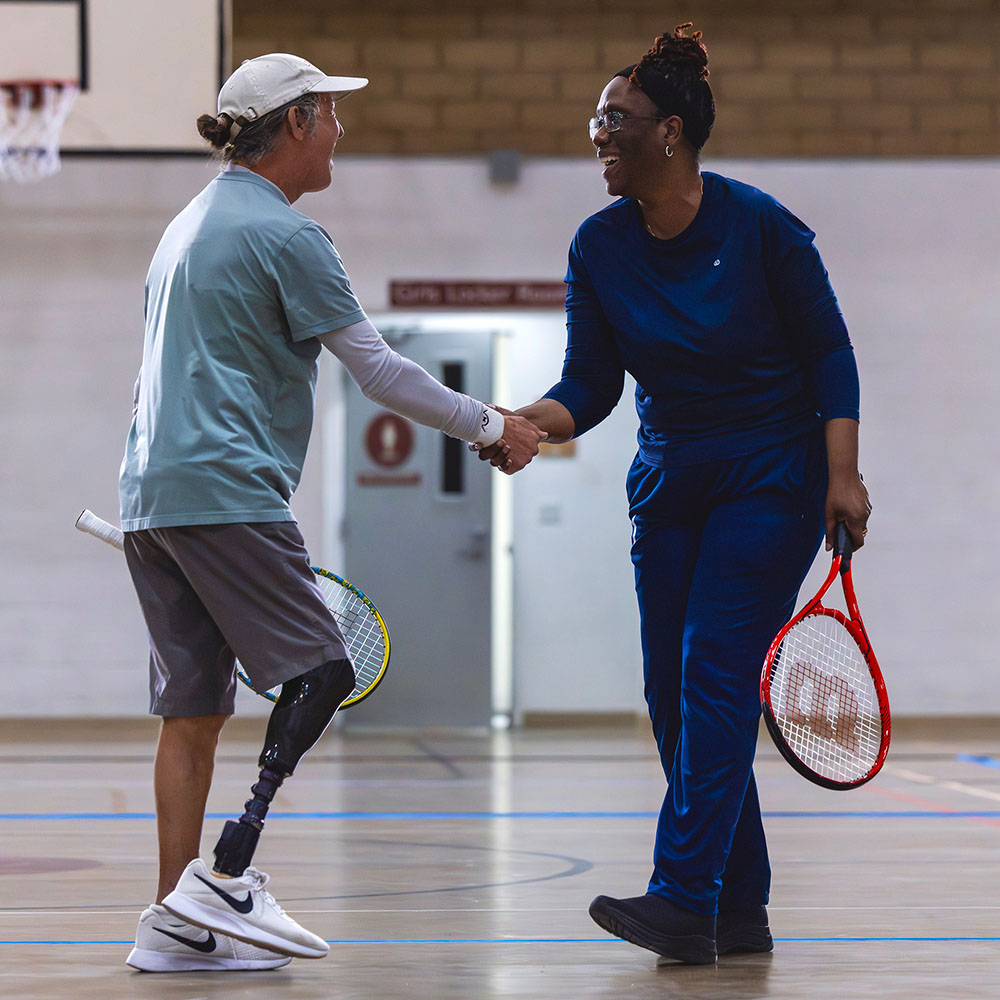
Top: Will Rogers from Indio, California and Marcia Harvey from Vienna, Virginia share a handshake at the Blind and Low Vision Tennis Tournament hosted by USTA Southern California at Wayfinder Family Services.
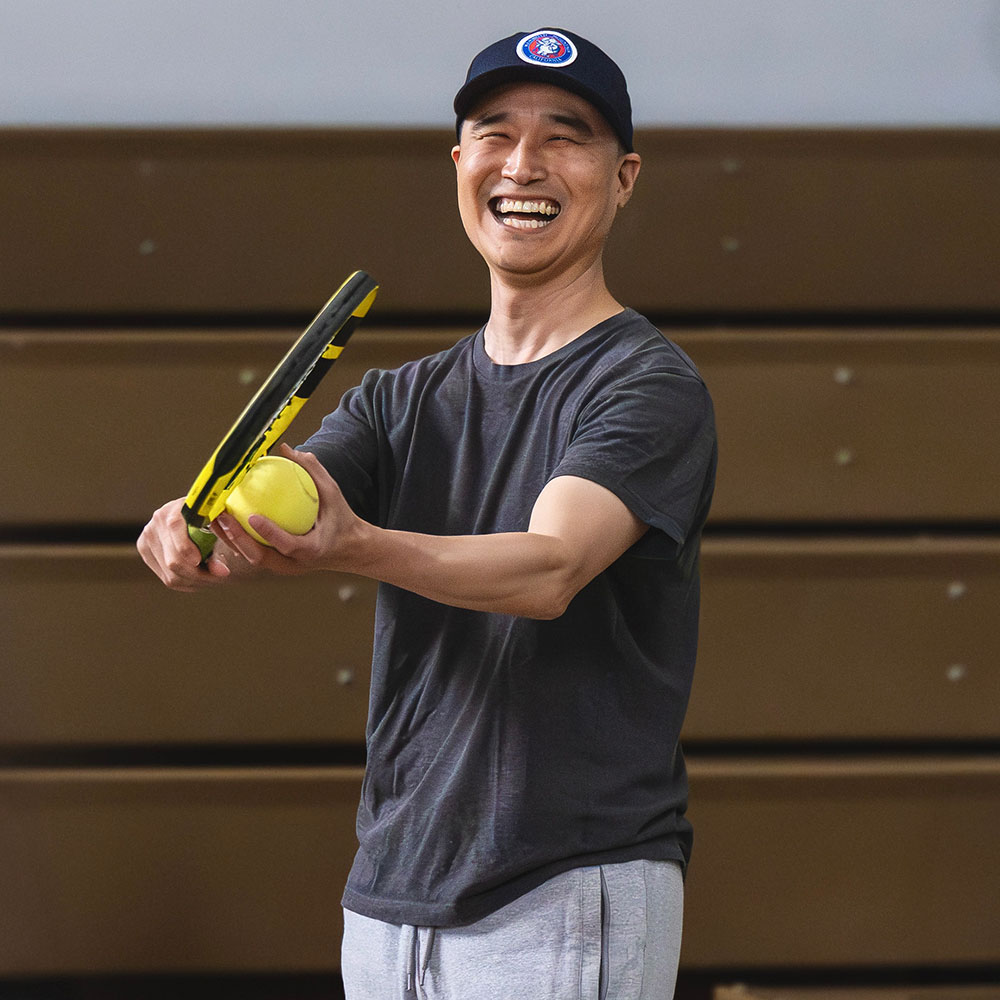
Middle: Eugene Kim from La Crescenta laughing on court during Blind and Low Vision Tennis action at the USTA Southern California adaptive tennis event.
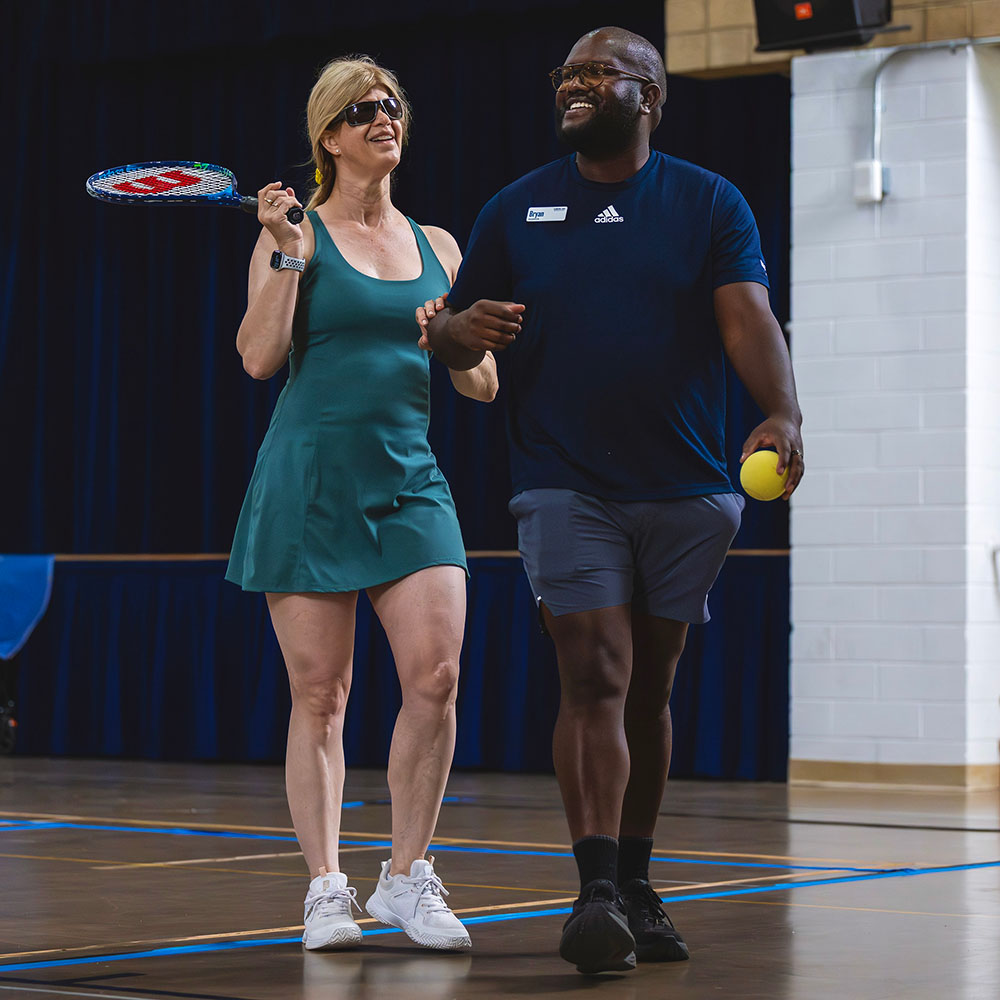
Bottom: Shannon Dillon and Bryan Hudson walking on court at the Blind and Low Vision Tennis Tournament hosted by USTA SoCal in Los Angeles.
(Photos – Jon Mulvey/USTA SoCal)
Top: Will Rogers from Indio, California and Marcia Harvey from Vienna, Virginia share a handshake at the Blind and Low Vision Tennis Tournament hosted by USTA Southern California at Wayfinder Family Services.
Bottom: Eugene Kim from La Crescenta laughing on court during Blind and Low Vision Tennis action at the USTA Southern California adaptive tennis event.
(Photos – Jon Mulvey/USTA SoCal)
April is National Adaptive Sports Month, a time that highlights the importance of access, inclusion, and opportunity in sport. Against that backdrop, Blind and Low Vision (BLV) tennis is helping create new pathways for athletes of all abilities to compete, connect, and thrive through the game.
One of the fastest growing adaptive sports in the world, BLV tennis is expanding opportunities locally, nationally, and internationally while reinforcing a simple truth: tennis should be for everyone.
Understanding Blind and Low Vision Tennis
BLV tennis is designed for athletes with varying degrees of sight loss. It uses modified equipment and adapted rules so players can fully participate while still experiencing the pace, strategy, and challenge of traditional tennis.
Players are grouped into classifications based on their level of vision. B1 athletes have no sight or only light perception. B2 athletes have very limited or blurred vision. B3 athletes have low vision or a limited visual field. B4 athletes have low visual acuity or a restricted visual field. These classifications help ensure fair and competitive play across all levels.
The core rules of tennis remain familiar, with key adaptations to support accessibility. Depending on classification, players are allowed additional bounces to track and return the ball. B1 and B2 athletes may use up to three bounces, B3 athletes up to two bounces, and B4 athletes typically play with one bounce, similar to traditional tennis.
Other adaptations include audible balls, tactile court markings, and standardized verbal communication before serves. These adjustments allow athletes to compete independently while preserving the rhythm and strategy of tennis.
A Growing Global Movement
Blind tennis was first developed in 1984 by Mioshi Takei, a blind Japanese athlete widely recognized as the sport’s pioneer. Takei envisioned a version of tennis that athletes with visual impairments could play without losing the competitive and technical integrity of the traditional game.
He introduced many of the adaptations still used today, including sound producing balls, raised court markings that can be felt underfoot, and a lowered net to better support play. His innovation and commitment to accessibility laid the foundation for what has become an international sport.
In 2014, the International Blind Tennis Association was formed to regulate and oversee the sport globally. Since then, BLV tennis has spread across continents, with organized play in numerous countries and international competition drawing more than 150 athletes annually.
In the United States, growth has accelerated through the United States Blind Tennis Association (USBTA), founded in 2022, working closely with the United States Tennis Association (USTA) at both the national and local levels. The current USBTA president, Murray Elbourn, first reached out to USTA Southern California to explore the possibility of hosting a tournament, helping spark local momentum for the event. The organization has focused on building meaningful access to tennis for a community that has historically been underrepresented in the sport, helping launch programs, train coaches and volunteers, create new access points for players nationwide, and support ongoing expansion through partnerships, research, and programming that have helped bring BLV tennis into the mainstream tennis conversation both nationally and locally.
A Milestone Event in Southern California
This past weekend, USTA Southern California hosted its first ever Blind and Low Vision Tennis Tournament at Wayfinder Family Services in the Windsor Hills neighborhood of Los Angeles, bringing together athletes and supporters for a meaningful day of competition and connection.
Wayfinder Family Services provides individualized support and services to children, youth, and adults, including those with vision loss, profound special needs, and foster youth with serious medical conditions or trauma. Its recreation programming also offers adaptive sports, trips, and camp opportunities for individuals who are blind or visually impaired, making it a natural home for the event.
The tournament was the latest milestone in a growing partnership between USTA Southern California and Wayfinder. In December 2024, the two organizations joined forces to host a two day training session for coaches led by Dana Costa and David Dilettuso, followed by a Blind and Low Vision tennis clinic for Wayfinder participants. Since then, Wayfinder has continued to host monthly BLV tennis clinics that are open to the public, helping create consistent opportunities for athletes to learn and play.
USTA SoCal’s Community Tennis Coordinator Bryan Hudson led the event alongside Annelie Du Plessis, Director of Recreation at Wayfinder Family Services, in bringing the tournament to life. Together with staff and volunteers, they created a welcoming and competitive environment for all players.
“I became familiar with blind tennis about two years ago, and I work with all types of adaptive athletes,” Bryan said. “At USTA Southern California, we’re focused on bringing tennis to communities of all kinds.”
“Anyone can be an athlete. You don’t need a certain body type or mental capability to play. Anyone can get out there and enjoy the game. Everyone should have the chance to stay active, keep their body moving, and keep their mind engaged. It helps people live healthier, longer lives, and I want to bring that opportunity to every community. Tennis has been a part of my life for nearly thirty years, and it’s something I want to share with anyone who is interested.”
Tournament Results
The tournament featured singles competition across the B1, B2, and B3 sight classifications, along with doubles play. All draws were played in a round robin format, with each player or team facing every other competitor in their group. Matches were contested using one set of the Fast4 format with no ad scoring.
In the B1 division, the title came down to a closely contested matchup between Shannon Dillon of Sacramento and Andrew Skvarla of Anaheim. Shannon earned a 4-3 victory to finish atop the standings.
The B2 division saw a dominant performance from Jessica Gonzalez also of Sacramento, who dropped only one game across three singles matches. Her closest contest was a 4-1 win over doubles partner Tiffany Manosh.
The B3 division was another tight race, with first and second place separated by just one game. Will Rogers of Indio rallied from behind to defeat Eugene Kim of La Crescenta 4-3 and capture the division crown.
The doubles draw was equally dramatic, with the championship also decided by a single game. Tiffany and Jessica edged Will and Dan Aubuchon of Coachella Valley 4-3 to claim the title.
While the results showcased strong competition, the tournament’s deeper impact was best reflected in the players’ own stories.
Voices from the Court
For many players, BLV tennis is about much more than results. It is a pathway back into movement, confidence, and community.
Shannon has been playing for about two years after first being introduced to the sport through Jessica.
“I met Jessica and she was actually looking for people to play tennis,” Shannon said. “I was like I don’t know how blind people do it, but I’ll try it and check it out. So I did and now I’ve stuck with it.”
Now part of a regular training group in Sacramento, Shannon says one of the biggest challenges is tracking the ball using sound alone.
“I’m pretty much just using my ears,” she explained. “I have no vision so I can’t look at it. I’m listening, trying to judge where the ball is going to be after it’s hit the ground.”
Even with those challenges, her focus is on helping the sport grow and become more accessible. “I hope more people are interested,” Shannon said. “I hope we find a way to build infrastructure because it’s really hard to find clubs where we can play.”
For Eugene, BLV tennis has been a return to activity after vision loss. After previously playing tennis for five to six years through high school and college, he found his way back to the sport through BLV tennis. “Vision loss doesn’t end life, it’s just a new way to do things,” he said.
His focus now is on expanding opportunity and access within the sport. “I would love to see this sport in the Paralympics,” Eugene added.
That same aspiration is echoed across the community.
Robin Patche, who began playing in September 2025, values the inclusive environment BLV tennis creates. “Everyone has something to work on,” Robin said. “No one is really above you or better. The feedback is to help your game and they also learn from you too.” She also sees the sport as something that can reach a wide range of participants. “I would love to see it in the Paralympics,” she said. “You can get people of all ages moving and doing it.”
Tiffany, who started playing in April 2025, describes the learning curve of adapting to a new way of playing. “Returning the ball is one of the most challenging things,” she said. “There are times when you think you’re lined up and it just goes right past you.”
Even so, she sees clear potential for the sport’s future. “To be able to have it in the Paralympics, that’s the dream,” Tiffany exclaimed.
For Jessica, who began playing in 2023 and fully committed in 2024, the sport has already created new opportunities while fueling her hopes for what comes next.
“I love that it’s very inclusive, I love that we can actually play something that isn’t just completely blind related,” Jessica explained to ABC7. “We listen for the ball and we only get three bounces for two players, so the first bounce is based on our hearing and then the rest of the two bounces you have to run to that ball quickly.”
After her matches, Jessica also shared her hopes for the future of the sport. “I see it going to the Paralympics,” she said. “That’s the goal of all goals. To make it where we can all play inclusively together with everybody else.”
More Than a Sport
At its core, BLV tennis expands what is possible within the game while reinforcing a simple truth: tennis should be available to everyone, regardless of ability or level of vision.
Across every story, a shared theme emerged. BLV tennis is not just adapting the game. It is expanding access, building community, and redefining who gets to play.
As the sport continues to grow, so does the community surrounding it, with players, coaches, and organizations working together to ensure pathways into tennis are open, supported, and sustainable.
From local training groups to national organizations, BLV tennis is advancing through the efforts of people committed to making the sport more inclusive. Its continued growth reflects a larger movement within tennis to prioritize innovation, opportunity, and belonging.