

Cecil Mamiit’s Global Impact Across
Cultures and Courts
USTA SOUTHERN CALIFORNIA
USTA SOUTHERN CALIFORNIA
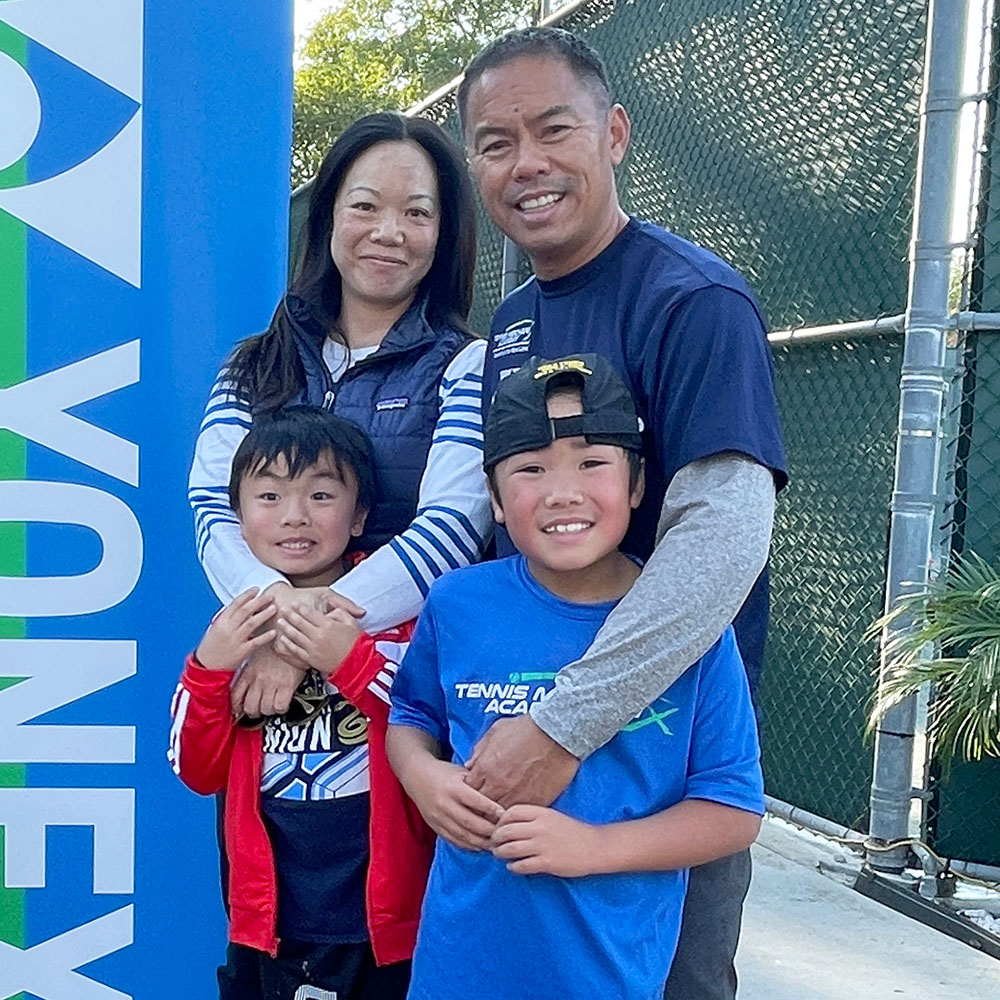
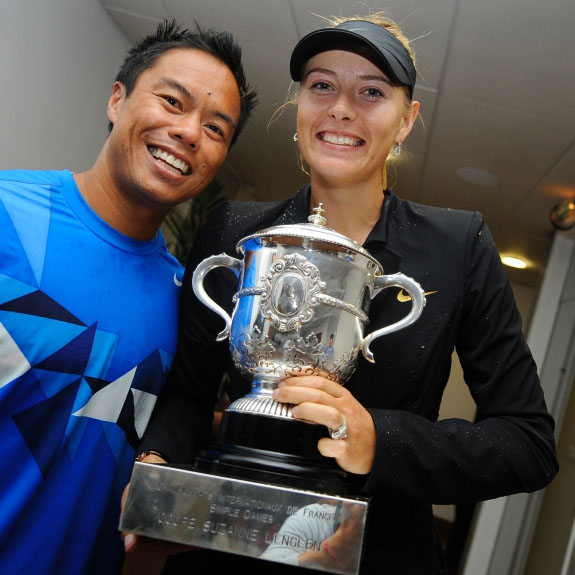
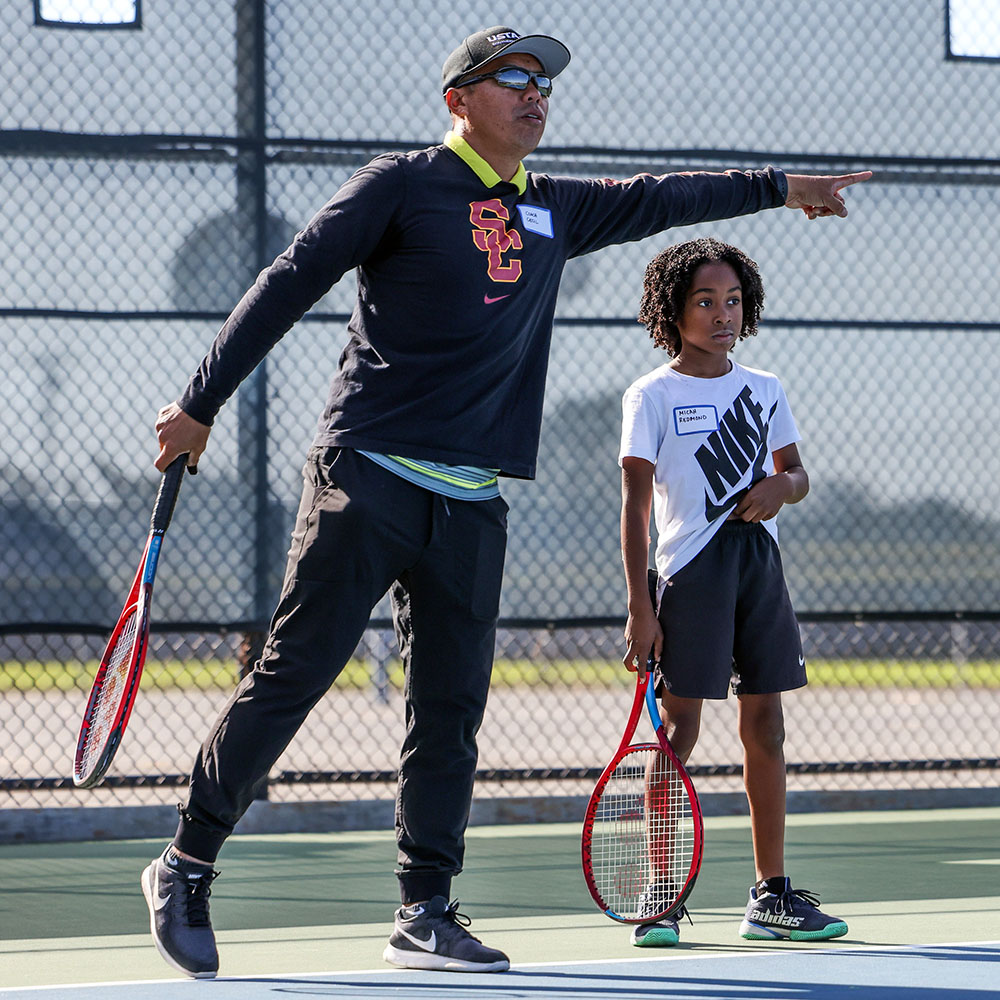
Top: Cecil Mamiit with his family at the Burbank Tennis Center; Middle: Mamiit served as a hitting partner for Maria Sharapova during her French Open victory; Bottom: Mamiit coaching at a USTA Southern California Green Ball clinic in Huntington Beach. (Photo – Jon Mulvey/USTA SoCal)
Top: Cecil Mamiit with his family at the Burbank Tennis Center; Bottom: Mamiit served as a hitting partner for Maria Sharapova during her French Open victory.
Throughout his career, Cecil Mamiit has utilized tennis as a platform to express his culture and heritage. A Filipino-American, his journey has been largely shaped by his dual identity and representing two countries with pride.
From learning to play in Southern California’s public parks to reaching World No. 72 on the professional ATP Tour—and most recently being named a 2026 Philippine Sports Hall of Fame inductee—each milestone has been a powerful part of his story on what it means to belong, connect, and give back to the next generation of players. In honor of Asian American and Native Hawaiian/Pacific Islander (AANHPI) Month, we celebrate his inspiring road to success and the international mark he continues to make on the tennis community.
Family Roots and Early Playing Days
Growing up in Los Angeles, Cecil was an only child surrounded by extended family who helped shape his upbringing. His parents, both immigrants who met in LA, instilled in him discipline, gratitude, and a strong sense of community early on. Like many Filipino households, traditions like Sunday church, holidays, and “barrio fiestas”—or festive community gatherings celebrating Filipino culture, food, and tradition—were central to his family and the local community.
Tennis was introduced to Cecil through his family as well. Watching his older cousins play sparked an initial curiosity, though not an immediate love for the sport. He admits he didn’t enjoy playing early on, finding it both humbling and intimidating, but over time, his relationship with the game began to evolve.
Once Cecil started to find joy in the sport, something shifted. “My perspective changed when I got on the court and started to find things about the game that were intriguing to me,” he shares. “The exercise, the way I was hitting the ball…it started to be fun and more enjoyable. Being an only child going to lessons or tournaments, I felt like I started to meet new people and understand the community better.”
During his junior years, Cecil consistently improved, describing it as “very steady, progressing, nothing too up and down.” But it wasn’t his results that were memorable—it was the friendships he built that made an impact during his formative years. “Initially, I created my own path with my parents and learned a lot from being an only child in terms of patience and perseverance,” he recalls. “But playing in these tournaments, I was really enjoying the friendships and meeting numerous Filipino-American players that I looked up to and had a lot of success.”
College Breakthrough and Cultural Connection
Cecil’s talent eventually led him to University of Southern California (USC), where he made an immediate impact. As a freshman, he captured the NCAA singles championship—an achievement he largely attributes to the supportive and competitive team environment. Though his time at USC lasted just one year before turning pro, it left a lasting impression.
“Even though I was there for a year, I felt the legacy and that this was something special,” he shares. “Right off the bat, I felt that sense of pressure and excitement to play on a team. My teammates were fantastic. Every individual had great qualities that made me want to work hard and be successful. So, I think the experience and working hard in that environment contributed to winning that NCAA title.”
It was also during this time that Cecil deepened his connection to his Filipino heritage. He joined a campus organization called Troy Philippines, participated in cultural events, and found community beyond the court. Even as his tennis career accelerated, his identity remained grounded in culture and connection.
Life on Tour and Competing with Legends
When Cecil turned professional in 1996, he entered a highly competitive era of tennis. Over the next several years, he steadily climbed the rankings, eventually reaching a career-high of World No. 72 in 1999. Along the way, he competed in all four Grand Slams, faced legends like Andre Agassi, Pete Sampras, and Michael Cheng, and built a reputation as a relentless competitor.
He also spent two years as a hitting partner for tennis phenom Maria Sharapova, where he witnessed her capture a French Open Grand Slam title and rise to World No. 1. “I met Maria for the first time when I was on tour,” Cecil shares. “She was 11 years old, and right away I knew she was going to be something special. She always took care of her team well. She’s amazing.”
An International Career and Dual Identity
One of the most defining moments in his professional career came when he decided to represent the Philippines instead of the United States on tour. After multiple visits to see his extended family with his parents and during his early tenure on the pro tour, he established a connection with the Filipino Tennis Association that he maintained for many years. By the mid-2000s, the opportunity to represent the Philippines in events like the Davis Cup and Southeast Asian Games felt like the right step.
“Filipinos are just so hospitable and my parents always wanted to give back to our extended family back home. Fans in the Philippines are also really rowdy. They’re really loving and fight for who they support. It’s amazing how they’ve gravitated to the sport of tennis,” he remarks.
Playing for the Philippines meant performing in front of passionate, energetic crowds who treated matches like celebrations. He describes the atmosphere as a “fiesta,” filled with pride, noise, and unwavering support. It also deepened his appreciation for Filipino culture—its hospitality, generosity, and strong sense of community.
“As my success in tennis became more noticeable, I began to see a growing presence of Filipino fans supporting me wherever I played. Even while playing for the U.S., I could feel that connection,” he says.
Cecil’s Filipino-American identity gave him a unique perspective on the global nature of tennis. Rather than choosing one identity over the other, Cecil embraced both—bridging cultures through a shared love of the sport. He recalls a moment when this was especially true, seeing two communities come together as one. “I remember playing at the Pan American Games [in 1999] and winning a silver medal in Winnipeg, Canada, and seeing a strong showing of support from the Filipino community there. That moment really stayed with me as it made me realize the unique position I had to serve as a bridge between the U.S. and the Philippines through tennis. It became something I was truly passionate about, representing both communities and bringing people together through the sport.”
The Power of Representation
For many AANHPI athletes, visibility matters. Growing up, Cecil looked up to players like Michael Chang, whose success showed what was possible. Now, Cecil understands the importance of that same representation for others and creating a space to share the community’s stories.
“This month means a lot because it’s about inspiring others. It’s special to see the Asian community come together and share stories about where they come from. Every tennis player has a story, and it’s great to have their stories come to life and be highlighted—not just me, but many others. Tennis is such a powerful way to bring people together.”
For Cecil, representation is also about education. As a father of two, he makes a point to expose his children to Filipino history and culture, ensuring they understand the sacrifices ancestors made before them.
“One thing we do as a family is go to museums and I think it’s great that my kids can historically see where things come from,” he states. We shouldn’t forget all the people that worked hard and what it takes to create opportunities. I think this is a great month to show that and highlight our community.”
Coaching and Giving Back
Today, Cecil remains connected to the sport through coaching at his academy, Tennis Mechanix Academy (TMX), which he founded in 2011 alongside former USC teammate Joel Dacay. Based in Burbank, the program focuses on developing junior players ages 5 to 18 through elite training, physical conditioning, and mental toughness. Southern California standout juniors like Thea Frodin, Tianmei Wang (Stanford), Amanda Perez (UC Irvine), Rena Lin (University of Chicago), and Hannah Galindo (University of Hawaii) have all come through TMX, demonstrating how the academy’s programming has positively translated to collegiate and professional success.
He also keeps a close eye on the growth of tennis in the Philippines and among Asian American athletes. Seeing rising stars like Alex Eala—whom he met as a young player—reinforces his belief in the sport’s future.
“We did a clinic after a Davis Cup match [in the Phillipines] and for the younger kids,” he shares. “Alex was probably eight years old at the time. To see her involvement in the game is amazing and she’s definitely taking it to the next level. I think for Asian tennis in general you can see how much the fans are coming out [to tournaments] today. It’s amazing the way tennis has grown so much.”
Hall of Fame Inductee
In 2026, Cecil’s impact on the sport and his cultural legacy will be further cemented with his induction into the Philippine Sports Hall of Fame on May 20. The honor recognizes not only his achievements on the court, but also his role in elevating Filipino representation in tennis on a global stage. “I’m truly grateful for my family, my journey in tennis, and my Filipino heritage,” he reflects. “I’m honored to be a part of the athletes that have paved the way and I hope it inspires the next generation to dream bigger.”
More Than a Sport
Tennis has always been just one piece of Cecil’s identity. For him, the culture, representation, and community-building that accompany the sport will always trump any rankings or titles. During AANHPI Heritage Month, his story stands as a powerful example of how tennis can unite us and create a movement for good.