

“Good News Travels Fast”:
Serena Williams and the Ultimate Third Act
USTA SOUTHERN CALIFORNIA
USTA SOUTHERN CALIFORNIA
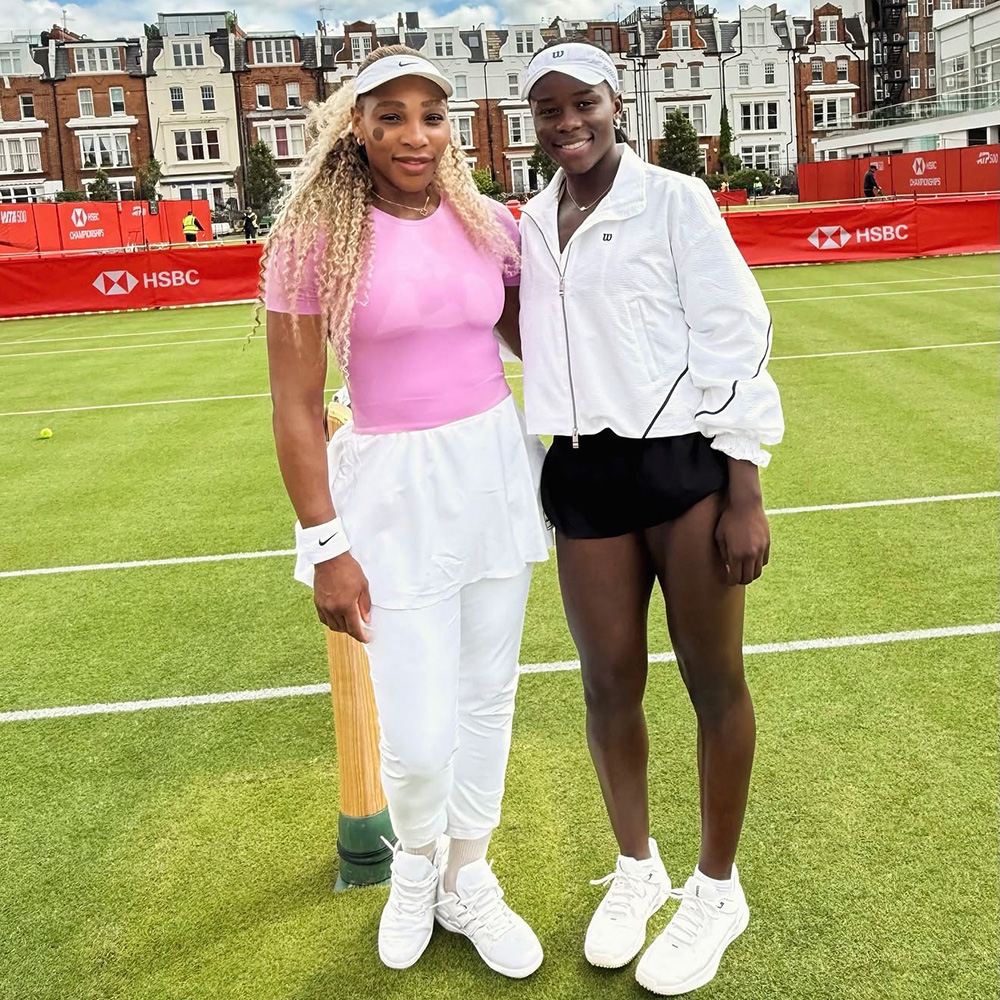
Tennis legend Serena Williams and player Victoria Mboko pose together for a photo on an outdoor grass tennis court. (Photo: @vickymboko on Instagram)
Tennis legend Serena Williams and player Victoria Mboko pose together for a photo on an outdoor grass tennis court. (Photo: @vickymboko on Instagram)
Whenever observers recount the career of Serena Williams, they often frame it as a completed masterpiece, sealed behind glass like a museum artifact. The raw math of her career alone is enough to induce sports vertigo: 23 Grand Slam singles titles, 14 doubles crowns with her sister Venus, 319 weeks at world No. 1, and 73 WTA singles titles. Her legacy of dominance and intimidation firmly establishes her as the undisputed greatest to ever hold a tennis racquet. Yet numbers can’t quite capture how she permanently altered the sport’s environment, especially on grass.
But the most thrilling thing about a living legend is that there is no final draft, no locked vault, no permanent closing chapter. Even after the world assumes the book has been set down, an icon can step back into view and reshape the narrative entirely.
That is exactly what Williams has done. In June 2026, nearly four years after her emotional “evolution away” from tennis at the US Open, the 44-year-old icon announced her return to professional tennis. Her comeback begins on the very grass courts that helped define her career. Suddenly, a story the world believed was complete feels thrillingly unfinished once again.
The Collision of Worlds: From Compton to Centre Court
To understand her paradoxical relationship with grass, you have to look far beyond the exclusive clubs of London and travel back to her roots. What often gets flattened in retrospect is just how specific her origin story really is.
The typical imagery of a grass-court champion evokes pristine whites, manicured lawns, and polite silence under a soft English sky—a world carefully curated and almost untouchable.
You certainly do not think of Compton, California.
Yet that cultural collision is exactly where the magic comes from. Serena didn’t grow up sliding across soft turf or feathering slice volleys at elite European academies. Her foundation was forged on the cracked concrete of public parks. Those courts had no give, no softness, and no forgiveness. They were loud and fast. Public concrete doesn’t teach polish first; it teaches improvisation, physical conviction, and a flat-out refusal to yield space. It was an environment that produced an athletic psychology built for pure survival.
When Serena first stepped onto the lawns of SW19, she confronted a completely foreign physics. Unlike hard courts, which push the ball upward and grant players time to set up, grass swallows the ball—skidding it low, fast, and erratically. Traditional grass tennis rewarded an inherited etiquette of soft hands, delicate volleys, and careful placement. For a teenager raised on concrete, adapting to this surface is usually an agonizing psychological barrier.
But Serena did not politely learn the language of grass. She conquered it.
Rather than bending to the delicate nature of the turf, she forced the surface to respond to her. She brought raw baseline violence to the pristine lawns of West London, weaponizing her serve into an unreturnable missile that collapsed time. It was a permanent collision of tennis cultures: one shaped by tradition and touch, and the other by the uncompromising power and blistering pace of her Southern California upbringing.
Redefining the Shape of Winning
Standard tennis history tells a very tidy story about her lawn dominance. But the real narrative is how her signature Southern California power fundamentally rewrote the tactical manual for playing on grass, tearing up a historic playbook once defined by finesse, heavy slice, and passive risk-minimization.
The rise of the Williams sisters brought a completely new level of athleticism and power to the tour. Serena did not just set a higher standard; she redefined what a champion could accomplish across all surfaces, twice holding all four major singles titles simultaneously and dominating the doubles circuit alongside Venus.
Her greatest moments on that living canvas read like a classic Hollywood movie script. The cinematic journey began back in 1998 with a brilliant competitive breakthrough. A 16-year-old Serena captured her very first Grand Slam title of any kind on the lawns of Wimbledon, winning the mixed doubles crown alongside Maksim “Max” Mirnyi. It was the world’s first major hint that her game, built entirely on raw velocity, could paralyze opponents on grass just as easily as it did on hard courts.
Then came the legendary 2002 family takeover. Defeating Venus in a high-stakes singles final to capture her first Wimbledon singles title was a seismic shift in the sport. She and Venus teamed up to snatch the doubles title as well, cementing a brand of power tennis that left traditionalists completely stunned and signaled a permanent changing of the guard.
If 2002 was the takeover, the golden summer of 2012 was arguably her ultimate competitive peak on turf. Over a matter of just a few blistering weeks, Serena swept the Wimbledon singles and doubles titles, then returned to the same lawns for the London 2012 Olympics, where she utterly obliterated the international field to secure historic singles and doubles Gold.
A few years later, in 2015, she pulled off her spectacular second “Serena Slam” at 33 years old, securing her sixth Wimbledon trophy and completing a non-calendar year Grand Slam. Her serve during that stretch was universally recognized as the greatest weapon the sport had ever seen, rendering her completely unplayable on the slick green turf.
Most sports legends are content to leave these iconic stories safely tucked inside the history books. They retire, build massive global business empires, accept their hall of fame jackets, and comfortably watch the next generation of athletes sweat from the luxury suites. For nearly four years after her emotional send-off at the 2022 US Open, that exactly seemed to be Serena’s chosen path. She became a mother of two, championed venture capital initiatives, and openly discussed the profound physical and emotional journey of transitioning away from the sport that defined her youth.
The Mic-Drop Return
Then came June 2026, and the sports world effectively ground to a halt.
Attentive fans had already spotted her name quietly popping back up on the International Tennis Integrity Agency anti-doping testing lists as early as late 2025, but the internet was completely set on fire when her new Nike campaign dropped without warning. In a brilliantly self-aware, high-production 17-second clip, a 44-year-old Serena is seen casually strolling onto a tennis court wearing a flawless, all-white kit. In her hand, her smartphone is buzzing with nonstop notifications, dings, alerts, and buzzes. She looks down at the chaotic screen, delivers a vintage, deadpan line about needing to change her phone number, and leaves the audience with a simple, tantalizing caption: “Good news travels fast.”
It was the ultimate, mic-drop announcement. Rather than organizing a formal, tearful press conference or releasing a sterile corporate statement, she used, in Serena-fashion, a viral, stylish wink to the camera to let the entire world know that the Queen of Grass was officially reclaiming her territory.
Williams will officially take the court at the WTA 500 event at the Queen’s Club in London, marking her return 196 weeks after her final appearance at the 2022 US Open. Because of her prolonged absence from the tour, she will need wildcards to compete both there and at Wimbledon just three weeks later. In launching this comeback, she made her motivations beautifully clear: “Grass has given me some of the most meaningful moments of my career and I’m excited to be back competing on one of the sport’s most iconic stages.” When later asked by the creative team what she actively looks for in a grass-court doubles partner, her answer was pure, unadulterated Serena excellence: “I’m looking for someone that wants to win, and can win. I guess that hasn’t changed.”
The Cinematic Partnership
To truly comprehend why this real-time comeback is so incredibly cinematic, you have to look closely at her chosen partner for her competitive re-entry in London. Serena is officially teaming up with 19-year-old Canadian phenom Victoria Mboko, who has quickly emerged as one of the most exciting prospects in the women’s game and is currently ranked world No. 9 in singles. There is a literal quarter-century age gap between the two women. While Mboko represents the roaring, athletic future of the WTA top ten, she is also a young woman who grew up with posters of Serena plastering her bedroom walls.
The narrative symmetry of this pairing is absolutely gorgeous. Speaking after her second-round match at the French Open last week, Mboko warmly described Williams as her “idol.” Even though Mboko’s clay run cut short when she lost in the third round at Roland Garros on Saturday to former Australian Open champion Madison Keys, her focus immediately shifted to the grass. Serena is stepping onto the competitive lawn not as an ancient relic of the past or a ceremonial novelty act, but as a living, breathing mentor-competitor. She is actively sharing the baseline with a teenager who was not even born yet when Serena was already lifting Grand Slam trophies on Centre Court.
Why Grass Pulls Her Back
Critics and talking heads are loudly asking why she would risk her pristine, untouchable legacy at this stage of her life. The answer lies entirely within the physics of the surface itself.
On scorching concrete or deep clay, long, lung-busting rallies inevitably favor the stamina of youth. Grass, however, compresses time. It is short-point territory, a surface that brutally punishes hesitation, heavy movement, and defensive grinding, while deeply rewarding tactical genius, an immense psychological presence, and a heavy, pinpoint serve. On grass, pure power and an imposing mental edge can wrap up a match in a dominant 45 minutes, weapons Serena possesses in absolute abundance.
Beyond the tactical advantage, this return brings her back full circle to the profound camaraderie of modern tennis. Stars like Naomi Osaka, Coco Gauff, and Taylor Townsend have spoken openly about the deep sisterhood and unique cultural bond shared among Black women on the tour. Osaka and Gauff immediately voiced high-octane excitement, with Gauff noting that sharing a draw with Serena washes away one of her generation’s biggest regrets. This summer, Serena won’t be a historic icon trapped on a distant pedestal; she will be an active peer, teammate, and competitor sharing locker rooms and baseline battles.
The site of her seven singles and seven doubles crowns now sits not as a memory, but as a potential stage once again. From sun-baked municipal concrete to the most exclusive, protected lawns in sport, Serena Williams has spent her life redefining arbitrary boundaries. Her career has always been defined by contrast, not assimilation. Coming back at 44 as a proud mother of two after a four-year hiatus isn’t about protecting an old legacy; it is about the raw, addictive joy of the fight. She never needed to mold herself to fit into the traditional, ultra-polite world of grass-court tennis. Instead, she took her unyielding Compton grit, revolutionized the sport, and proved that the Queen of Grass still dictates every term of her own historic reign.
That is what remains unfinished about it. Not the record, and not the legacy, but the way she still keeps changing what the sport believes is possible.