

John Lansville’s Lifelong Effort to Cultivate Pride,
Equality, and Belonging in Tennis
USTA SOUTHERN CALIFORNIA
USTA SOUTHERN CALIFORNIA


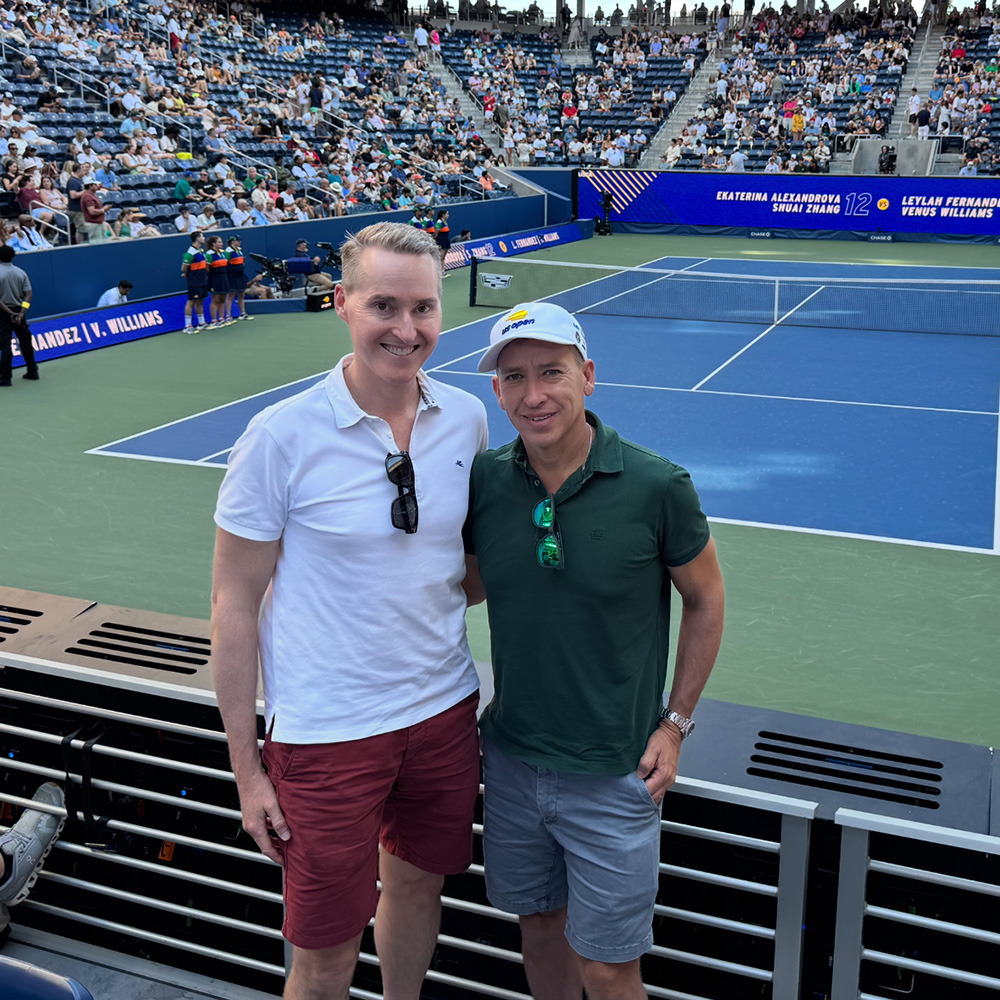
Top: John Lansville at the LA28 offices in Downtown Los Angeles.
Middle: John Lansville with Herlinda Lombardi from USTA Florida at the USTA Annual Meeting & Conference.
Bottom: John Lansville and his husband Bobby Kolb at the US Open.
To a casual observer, the sight of a tennis court carries little weight. For the players, families, and fans who love the game, it represents a familiar space for fitness, competition, and shared community.
For John Lansville, the court carries a much deeper meaning. Having witnessed the sport’s impact firsthand, he sees tennis as a profound equalizer where anyone, regardless of identity or ability, has the right to stand on a level playing field, find acceptance, and have a fair opportunity to succeed.
As a former NCAA All-American, coach, national player development executive, and current member of the USTA Southern California Diversity, Equity, and Inclusion (DEI) Committee, Lansville has spent his life navigating every level of the sport. Now, as the Tennis Sport Manager for the LA28 Olympic and Paralympic Games, he is using his platform to ensure that the global stage reflects the diverse community it serves. This Pride Month, Lansville’s journey stands as a profound reminder of how intentional leadership can dismantle barriers, amplify visibility, and foster an unconditional sense of belonging for every athlete, regardless of identity or ability.
Makings of a Competitor
Lansville was born in San Diego before his family relocated to Barstow when he was two years old. To build foundational strength as a young child, he initially participated in ballet and gymnastics, but by age seven, he discovered the sport that would define his life.
At first, Lansville was content to watch from the sidelines, spending nearly a year as a spectator before finally deciding to step on the court himself.
“From day one, I fell in love with tennis,” Lansville recalled. “I quickly found myself completely consumed by it. I really enjoyed my time playing and competing with other kids and adults. I made a lot of friends through tennis, so I spent a lot of time with the people I met both at the court and away from it.”
As he grew up within the sport, Lansville quickly developed a strong sense of independence. He built immense confidence through one of his greatest supporters, his coach, Theris Brown, who encouraged him to grow as a complete person, not just a competitor. Outside of his own matches, Lansville spent his childhood engrossed in watching the historic television battles between Chris Evert and Martina Navratilova. Yet, it was another tennis icon who permanently shaped his view of the sport’s broader cultural responsibility.
“Billie Jean King was a trailblazer for women and LGBTQ+ rights,” Lansville said. “I admire everything that she has accomplished in leading and pushing for rights for all.”
As Lansville continued to play and develop throughout his youth, his talent steadily emerged. His dedication to the sport eventually earned him the opportunity to play collegiate tennis at the University of Redlands, located just an hour and a half drive away from Barstow.
Fostering Belonging on the Campus Court
Lansville carried that commitment to authenticity into college, where his experiences as both a student-athlete and later as a coach heavily shaped his philosophy on team culture. Entering the program as a freshman, Lansville joined a roster that sat well outside the national rankings, yet through collective work ethic, the team fought its way into the top four in the country.
Though he admits he was rarely the most naturally athletic player on the court, Lansville maximized his impact through consistency and relentless effort. His collegiate playing career culminated in a defining senior year, earning NCAA All-American honors and pushing the eventual national champion to a tight, three-set thriller at the national tournament.
After completing his undergraduate degree, Lansville transitioned into coaching the men’s and women’s programs at Redlands while earning his Master’s degree. He quickly realized that tactical knowledge was only half the battle, and that true success required an environment where athletes felt secure enough to be entirely themselves. Under his two-year leadership, the men’s program captured back-to-back SCIAC championships, and he helped guide Dina Dajani to the 1996 NCAA Division III Women’s Singles Championship title.
“The team environment taught me that success requires complete buy-in from every single person on the roster,” Lansville reflected. “Moving into coaching, my views expanded to make sure every person was given the time and opportunity to excel. Success is built by creating an inclusive culture, and a feeling of belonging isn’t a one-size-fits-all formula. It takes listening to individual needs so that nobody ever feels like an outsider.”
Optimizing the Pathway
Lansville’s knack for structural development eventually drew him away from collegiate coaching and into major administrative roles, beginning with USTA Southern California as the Manager of Player Development and High Performance. Backed by his grassroots background, Lansville approached the administrative pathway with a clear mandate to elevate operational standards, drive regional participation, and intentionally make competitive tennis affordable for families.
Throughout this transition, he stayed deeply connected to the court by coaching and leading numerous player milestones across the region. He lent his expertise to the Wilson Super Excellence Clinics, Maze Cup, and various Zonal team competitions.
A major highlight of this era was running the tournament desk for the ATP Tour event in Los Angeles. Managing an international event of that caliber and watching world-class stars handle immense pressure up close deeply intensified his drive to build better, more accessible developmental pathways for juniors in Southern California.
To bridge the steep gap between recreational play and elite junior tennis, Lansville introduced the First Serve High School tournament, a breakthrough initiative designed to capture unattached talent. He also established localized Competition Training Centers to gather the section’s top juniors for high-level weekly match play. Drawing heavy inspiration from the successful North County Tennis Patrons model, he systematically scaled novice and satellite events, driving unprecedented grassroots growth across Southern California by creating a clear, affordable step-by-step ladder for young players.
When the USTA National office established its National Training Center in Carson, California, Lansville was brought on to manage elite player development on a national scale. Recognizing that the initial supplemental training model operated too loosely and was not moving the needle for American tennis on the global stage, Lansville helped execute a massive, historic strategic pivot.
Under his management, the national center restructured its entire mission around hyper-vetted elite development, aggressively targeting resources, coaching, and travel budgets toward players with the distinct drive and physical upside to break into the global Top 100. Lansville implemented strict, data-driven, measurable criteria for player grants, removing the guesswork from funding. He expanded high-performance programming into much younger age groups to catch habits early, and he deepened structural integration with local Southern California academy coaches through advanced training clinics.
Throughout this intensive administrative evolution, his core developmental philosophy remained simple.
“The fundamental principles of development remain exactly the same,” Lansville explained. “It isn’t about chasing the next flashy trend or the coach with the magic pill. It’s about a willingness to put the hard work in and to do the right things every day. To reach the highest levels of the game, you have to train with a plan and purpose. You have to be willing to look in the mirror and say, ‘Am I doing everything I can, or should I be doing things differently?’”
LA28’s Blueprint for Accessibility
Today, Lansville is taking those decades of operational expertise and applying them to the ultimate global sporting event, the LA28 Olympic and Paralympic Games. Serving as the Tennis Sport Manager, Lansville and his team are tasked with a visionary objective of designing venue spaces where Olympic, Paralympic, and wheelchair tennis athletes experience absolute structural and social equality from day one.
“We are working hard under our leadership to ensure that the layout, infrastructure, and flow of our venues are world-class,” Lansville emphasized. “When we look at venue design, ‘accessibility’ isn’t a compliance checklist, it’s an elite athlete experience. The goal as we build onto the existing spaces, we want to make them ready for Olympic and Paralympic competition. We want wheelchair tennis athletes to have spaces that flawlessly meet their needs as we work within the framework of the existing facility.”
The long-term impact of this design extends far beyond the final medal ceremonies of 2028. Lansville views the global platform as an opportunity to amplify the visibility of adaptive sports. By showcasing wheelchair tennis athletes at their absolute highest physical threshold, the Games will actively redefine how the public perceives adaptive performance.
Furthermore, the legacy of LA28 is already taking root locally. Through LA28’s historic $160 million investment in youth sports development across Los Angeles, which represents the single largest investment of its kind in California history and directly funds the city’s PlayLA initiative, the event is actively breaking down structural barriers. Having already achieved over one million program enrollments, the initiative directly targets low-income neighborhoods where youth participation rates have historically lagged by 20% to 30% compared to affluent more areas, systematically ensuring that the sport looks like the diverse community John champions.
“Operating responsibly within our framework, we are collaborating with the ITF and the USTA, including its regional areas, to capitalize on Olympic momentum and revitalize tennis nationwide,” Lansville said. “We will measure success by two benchmarks: providing world-class amenities and an elite experience for players and fans, and igniting a massive, nationwide surge in tennis participation and programming.”
A Legacy of Equity
As a member of the USTA Southern California DEI Committee, Lansville remains vocal about the cultural weight that leadership carries. He frequently stresses that coaches and administrators are the front line of defense for an athlete’s mental well-being, noting that a coach’s casual comment can either systematically build a player up or completely alienate them.
“For me, inclusion in tennis isn’t something you just talk about; it’s something you practice daily,” Lansville shared. “Being a gay man who has lived and breathed tennis my whole life, I’ve definitely felt the uncertainty of being fully accepted in certain spaces. That’s why I look at inclusion through a practical lens, and that lived experience is precisely what drives my current approach. I try to bring an intentional, grounded energy that signals safety and respect to everyone, and it is also how I draw inspiration from my own home.”
That personal foundation provides a constant source of strength in both his public advocacy and his private life.
“In my day-to-day life and career, I draw immense inspiration from my partner,” he explained. “He is a kind person and leader, and his actions remind me every day that the best kind of leadership is grounded in empathy, authenticity, and creating spaces where people can show up as themselves.”
For Lansville, celebrating Pride Month within the sports landscape requires moving past temporary visibility campaigns and focusing on permanent, structural safety.
“To me, Pride is a reminder that legal protections are neither universal nor necessarily permanent,” Lansville stated. “In the context of sport and leadership, Pride Month is a vital reminder that true excellence is impossible without a space of unconditional belonging. Pride is about evaluating how we lead every single day, ensuring that inclusion isn’t just a marketing campaign for June, but a core cultural value that allows every team member to thrive and perform at their absolute highest level. This wasn’t always possible for me early in my career, which is why I feel an immense sense of pride today in showing up authentically every day, proving that who you are should never be a barrier to what you can achieve.”
Lansville defines ultimate DEI success by representation, equitable access, and genuine psychological safety for all minority groups.
“Success means a sport looks like the diverse global community it represents, from grassroots programs to international sports administration,” he added. “It means an adaptive athlete, a person of color, or a gay competitor can walk into any sporting environment and feel entirely secure, allowing them to focus on excellence rather than survival.”
For any young player or adaptive athlete looking at a tennis court and wondering if they belong, Lansville offers simple, empowering advice rooted in his own life’s work.
“The court does not care who you are, how old you are, who you love, how you got there, what your background is, or how you move around on it,” Lansville smiled. “The lines on a tennis court are exactly the same for everyone. Pick up a racquet, take a chance, and jump out there. Tennis is a universal connector, and it is an incredible way to build community. Not every experience will be perfect, but tennis teaches you how to navigate different situations. It builds independence, rapid problem-solving, and emotional resilience. Give it a chance, because tennis will give you joy, fitness, camaraderie, and a lifelong community.”