

USTA SOUTHERN CALIFORNIA
USTA SOUTHERN CALIFORNIA


Top: Sarah Koudouzian at the USTA Billie Jean King Tennis Center holding her 2026 USTA Champions of Equality trophy.
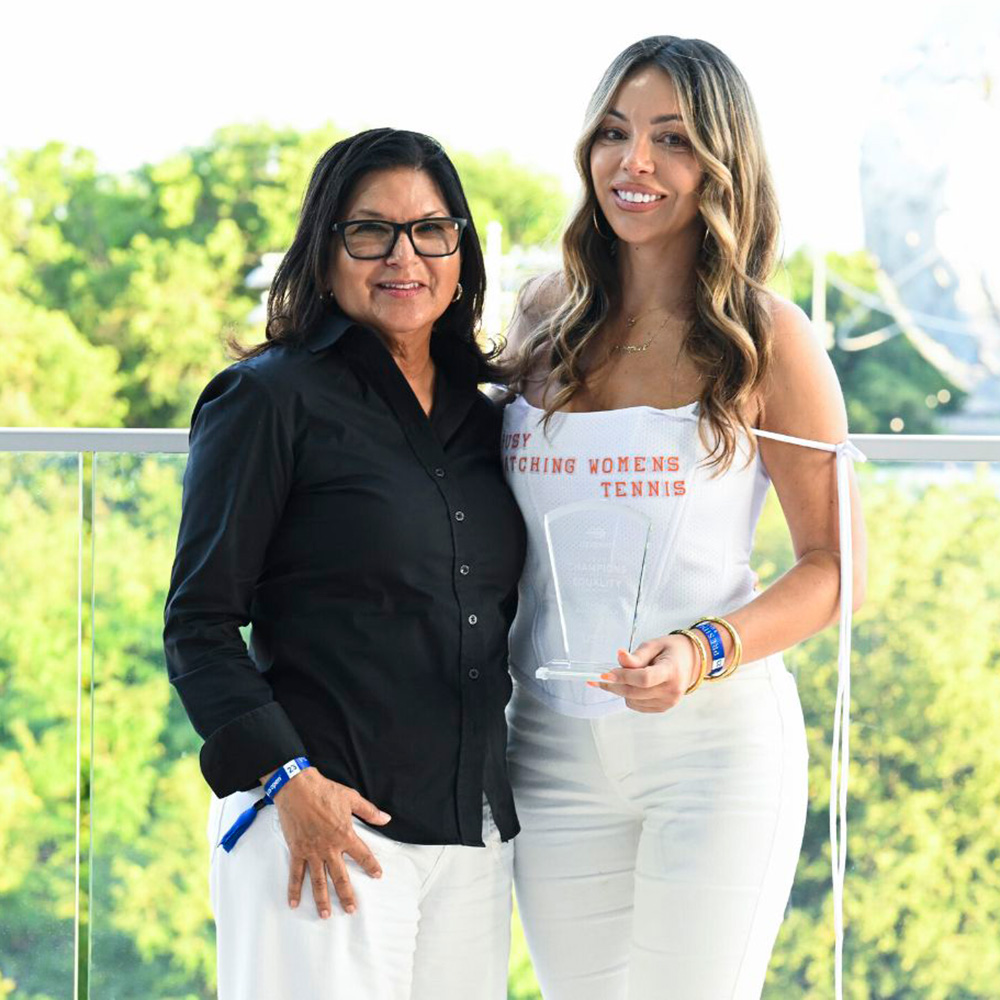
Middle: Sarah Koudouzian and Esther Hendershott. (Photo – Mike Lawrence/USTA)
Bottom: Sarah Koudouzian poses before the USTA Women on the Rise panel during Women’s History Month at the USTA Offices in New York, New York. (Photo – Chris Krusberg/USTA)
Sarah Koudouzian at the USTA Billie Jean King Tennis Center holding her 2026 USTA Champions of Equality trophy.
The US Open’s annual Champions of Equality celebration, hosted by the United States Tennis Association (USTA), recognizes women who are creating greater opportunities in tennis, sports, and society. Launched in 2023 as part of the US Open’s celebration of 50 years of equal prize money, the program honors national trailblazers alongside grassroots leaders from USTA’s 17 sections, carrying forward Billie Jean King’s lifelong commitment to equality and opportunity.
At the fourth annual celebration last Thursday, September 10, 16 women representing USTA sections nationwide were honored at the USTA Billie Jean King National Tennis Center in Flushing, New York. The event also recognized Emmy Award-winning journalist, author, and entrepreneur Hoda Kotb, who received the US Open Billie Jean King Champion of Equality Award presented by Billie Jean King. Previous recipients of the national award include Venus Williams, Shonda Rhimes, Ava DuVernay, and Stacey Allaster, reflecting the wide range of women who have used their platforms to create change in sports and beyond.
Among this year’s section honorees was Southern California’s Sarah Koudouzian, co-founder of tennis accessories brand richsport and a former competitive player whose unexpected journey away from the court ultimately brought her back to the sport in a new way.
Koudouzian is the fourth woman from USTA Southern California to be recognized through the Champions of Equality program. Doris Obih of 40 Love Foundation was honored in 2023, followed by Bakersfield Area League Coordinator Beth Kuney in 2024 and Shaina Zaidi, co-founder of TuMe Tennis Club, in 2025.
The program’s inaugural celebration in 2023 honored King with a Lifetime Achievement Award and named Compton’s Venus Williams the first recipient of the US Open Billie Jean King Champion of Equality Award. King, a Long Beach native and 39-time Grand Slam champion, has spent her career challenging barriers for women in sports, from founding the Women’s Tennis Association (WTA) to advocating for equal prize money.
Today, the program’s honorees reflect that legacy in different ways, from expanding access and building community to mentoring the next generation and creating new pathways into the sport.
For Koudouzian, that mission has taken a deeply personal path.
From the Court to a New Calling
Koudouzian grew up immersed in competitive junior tennis and once dreamed of turning professional. But her playing career did not unfold as she had imagined. Stepping away from the sport was difficult, but the experience ultimately shaped the way she approached the next chapter of her life.
“You can’t always control what happens, but you can control how you respond to it,” Koudouzian said. “I’ve learned that redirection isn’t always a bad thing.”
That redirection led Koudouzian into the world of sports fitness. After sustaining a career-ending injury, she earned a Bachelor of Science degree in Kinesiology and completed internships with athletic programs at the University of Southern California (USC), Sierra Canyon School, and Notre Dame High School.
She eventually became a celebrity fitness trainer, launched her own online subscription-based fitness company, and co-authored a book called Chiquis Keto published by Simon & Schuster that became a national bestseller, including an exclusive Walmart edition.
Though her career had taken her far from the tennis court, the lessons she learned as a player continued to shape her.
“I went from dreaming of turning pro myself to now having professional players wear and use richsport, which is something I never could have imagined at that point in my life,” Koudouzian said. “Tennis taught me to adapt, stay resilient, and recognize that sometimes an unexpected ending is actually the beginning of something even more meaningful.”
Finding Her Way Back
Koudouzian spent roughly a decade away from tennis before finding her way back to the court. The turning point came after a family tragedy. She had tried journaling, breathwork, and therapy to process the pain, but still felt unable to fully release it. Then she saw a tennis racquet in her closet. It was the one remaining racquet she had kept after leaving the sport.
“One day, I saw my one remaining tennis racquet in my closet, the only one I hadn’t smashed or broken after I quit, and something told me I needed to get back on the court,” Koudouzian said.
When she returned, she finally allowed herself to cry.
“It was an incredibly cathartic moment, and for the first time in a very long time, I remembered why I loved tennis in the first place,” she said. “In a way, the sport became a place for me to release, heal, and reconnect with myself.”
Her return was not about resurrecting the professional career she once envisioned. It was about rediscovering the joy that had brought her to tennis in the first place. And that changed everything.
“Tennis has evolved from being something I played to something I now feel deeply connected to shaping,” Koudouzian said. “Being on the court taught me discipline, resilience, confidence, and what it means to compete.”
Today, she is back to playing at a high level throughout Los Angeles, Malibu, and Newport. But her relationship with the sport has evolved far beyond her own performance. As the co-founder of richsport, Koudouzian is now helping shape the culture surrounding tennis.
Bringing More Fun to the Game
When Koudouzian returned to tennis, she quickly realized that some things about the sport had not changed during her decade away. She saw a game that could still feel serious, gatekept, and heavily focused on performance. At the same time, she remembered how much fun tennis could be.
“When I came back to tennis, I realized how much I had missed the fun, energy, and feeling of being part of the sport,” Koudouzian said. “At the same time, the narrative around tennis still felt very much the same, it’s such a serious, gatekept, performance-driven world.”
That observation became part of the inspiration for richsport, which Koudouzian co-founded to bring more color, personality, and self-expression to tennis. She wanted to challenge traditional ideas of what tennis should look and feel like, creating a brand that made the sport feel more fun, expressive, colorful, and inclusive while connecting it to culture and lifestyle. At its core, her vision was to make more room for individuality and creativity, offering a fresh perspective on what tennis could be.
For Koudouzian, the ultimate goal is not simply to sell tennis accessories. It is to make people want to play.
“richsport is an invitation to experience the game differently, to be bold, expressive, and challenge some of the norms around what tennis is supposed to look and feel like,” she said. “One of my favorite things to hear is, ‘richsport makes me want to play tennis.’ If we can spark that feeling and bring more people to the court, that’s incredibly meaningful.”
That idea is also at the heart of what the name richsport means to Koudouzian.
“To me, being ‘rich’ through tennis has nothing to do with material wealth,” she said. “Tennis has enriched my life through the people I’ve met, the experiences I’ve had, the memories I’ve made, and simply the joy of playing.”
She hopes others can find that same richness through the sport.
“I hope people feel that same sense of connection, joy, and belonging, and that their lives feel a little richer because tennis is part of them,” she said.
Creating a Place to Belong
Koudouzian’s vision for tennis extends beyond aesthetics and accessories. At its core, she wants people to feel like they belong. That mission is personal.
“As an immigrant and a Middle Eastern woman, representation has always meant a lot to me, and I want to show up fully as myself,” Koudouzian said.
She hopes young girls and women see her story and understand that their future does not have to follow a predetermined path.
“I want young girls and women to know that they can create anything their heart desires, even if their path doesn’t look the way they originally imagined,” she said.
Her message is also for the athletes who once dreamed of playing professionally but ultimately walked away from the sport. Koudouzian knows that experience firsthand.
“You can take everything the sport gave you and use it to build something new,” she said. “Your playing career can end, but what the sport gave you never has to.”
That philosophy has become one of the defining themes of her journey.
A career-ending injury may have taken away the professional tennis career she once envisioned, but it did not take away everything tennis had given her. Instead, those lessons became the foundation for everything that followed.
Leading With Heart and Purpose
For Esther Hendershott, USTA Southern California’s Director of Community & Diversity, Equity, & Inclusion (DEI), Koudouzian’s evolution from junior player to entrepreneur and advocate has been remarkable to watch.
“Sarah was a shy girl who was fierce on the tennis court,” Hendershott said. “Since her junior and college playing days, I’ve watched her grow into an entrepreneur, mentor, and advocate who has never forgotten her roots.”
Hendershott has seen Koudouzian use her platform to support others throughout the Southern California tennis community and beyond, including families impacted by the Eaton Fire in Altadena, National Junior Tennis & Learning (NJTL) youth and young players who may question whether they belong in the sport.
“Sarah leads with heart and purpose,” Hendershott said.
That authenticity, Hendershott explained, is part of what makes Koudouzian such a meaningful role model for young women.
“Sarah’s soft-spoken nature and authenticity come through in both her words and her actions,” Hendershott said.
Koudouzian’s own experience has shaped the way she approaches mentorship and advocacy. She wants women and girls to feel comfortable reaching out, showing up alone, and finding community through tennis.
“One of the things that means the most to me is hearing from women and girls who feel comfortable reaching out, sharing their experiences, or coming to a richsport event completely solo and feeling like they belong,” Koudouzian said. “I want more of that in tennis, less of the gatekept, exclusive feeling and more of a ‘hey, come play’ energy.”
For Hendershott, that commitment is exactly why Koudouzian deserved to be recognized as a Champion of Equality.
“I nominated Sarah because of what she represents to girls and women, both on and off the court,” Hendershott said. “I’m incredibly proud of the woman she has become and all she represents as a Champion of Equality.”
Carrying the Legacy Forward
For Koudouzian, being recognized as a Champion of Equality is an honor. But more importantly, it represents an opportunity to continue creating the kind of tennis community she wishes she had always experienced.
“When we encourage women to play and stay in sports, we open the door to so many possibilities off the court,” she said.
That belief connects directly to the legacy of Billie Jean King, whose career has been defined by challenging limitations placed on women and creating opportunities for those who followed.
“Her legacy means showing up boldly, taking up space, and not accepting the limits that are placed on you,” Koudouzian said.
King’s example has shown generations of women that change does not always come from waiting for permission. Sometimes, it comes from having the courage to create something different.
“She showed generations of women that you don’t have to wait for permission to change the rules,” Koudouzian said. “That’s something I carry with me: having the courage to create your own path and, hopefully, make it a little easier for the women who come after you.”
Koudouzian has already created her own path.
She once dreamed of turning professional as a tennis player. An injury forced her to find another direction. She built a career in sports and fitness, became an entrepreneur and bestselling author, and eventually found her way back to the court.
Now, she is using everything tennis gave her to help shape what comes next.
Her story is a reminder that a tennis career does not have to end when a player leaves the court. Sometimes, it simply takes on a different form, and for Koudouzian, that may be the most meaningful chapter yet.