

Celia Quintero’s Path to Empowering
Players of All Backgrounds
USTA SOUTHERN CALIFORNIA
USTA SOUTHERN CALIFORNIA
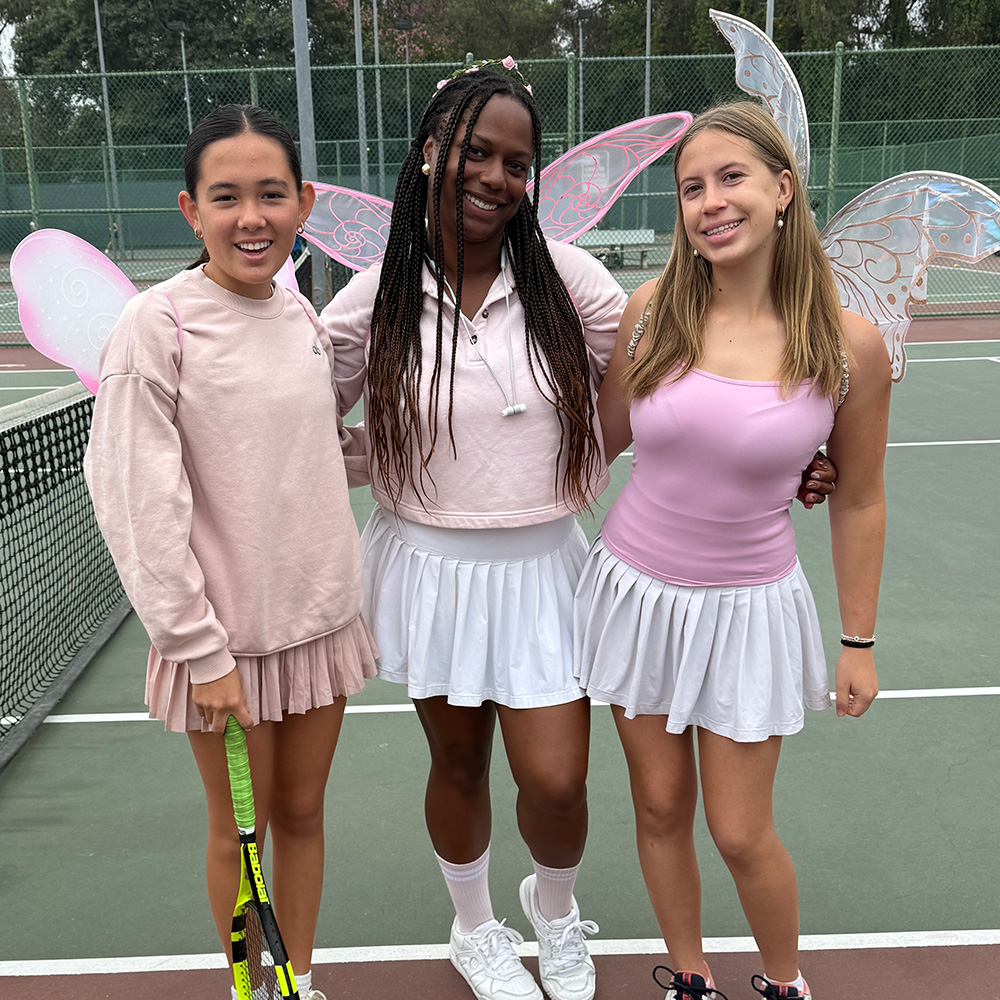

Top: Celia Quintero leading a girls’ tennis clinic in Brentwood.
Middle: Celia coaching Kaley Cuoco.
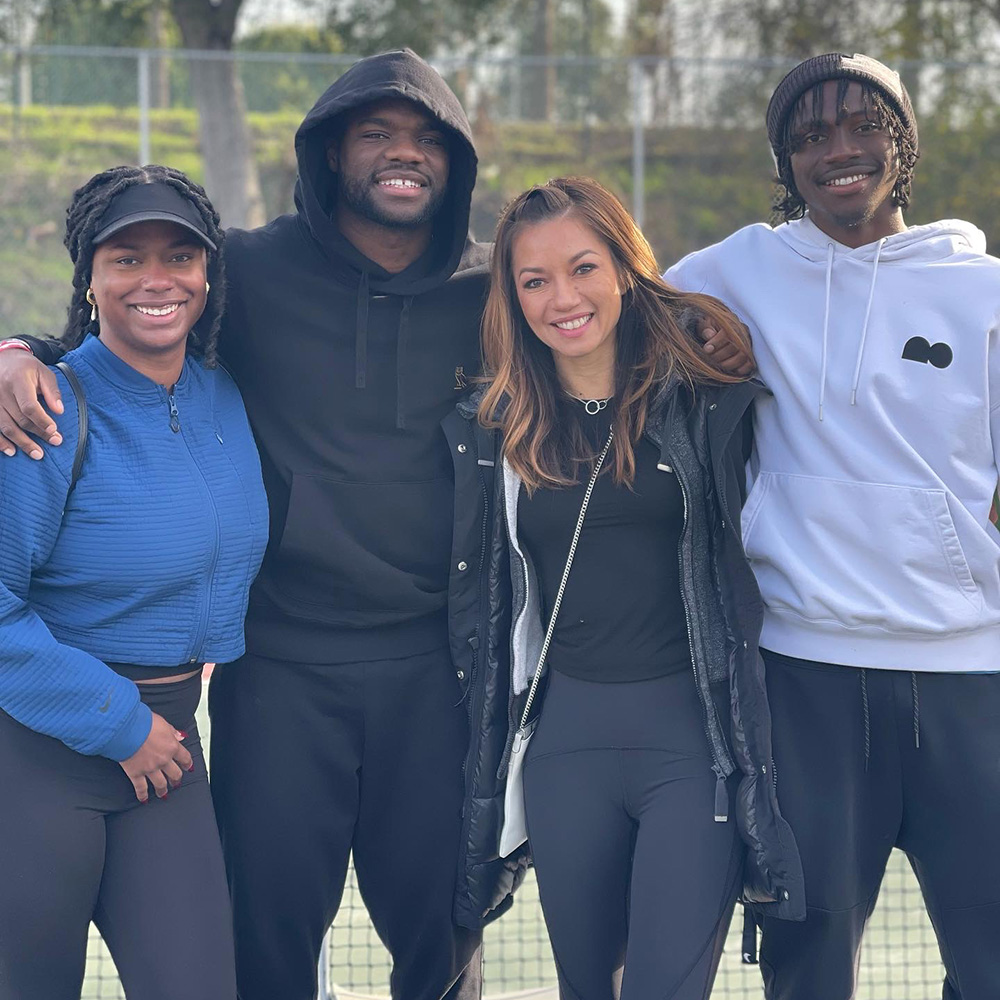
Bottom: Celia with France Tiafoe.
For Celia Quintero, tennis has never been just a sport. It has been a classroom, a community builder, and ultimately a platform for creating belonging—one that has shaped her identity and purpose.
Originally from New York City and now based in Brentwood, California, Quintero is a professional tennis coach, entrepreneur, consultant, and founder. Her journey has taken her from public courts to film sets and from junior clinics to community programs, all driven by one mission: to ensure every player feels seen, supported, and confident.
Quintero was initially drawn to tennis for its mental and physical demands. “With other sports like basketball I could physically take a break if I was tired because we always had a sub on the bench… with tennis you have to always be locked in,” she said. “If I get beat, it’s because of me, I have no one else to blame but myself and how I played. This sport has been such a gift to me.”
A Mother’s Influence
Quintero’s love of tennis began with her mother in Riverdale, New York, whose steady support nurtured her confidence and curiosity from the very start. Their first lessons are remembered fondly, with the court often treated like a baseball field and balls flying over the fence. Through these early missteps, she learned perseverance and leadership.
“Tennis has taught me a lot of resilience. It has actually helped me become a stronger person and leader,” she said. Today, she passes those lessons on to young players just starting their own journeys.
Their bond deepened through shared experiences, from annual trips to US Open Kids Day to watching professional matches at home, where her mother taught strategy, scoring, and etiquette, turning even the living room into a classroom. One unforgettable memory involved Quintero winning a Kids Day challenge, and getting slimed like a Nickelodeon show. “My mom had just gotten my hair done the day before, so let’s just say she wasn’t thrilled,” Quintero laughed. “Love you, Mom! I am who I am today because of you.”
The Power of Representation
Growing up, Quintero also felt the absence of representation in the sport. Matches felt heavier, wins felt bigger, and losses felt lonelier. Watching Compton natives Venus and Serena Williams compete provided a powerful example of resilience and possibility.
“I saw Venus and Serena growing up and what they had to deal with, and it made me want to make sure every person has a place to play tennis and to feel like they belong. If they could stand in front of entire stadiums booing them and still believe in themselves, then I could keep pushing too,” she said. “It really made me want to make sure every person has a place to play tennis and to feel like they belong.” Their confidence and perseverance inspired Quintero to push through challenges and reinforced her commitment to creating inclusive spaces for every player.
Her coaching is also shaped by her own experiences with feeling unwelcome at times because of her identity. “Even with those experiences, I still wanted to play because I will never apologize for doing my best,” she explained. “Representation means everything to me. You don’t know something is possible until you see someone like you doing it.”
Those experiences continue to guide her coaching philosophy. She is intentional about creating inclusive environments where all players, regardless of background, ability, or identity, feel welcome. “I want to normalize that we are out here—Black players, Black coaches, women in leadership—we belong in this sport,” she said.
Quintero also speaks openly about imposter syndrome and learning to trust her place in any room: “I remind myself that I got here because of who I am and what I can do. I am enough.”
Coaching With Heart
Quintero’s coaching philosophy reflects everything tennis has taught her: compassion, confidence, and determination, the three traits she believes every coach should embody. She describes her style as friendly yet technical, grounded in structure and repetition to build proper habits, sharpen consistency, and develop long term confidence. Her sessions emphasize both connection and clarity, where encouragement is constant and improvement is treated as a shared journey with natural ups and downs. Mistakes are never punished but examined, each one becoming a thoughtful conversation about decision making and strategy that helps players grow with self assurance and belief.
“I try to keep it very lighthearted,” she explained. “If they mess up, I’m not going to make them run for that. I’ll probably talk about why that happened and how to fix it. Why did we make those decisions? Was that the best course of action or best strategy? I want them to understand the mental part of it and how to set up a point.”
Growth, she believes, is rarely linear. Every player deserves patience and the chance to feel heard, especially on the days when performance dips for reasons that may have little to do with tennis. “Each kid [needs to] feel heard. It can be hard. There might be a bunch of different reasons for why they’re not playing well,” she said.
Quintero works with players of all ages, from middle and high school students to adult beginners and advanced beginners, also serving as the assistant coach at the Archer School for Girls in West LA. Beginners hold a special place in her heart.
“I love helping them learn and watching them get their first ball over the net perfectly—the look on their faces and how happy and proud they are is such a wonderful moment I get to share with them,” she exclaimed. Belonging is not a byproduct of her program; it is the foundation.
“I want my players to feel a sense of belonging and community. That’s honestly why I started this. There’s a place for all types of kids, all of their different personalities as silly as they may be. You really end up becoming a little tennis family and it’s such a fulfilling purpose. You get to shape these minds and help them in life as well. It’s so wonderful.”
Her girls and junior clinics feature monthly themes like Pink Halloween, Pink Elephant, and Galentines Day, and she takes players to UTR tournaments as a group, reinforcing a simple mindset: “I always tell them we don’t lose, we learn. What we learn we put in our journals.”
Parents, she emphasizes, are also part of the culture she intentionally builds—present at lessons, tournaments, and parent child events, creating the support system young athletes need.
For fellow coaches, her advice is simple: “Honestly, for coaches I would say just do it for the love of it. Don’t give up. Always persevere. Once you find your community it just clicks and it’s one of the best feelings. You are creating a safe space for future tennis players.”
Building CQ Sports Consulting
Quintero’s entrepreneurial drive led her to launch CQ Sports Consulting, which began by helping friends organize tennis events and grew into a full-fledged business consulting for TV productions, athletic shows, and community programs. What started as small, local events has expanded into clinics, community programs, and technical consulting, reflecting both her vision and her passion for creating meaningful experiences.
“It’s been a crazy journey, but I wouldn’t trade it for anything,” she reflected.
A turning point came in 2022, when she fully stepped into her own vision. “I can design my clinics and tournaments exactly the way I want instead of making someone else’s vision come true,” she said. “After I chose myself, everything fell into place, more opportunities, more collaborations, more ways to give back. It felt like fate. I accept myself for who I am, I’m always looking to learn, and I’m loving this journey.”
Her legacy, she hopes, will be rooted in joy, creativity, and connection.
“Just being yourself, being who you are, that should be everything you need,” she said.
From Tennis Courts to Television Sets
Quintero’s expertise has also taken her beyond traditional tennis spaces and into the entertainment world as a tennis consultant, working on productions including All American: Homecoming, Based on a True Story, and Apples Never Fall.
Bringing tennis to television was more intricate than it might appear.
“Tennis is very situational and technical,” she explained. “It was hard to script tennis scenes.” Rallies cannot simply be choreographed like a dance; Quintero often had to adjust patterns on the fly. She would suggest hitting more crosscourt to capture certain angles, or tweak footwork and preparation so forehands and backhands looked authentic on camera.
On All American: Homecoming, she served as a tennis coordinator and even stepped in as a body double when needed, collaborating with San Diego tennis pro and former SoCal Pro Series champion Megan McCray, who played the stunt double for the lead actress.
“She is very passionate about the game and coaching tennis,” McCray said. “Through tennis she brings people together to learn the game in a fun and social environment.”
Quintero prepared Chris Messina to portray a former pro in Based on a True Story, fine-tuning everything from stroke mechanics to on-court movement to make it ring true. “They’re just like anyone else trying to learn a sport,” Quintero said. “It can be awkward at first, but it’s really fun to be on that journey with them.”
She also worked with Kaley Cuoco, who—unlike many of the actors she coaches—surprised her with a strong Southern California junior tennis background, bringing an unexpected level of comfort and credibility to the court.
For Messina, the preparation extended beyond filming, and the connection lasted after production wrapped. Quintero still hits with him and his wife when schedules allow. “I hope they continue to play because tennis is a wonderful sport for life,” she said.
Some of her favorite memories, though, happened when the cameras stopped rolling. “We were wrapping up season two and ended up doing karaoke in the parking lot,” she laughed. “We got shut down because we were too loud, but everyone was dancing. It felt like such a beautiful, lively community moment.”
Being part of a show centered on a Black female collegiate tennis player at a Historically Black Colleges and Universities (HBCU) was meaningful for both women. “It showcased Black excellence and relatable experiences of being a Black girl in tennis,” McCray said. “That’s so rare to see on TV. Celia being on the show inspired not only her African American students, but anyone who aspires to be great at tennis.”
Mentorship and Moving Forward
Quintero credits mentors like Paula Feigenbaum, Nancy Abrams, and Esther Hendershott for guiding her path in coaching and community leadership. “They helped me feel like I was on the right path. Having women support women in this space means everything,” she said.
Her long-term vision is simple but powerful: grow her programs, reach more communities, host more events, and continue introducing tennis to people who never thought it was for them. “One person, one day at a time,” she said.
A Message to the Next Generation
Quintero understands the responsibility that comes with visibility. Through her clinics, mentorship, and partnerships, she focuses on listening to her players and creating safe, inclusive environments for all. “Listening to your student is very important,” she said.
For young Black players and aspiring coaches, Quintero wants her story to deliver one message above all: “Anything is possible.” She teaches confidence as intentionally as forehands and footwork. “Celebrate when you do something right,” she tells her players. “Be proud. And when something doesn’t go well, we learn.”
Her own journey toward confidence and leadership has been gradual. “I kept helping other people achieve their goals, but eventually I realized I could do this for myself,” she said.
Through her work on court, on screen, and in the community, Quintero is doing more than coaching tennis. She is building confidence, opening doors, and reminding the next generation that they belong in every space they step into. For Southern California tennis, her impact is only just beginning.