

Reimagining Tennis Through Culture, Community,
and Rhythm with Club Volley
USTA SOUTHERN CALIFORNIA
USTA SOUTHERN CALIFORNIA
Photos – Alleck Doxer/HUE Unlimited
A Conversation with the Founders of Club Volley
On a Sunday morning in Los Angeles, there’s a fresh energy unfolding on the tennis courts. This isn’t a traditional tennis clinic—it’s a gathering shaped by curiosity, movement, and community.
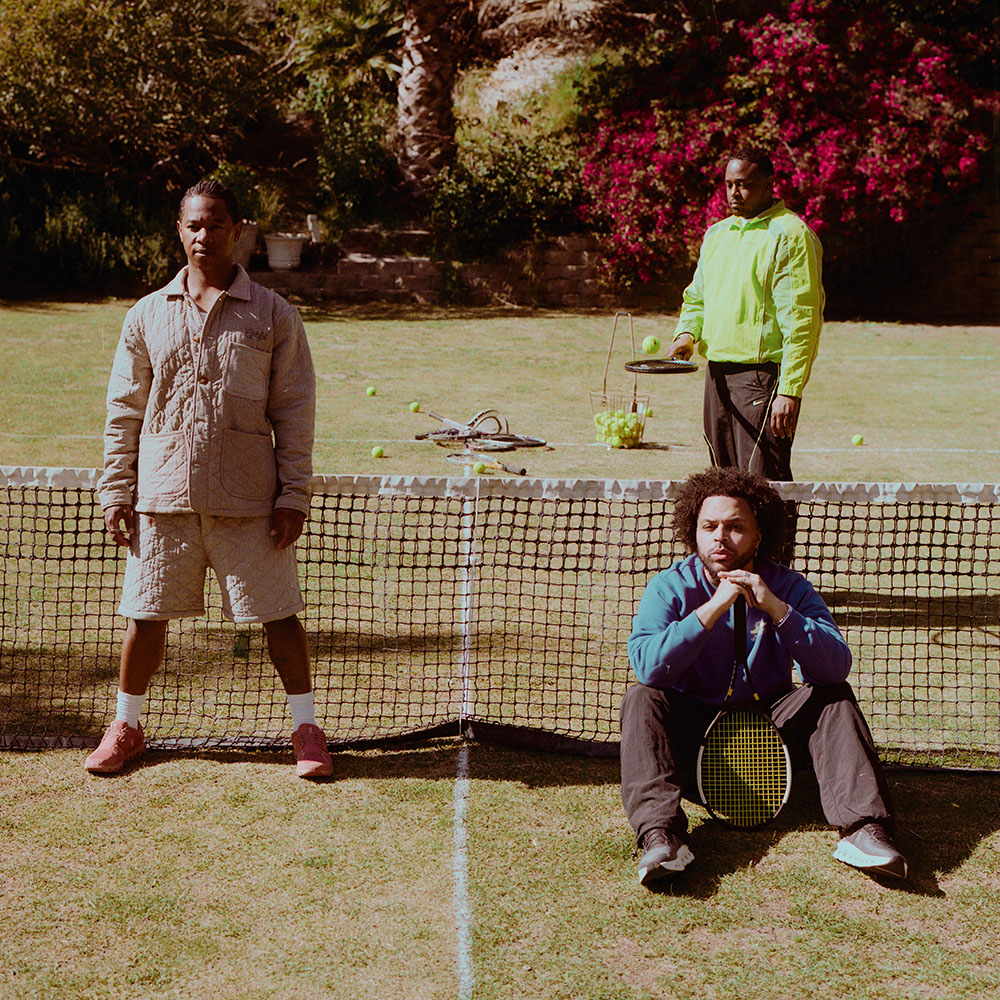
Founded in 2024 by Stedmon Harper, Deyonte Davis, and Michael Watson II, Club Volley was created to reimagine how people discover, embrace, and enjoy tennis. Built at the intersection of creativity and culture, the club has created a space to show up as you are with no expectations. As three Black founders, their work during Black History Month and throughout the year demonstrates how building community through sport can cultivate meaningful social connection and camaraderie.
We sat down with the founders to talk about how Club Volley began, what makes it different, and why culture—not competition—has been their guiding force.
–
Question: Club Volley feels less like a traditional tennis club and more like a cultural gathering. How did it start, and what problem were you trying to solve?
Answer: Club Volley began in the summer of 2024, but the idea behind it had been forming long before that. It started with a few of us showing up to courts with no expectations. We weren’t lifelong tennis players or club members, just curious about the game and what it felt like to play together.
What became clear early on was that tennis itself wasn’t the barrier. The barrier was the culture surrounding it. There was no obvious place for people who came to the game through creativity, music, or community rather than competition. So instead of waiting for that space to exist, we decided to create it.
From the beginning, we’ve thought about Club Volley as a model rather than a location. The sessions, the storytelling, the tone—all of it is designed to be adaptable to different cities, communities, and cultural contexts. As Southern natives and West Coast transplants, Los Angeles is where it all started, but the energy we’re building is portable.
Our first session was intentionally informal. Open play on a public court. Music playing. No dress code. No hierarchy. We didn’t even promote it as a “club” in the traditional sense. It was simply an invitation to show up. That rhythm stuck. People kept coming back. And what started as a single Sunday slowly became a recurring gathering that felt open, social, and accessible.
Q: What brought the three of you together as founders?
A: We’ve been working together in multicultural media and marketing via our creative studio, HUE Unlimited, for almost a decade now. We each were introduced to tennis differently, but we shared the same instinct: the culture around the game didn’t reflect the people who were beginning to show interest in it.
One of us came from a background in community-building and creative production, constantly observing how culture moves and how new audiences actually engage. Another was newer to tennis entirely, discovering the game through outdoor exploration and naming what we were building “Club Volley” as a way to signal that this wasn’t about exclusivity, but energy. The third came in as a creative first, with a lens to document our time on the courts and quickly realizing that the storytelling, aesthetics, and cultural atmosphere were just as important as the play itself.
What brought us together for this endeavor wasn’t tennis credentials; it was a shared belief that tennis could be reintroduced and reimagined through culture. That belief still guides every decision we make.
Q: What are each of your roles within the club?
A: Club Volley is led collectively, but each of us brings a distinct perspective that shapes how the community functions.
Stedmon stewards the long-term vision, defining how Club Volley sits at the intersection of culture and the future of tennis. That role focuses on partnerships, brand direction, and ensuring everything we build aligns with the bigger picture of expanding the sport.
Deyonte leads day-to-day community operations organizing sessions, managing on-the-ground logistics, welcoming new players, and maintaining the consistency that keeps the community strong week after week.
Michael focuses on storytelling by shaping the creative direction, narrative, and visual language of Club Volley, taking moments and translating what happens on and around the court into stories people can connect with beyond it.
Together, this balance allows Club Volley to function both as a living community and as a cultural platform.
Q: What makes Club Volley different from other tennis clubs?
A: Traditional tennis clubs are often built around performance, progression, and membership. Club Volley is built around entry. We don’t assume people already know the game, already own the right gear, or already feel like they belong. We design the experience so curiosity is enough. Our sessions are open by default—no tryouts, no rankings, and no pressure to perform.
Music is part of the environment, not an afterthought. People can play, observe, document, connect, or simply be present. That flexibility changes who shows up and who feels comfortable staying.
Instead of asking people to adapt to tennis culture, we adapt tennis to how people actually live today. That shift alone opens the door to an entirely different audience.
Q: What is Club Volley’s mission and values?
A: At its core, Club Volley exists to reimagine how people engage with tennis. Our mission is to expand the culture of the sport by centering creativity, identity, and community without stripping away the integrity of the game itself.
We believe tennis doesn’t need to be “fixed,” but it does need new pathways in. Our values are rooted in openness, cultural curiosity, and shared experience. We care about how tennis feels socially, how it shows up in people’s lives off the court, and how storytelling, music, and style can act as bridges into play.
Everything we build is guided by one question: Does this make tennis feel more alive, human, interesting, and accessible to the next generation?
Q: How has that approach shaped the community that’s formed around Club Volley?
A: We’ve built community by prioritizing rhythm over scale. Club Volley didn’t grow through campaigns or sign-ups, it grew because people kept returning and felt ownership over the space.
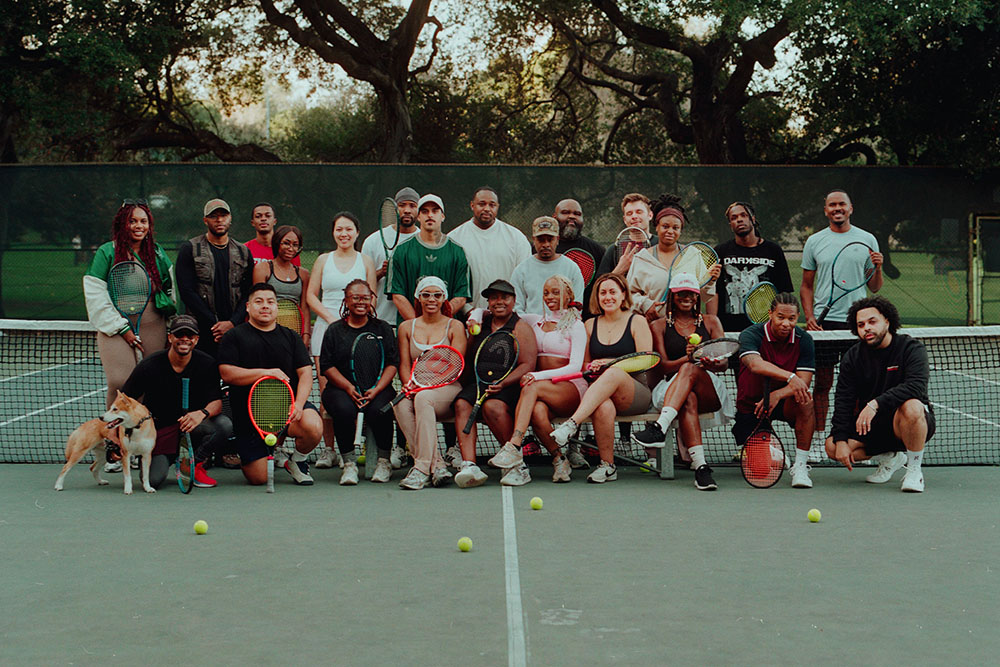
Club Volley’s Sunday Sessions became the anchor. These are open-play community gatherings designed to lower the barrier to entry while maintaining respect for the game itself. Players of all levels come. Some have years of experience and some are picking up a racquet for the first time. It’s all about showing up consistently, creating an atmosphere folks can rely on, and letting relationships form naturally over time. Tennis is the catalyst, but the community forms in the moments around it—the conversations between games, music playing in the background, and people playing without judgment or expectations.
We also document what’s happening through an artistic lens. Our analog-first content doesn’t manufacture moments; it reflects them. That rawness and creativity has allowed people to see themselves in the community before they ever step onto the court, which is often the difference between interest and participation.
Q: What does Black History Month mean to Club Volley?
A: Black history is full of moments where people took something rigid and reimagined it—not to fit in, but to make space. Club Volley sits inside that lineage. For us, Black History Month is a moment to honor that tradition of creative expansion—the idea that culture moves forward when people reshape systems through imagination, expression, and community.
We’re not looking at the past as something separate from the present. We’re building on it. Designing a future where tennis isn’t defined by exclusivity or legacy alone, but by who feels invited to show up and participate now.
Q: Why does Black representation matter in tennis?
A: It matters to name the truth: the imagination and leadership of Black creators helped spark this movement. And the influence of Black cultural innovation—in fashion, music, language, visual storytelling, and community-building—continues to shape how we show up on and off the court.
Club Volley didn’t set out to be “diverse.” It set out to be creative—and that distinction matters. Black representation isn’t about checking a box; it’s about acknowledging who has historically expanded culture and who continues to do so today.
Q: What does the future of diversity and inclusion in tennis look like to you?
A: For us, the future isn’t about categorization, it’s about expansion. Tennis grows when the culture grows, different stories are told, and new aesthetics emerge—when people encounter the sport through joy, creativity, and social connection before competition.
Nine years from now, when the USTA’s goal of bringing 35 million people into tennis is realized, it won’t be because the sport stayed the same. It will be because it expanded—culturally, visually, and socially—into spaces that felt alive and relevant to the next generation.
For us, that expansion begins with representation through creativity, not labels. It begins with telling the truth about how Club Volley started and who shaped it. It begins with celebrating Black creators not as exceptions in tennis, but as architects of the sport’s future. Black History Month is one chapter of that story. The movement we’re building will write the rest.
Q: Music plays a central role in Club Volley and that role has grown through your partnership with Spotify. Why has music always mattered to what you’re building?
A: Curated music was already part of how Club Volley functioned before there was ever a playlist or a partnership. Our sessions were built around rhythm—the moment people arrive, how they warm up, how energy moves across the court, and how it lingers afterward. Music wasn’t an add-on. It was part of how people felt comfortable stepping in.
At the same time, through our creative studio, we were working closely with Spotify on broader cultural programming, helping shape initiatives around community, creativity, and building culture from the ground up. So when Club Volley began to take shape, the overlap was obvious. What we were doing on the court mirrored the same thinking: culture first, participation second, performance later.
For us, music changes the temperature of the court. It shifts tennis from something that feels formal or instructional into something social. When music is playing, people arrive differently. They’re less focused on whether they “belong” and more focused on being present. Conversations start sooner. Play feels lighter.
The playlist became a way to formalize something that was already happening naturally. It wasn’t about branding tennis with music, it was about acknowledging that people experience the game inside a larger cultural rhythm. Spotify recognized that alignment and helped us extend it officially at a global level. We now have the official soundtrack for tennis.
Q: Where do you see Club Volley going next?
A: We see Club Volley evolving from a local community into a cultural platform that travels. Not by opening chapters everywhere overnight, but by building a repeatable way tennis can show up in different cities, cultures, and contexts without losing its soul. What we’re developing in Los Angeles—the rhythm of sessions, the role of music, the way storytelling and community intersect—is meant to be adaptable, not fixed.
Over the next few years, the goal is to take what’s working on the ground and begin translating it across regions, first nationally and eventually globally through partnerships that understand tennis as culture, not just sport.
For us, success isn’t about scale alone. It’s about whether the model we’re building helps more people see themselves in tennis and gives them a reason to stay connected to the game.
Q: What are you most proud of?
A: We’re most proud that people keep coming back. Not because they’re chasing performance, but because the space feels welcoming, creative, and real. Club Volley has become a place where people build friendships, find routine, and reconnect with play sometimes for the first time in years.
That kind of consistency comes from listening, paying attention, and protecting the culture you’re building. Seeing a community form around that—across backgrounds, skill levels, and identities—is what makes everything else meaningful.