

Making Space in Tennis: Rachel Bevis on the Fight
for Access and Representation
USTA SOUTHERN CALIFORNIA
USTA SOUTHERN CALIFORNIA
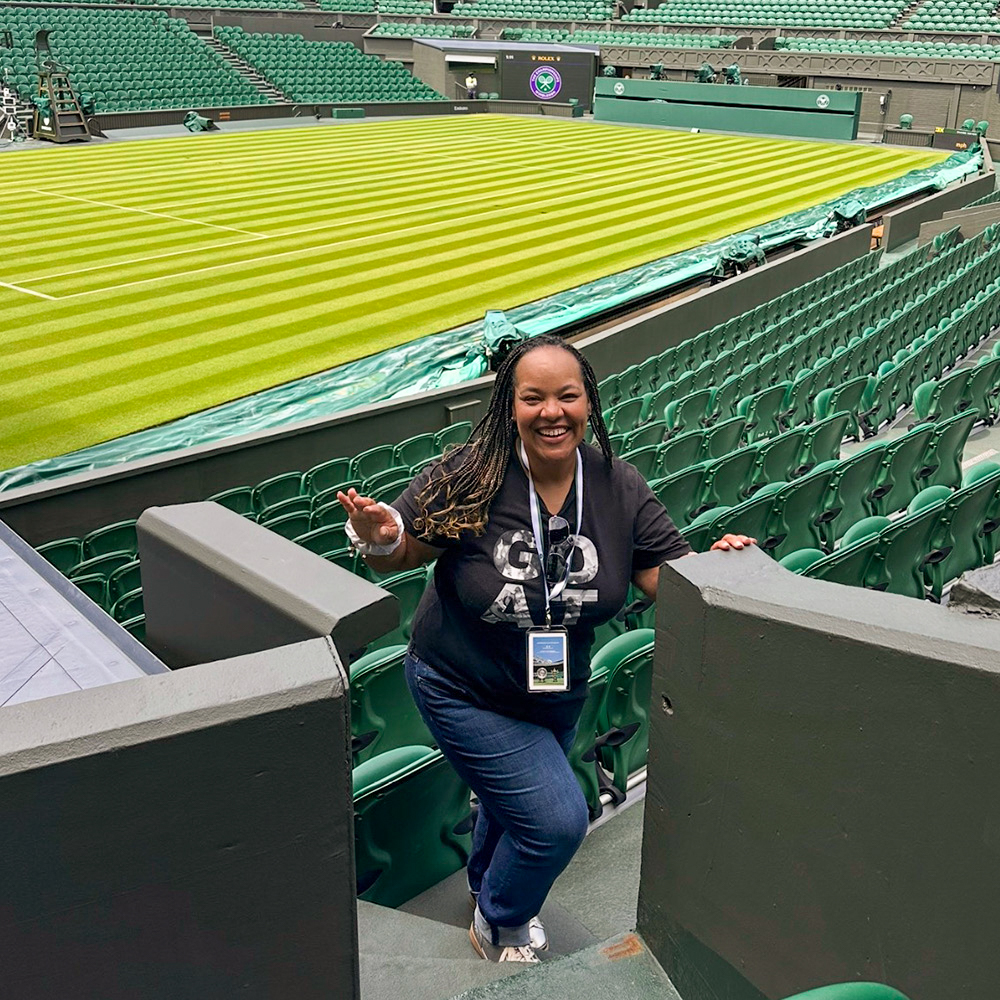
Top: Rachel Bevis smiling on Centre Court at Wimbledon.
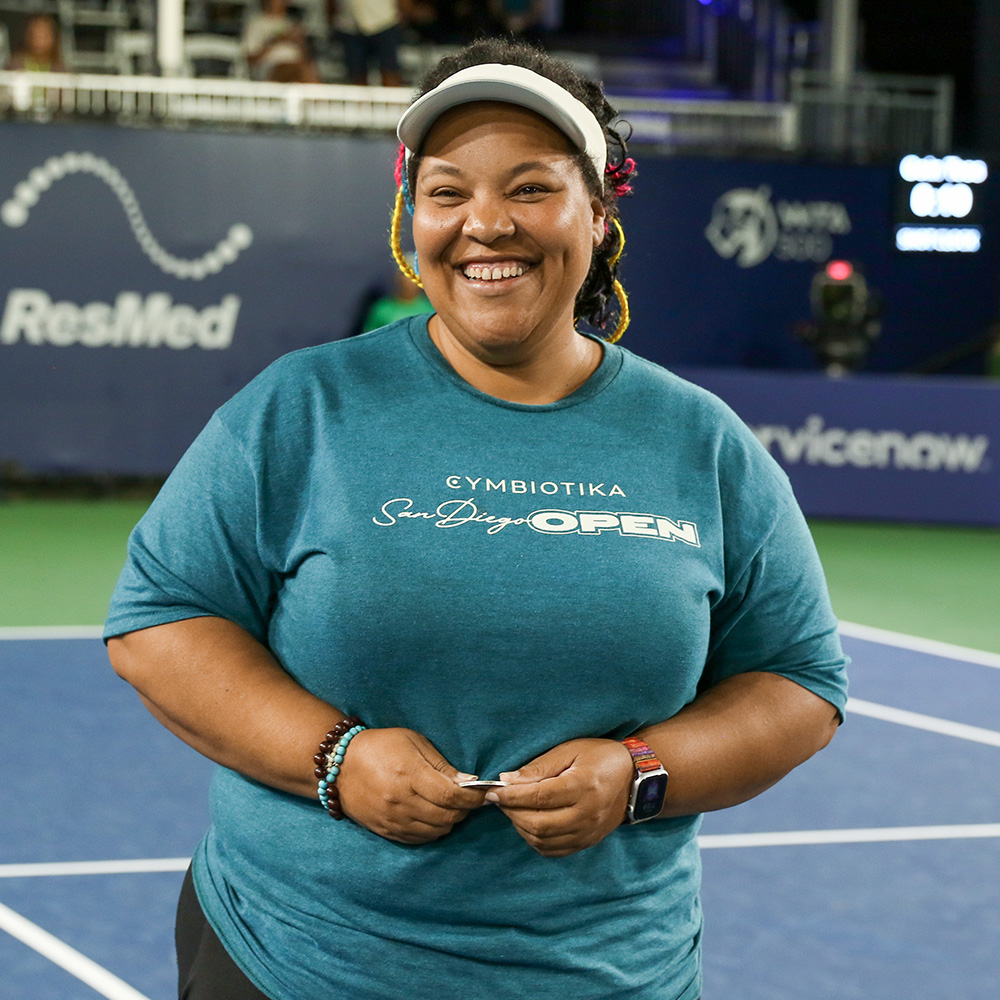
Middle #1: Rachel Bevis doing the coin toss at the 2023 San Diego Open. (Photo – Lexie Wanninger)
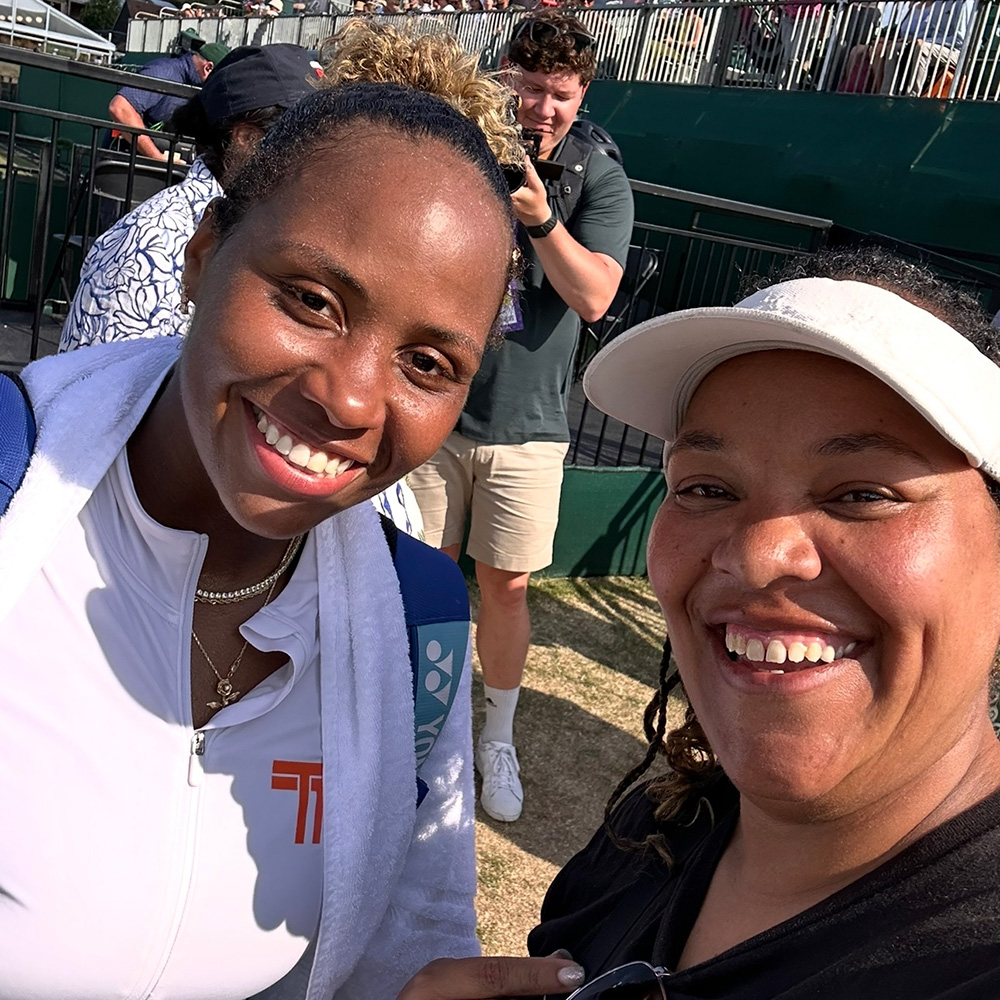
Middle #2: Rachel Bevis with Taylor Townsend at the BNP Paribas Open.
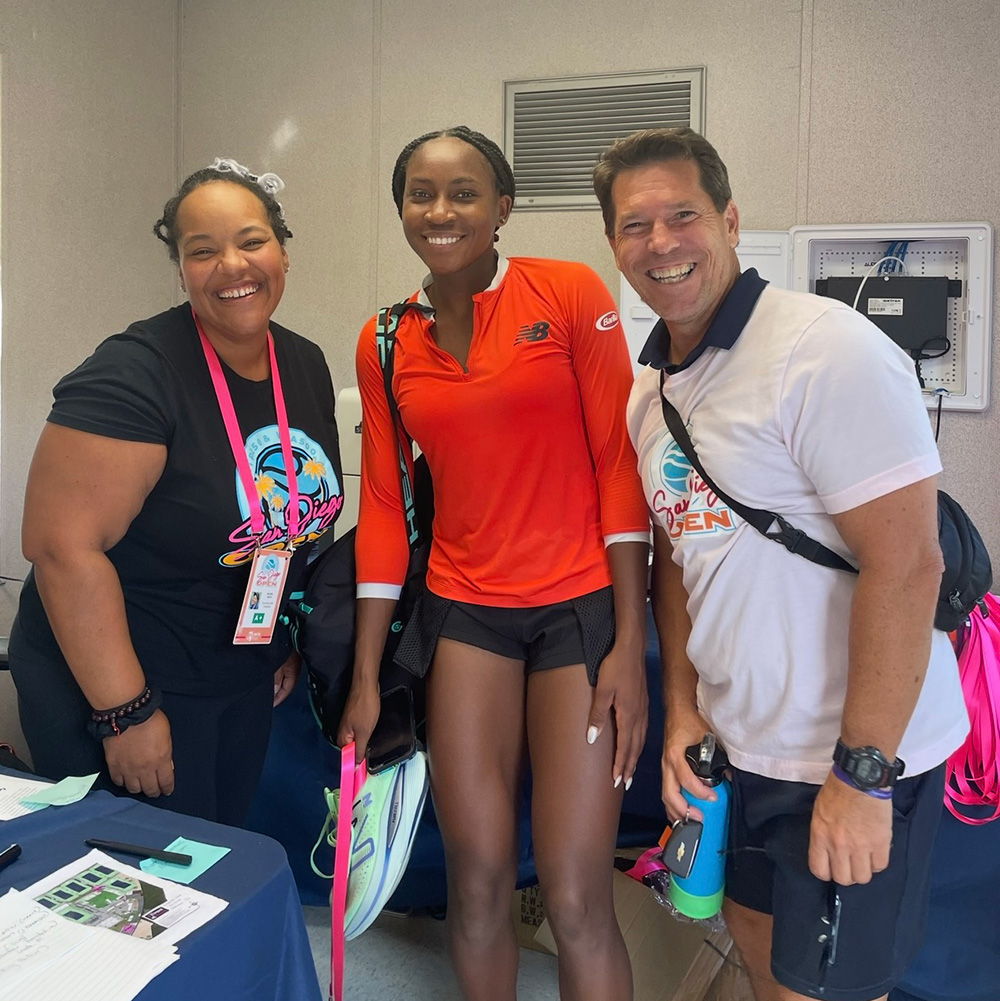
Middle #3: Rachel Bevis, Coco Gauff, and Mike Zarraonandia in the credential office at the San Diego Open.
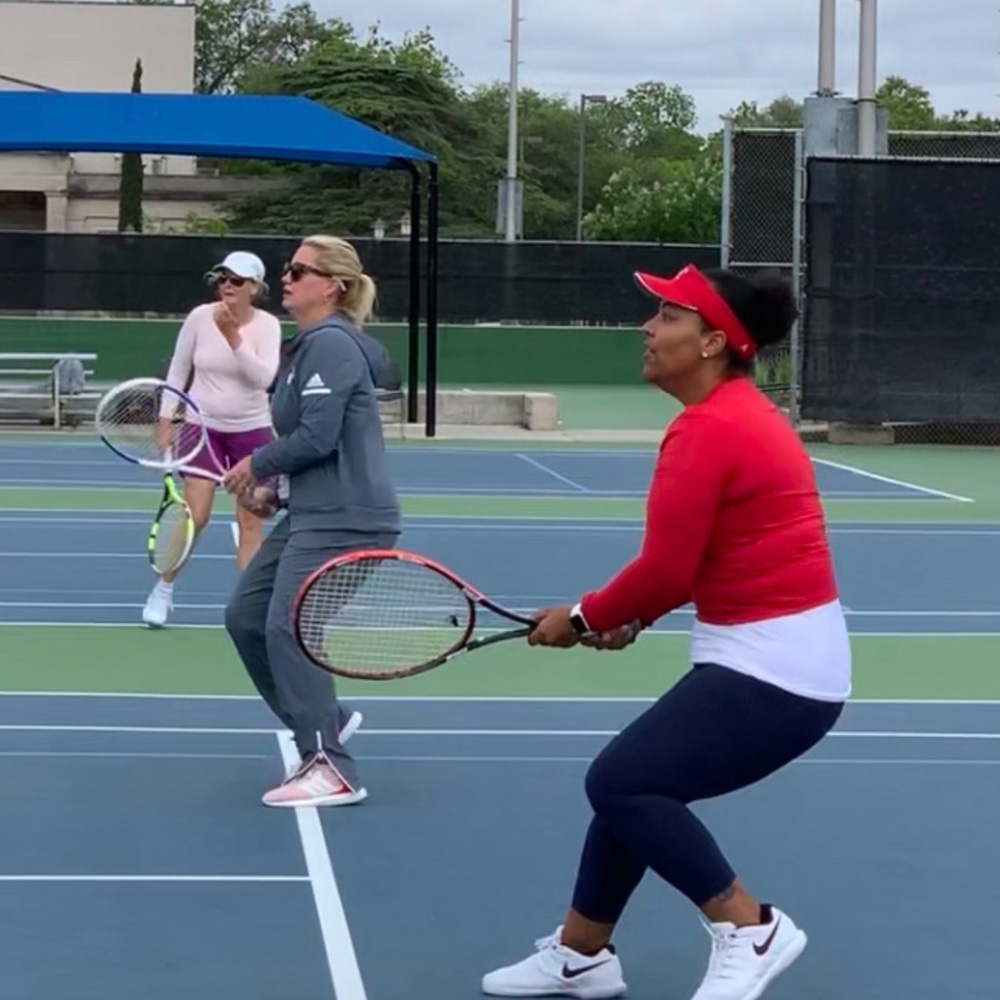
Bottom: Rachel Bevis playing tennis with Kathy Rinaldi, head of Women’s Tennis for USTA and former WTA pro.
Top: Rachel Bevis at the 2025 Wimbledon.
Bottom: Rachel Bevis doing the coin toss at the 2023 San Diego Open. (Photo – Lexie Wanninger)
Rachel Bevis, known in the tennis world as “Tennis Auntie Rachel,” is everywhere tennis lives and breathes. From hopping trains across England to follow SoCal standouts Marcos Giron and Taylor Fritz in Eastbourne, to sitting courtside at Wimbledon as University of San Diego’s Oliver Tarvet qualified and won his first round match after stepping onto the ATP Tour stage for the first time, Bevis shows up with boundless enthusiasm and an unmistakable smile.
You can often spot—or hear—Bevis cheering loudly for her favorite players, her voice carrying words of encouragement from the stands. Whether volunteering at the San Diego Open, championing rising stars at the SoCal Pro Series, or educating and uplifting fans online, her passion for the game radiates far beyond the baseline.
For Bevis, tennis isn’t just something you watch; it’s something you feel, share, and celebrate together, inspiring those around her from grassroots courts to grand stadiums.
What surprises many is that Bevis didn’t grow up with a racquet in hand. She didn’t come through junior pipelines or country club programs. In fact, she didn’t discover tennis until she was 41. What began as a late-in-life hobby quickly became a source of community, confidence, advocacy, research, and purpose. Today, she is a familiar presence across Southern California tennis: league player, volunteer, administrator, credentialing lead at professional tournaments, graduate student researcher, and social media educator known simply as “Tennis Auntie Rachel.” Her story is one of finding access, creating it, and holding the door open for others.
Finding Tennis Later and Falling in Love Fast
Bevis was living in Texas when tennis first entered her life. “I had a small community of framily—friends who were chosen family—and my friend Abe wanted to play,” she recalled. One Saturday, Abe invited her to hit casually on a local high school court. He brought a couple of racquets, and together they traded slow rallies under the Texas sun.
With a background in swimming and water polo, Bevis had strong hand-eye coordination, but the sport’s physical demands caught her off guard. That first session lasted barely 20 minutes, most of it spent chasing stray balls. A week later, armed with three fresh cans, they stretched their time on court to nearly an hour.
“It was fun to be able to hit a ball and be outside,” Bevis reflected.
When Abe injured his back, Bevis could have stepped away, but instead, she leaned in. Searching online, she discovered a Wednesday night women’s clinic at her local city park. She showed up, and never looked back.
“I was hooked,” she exclaimed. That clinic soon became a gateway. The women formed a USTA team, entered league play, and welcomed Bevis into the competitive and communal heartbeat of the sport. Tennis was no longer just exercise, it forged connections, built confidence, and gave her a lasting sense of belonging.
Competition, Confidence, and Identity on Court
Bevis rose quickly in league tennis, ranking No. 8 in Texas among 40 & Over 3.0 women in her first year, competing in Sectionals, finals, and tournaments.
“My identity as a Black woman is secure, it’s my everyday experience,” Bevis shared. “My identity as a tennis player became secure by playing on some pretty great teams.”
Yet being one of the only Black women on a team—or sometimes in an entire club—carries its own weight. In these spaces, she often becomes a monolithic representation, forced to combat stereotypes and manage expectations where Black women remain less common.
“People tend to remember me,” she said. “That comes with a certain amount of pressure.”
It’s a responsibility that reflects a larger reality of tennis culture: “Being Black in tennis in San Diego elicits a lot of questions,” she explained. “No matter how far we’ve come, people still aren’t used to seeing Black women on court with them.”
Lessons Beyond the Baseline
Tennis has shaped Bevis well beyond wins and losses. As a doubles player, she values communication, adaptability, and trust, skills that translate directly into her professional and personal life.
“Tennis teaches you how to be in the moment, always,” she observed. “After you train for a while, and you have your strokes down, you can start working on strategy. You have to be able to react and execute continually.”
Doubles, in particular, has reinforced her belief in shared responsibility.
“I love the team aspect,” she emphasized. “I’m known for my on-court communication. People work better together when they communicate consistently, in tennis and in life.”
That mindset has followed her off the court and into her work across the sport.
Behind the Scenes: Serving Tennis in New Ways
Over time, Bevis’s relationship with tennis expanded beyond playing. She stepped into administrative and operational roles, including serving as an Administrative Assistant at USTA Southern California and Head of Credentials at professional tournaments.
“Being behind the scenes is such a privilege,” she said. “I’ve always loved knowing how things work.”
From the annual San Diego Tennis Fests and league matches to professional events, Bevis gained a deep appreciation for the unseen labor that powers the sport.
“There are so many hours put in behind the scenes,” she noted. “I have a newfound love for the dedication of the people who make all of it possible.”
That perspective fuels her commitment to volunteering, especially in spaces where tennis intersects with service and gratitude.
Community, Service, and Giving Back
For Bevis, tennis has always been a community builder. When she moved from Texas back to San Diego in 2020 knowing no one, tennis provided an immediate way to reconnect and reintegrate.
“We’re so lucky here with the weather and the opportunities to play,” she expressed. “I want to give other people that same opportunity.”
One volunteer effort holds particular meaning. All three of Bevis’s sons are on active duty, making her especially grateful for initiatives that support veterans through tennis.
She highlighted the work of Steve Kappes, including weekly clinics with Wounded Warriors, shared lunches, and the annual Veterans Classic at the University of San Diego.
“I prioritize giving back in any way I can,” she said. “I’m thankful for the sacrifices veterans and their families have made for all of us.”
Representation, Inspiration, and Seeing Yourself
When asked what she hopes young Black girls and women see when they encounter her in tennis spaces, Bevis’s answer is unwavering.
“I want them to know there is space for them in this sport,” she affirmed. “I want them to know that the boundaries have been challenged and can continue to be pushed to allow even more space. Whether it’s on court, volunteering, or working behind the scenes, tennis is for people like them.”
That belief is deeply rooted in the legacy of the players who inspired her. Compton natives Venus and Serena Williams have been a profound source of motivation for Bevis, not only for their dominance on the court, but for the resilience and grace they displayed while reshaping the sport.
“The things that they had to endure, and work through while continuing to maintain the highest level in tennis is commendable,” Bevis reflected.
Today, her inspiration continues through a new generation of American women. She points to Coco Gauff, whose grounded presence and maturity at such a young age give her hope for the future of the game.
“I love the way Coco shows up,” she shared. “It gives me so much hope for this generation.”
Bevis is equally inspired by players making an impact beyond competition. From Madison Keys’ Kindness Wins initiative and Sloane Stephens’ Doc & Glo, to Taylor Townsend’s TT line and Frances Tiafoe’s partnership with the USTA Foundation to launch the Frances Tiafoe Fund—a charitable initiative expanding access to tennis and education for underserved youth through National Junior Tennis and Learning (NJTL) chapters nationwide—she admires how these athletes are using their platforms to redefine what leadership in tennis can look like.
“I’m so impressed with what they’re doing on and off the court,” Bevis added. “I’m a big fan.”
Bevis is also energized by the next wave of talent beginning to carve out space of their own. She points to players like Clervie Ngounoue, Hailey Baptiste, and Alycia Parks, whose growth over the past year has been especially exciting to watch.
“Seeing how they’re developing and coming into their own is really inspiring,” she added. “I’m excited to see how they continue to show up and shape the future of the sport.”
Becoming Tennis Auntie Rachel
Bevis’s passion for sharing tennis knowledge eventually found a digital home. While working at USTA SoCal, she became known as someone people called with questions about rules, leagues, and logistics. Friends encouraged her to turn that knowledge into content.
The idea lingered, until fans in the stands started asking questions, too.
Her first TikTok explained where to sit in a tennis stadium. From there, she expanded into tournament etiquette, ticketing structures, and behind-the-scenes insights. The response was immediate.
“I love explaining the nuances of tennis,” she said. “Imparting knowledge and empowering someone to access the sport is one of my favorite things.”
The name “Tennis Auntie Rachel” carries intention. Historically, “auntie” has been used dismissively. Bevis reclaimed it.
“Now, it’s an honorific,” she said. “Joining the term tennis in front of auntie, for me, allowed me to claim it for myself. I now see Tennis Auntie Rachel as helping Black people to have access to something they historically have been excluded from. It signifies my age, wisdom and protectiveness to the community.”
For her, Tennis Auntie Rachel exists to help Black people access a sport they’ve historically been excluded from.
Social Media as Access and Advocacy
Bevis sees social media as a bridge, between education and culture, fandom and participation.
“The biggest question I get is how to get tickets,” she said. “Every tournament is different, and it can be convoluted.”
Her process is methodical and inclusive: walk viewers through tournament websites, explain which tickets grant access to which courts, and follow up with comment responses and additional videos so information stays easy to find.
The feedback has been affirming. People tell her they’re attending their first professional tournament because of her content.
“That tells me this is advocacy,” she said. “By sharing knowledge, people now have access.”
A Sociological Lens
Bevis’s advocacy is also academic. She earned her Bachelor’s Degree in Sociology with a minor in Black Diaspora & African American Studies from the University of California, San Diego.
“Studying sociology offered me the lens, language and license to recognize the structures that have shaped my lived experiences,” she explained.
Her research focuses on access, inclusion, and the experiences of Black women in elite sports spaces, particularly professional tennis tournaments.
“Tennis has historically been an elite sport,” she observed. “Even without court fees, say at a city park, tennis can be prohibitively expensive. Representation has also been limited.”
By combining lived experience with empirical research, Bevis hopes to contribute new knowledge that can help dismantle institutional barriers.
“If tennis can lead the way,” she noted, “other elite sports can follow.”
Looking Forward
If Bevis could change one thing about tennis fandom, it would be clarity, especially around ticketing and access.
“A central space for that information would be incredible,” she said.
During Black History Month, her message is simple and unwavering: “I want Black people to know they belong in these spaces,” she said. “And these spaces are always better for it.”
From picking up a racquet at 40 to becoming a trusted voice for access and inclusion, Rachel Bevis continues to prove that tennis isn’t just about who’s been there the longest, it’s about who’s willing to open the door wider for those still finding their way in.