
How Dr. Christine Caron Is Redefining Inclusive
Movement in Southern California
USTA SOUTHERN CALIFORNIA
USTA SOUTHERN CALIFORNIA
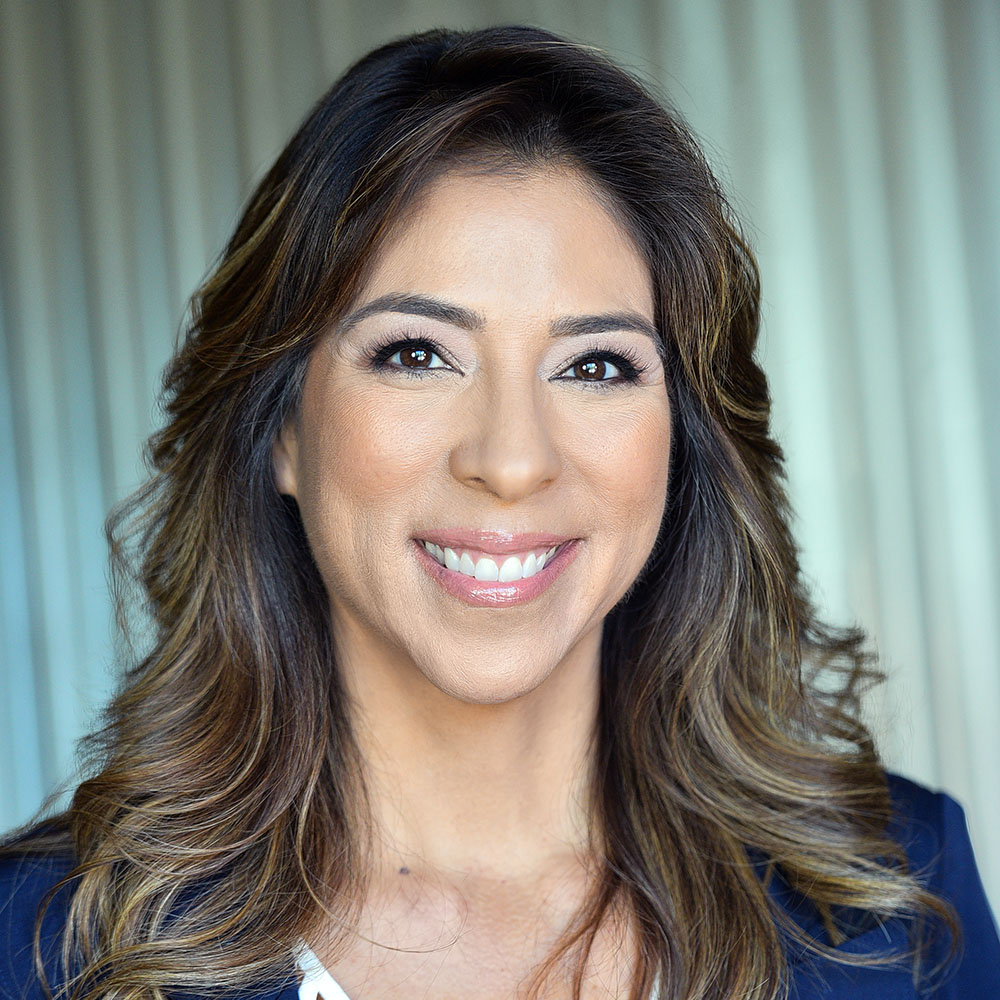
As the Director of Rehabilitation at the Luskin Orthopaedic Institute for Children (Luskin OIC) in Los Angeles, Dr. Christine Caron has spent over three decades proving that a disability should never sideline a child from the joy of movement. Through groundbreaking technology, innovative sports programming, and a transformative cerebral palsy summer camp, she continues to be a positive force in shifting the landscape of adaptive sports across Southern California.
This National Disability Pride Month, Dr. Caron’s work serves as a reminder to challenge societal biases and celebrate the profound capabilities and talent within the disabled community.
An Unexpected Journey to Pediatrics
Dr. Caron’s journey into healthcare began long before she entered clinical practice. Born in Colorado while her father served in the Air Force, she relocated to California as an infant and was raised in Santa Clarita. Her love for physical therapy was sparked early on when her father introduced her to the profession around twelve years old. An avid athlete who grew up playing high school volleyball along with competitive soccer and softball, she initially envisioned a career focused on sports rehabilitation. However, her trajectory shifted at age 16 when her grandmother suffered a stroke. Witnessing the profound impact of stroke rehab—and how it directly restored her grandmother’s autonomy—revealed to her the transformative impact physical therapists have on their patients.
Though she entered the field passionate about adult neurological rehabilitation, her career took an unexpected turn around 1998. A friend who was working at Shriners Hospitals for Children suggested that her personality would be a perfect fit for kids, anchoring a lifelong specialization in pediatric care.
Building Language and Connection
Growing up in a family of limited means, she experienced firsthand the vital necessity of health literacy and accessible medical care. Though her parents spoke Spanish as their first language, they chose to raise Dr. Caron and her sister in English to shield them from the educational struggles they had faced.
It wasn’t until her 20-year tenure at Shriners where her patients taught her to speak a basic level of Spanish—an evolution that directly transformed her medical approach, particularly given that Los Angeles is the largest Spanish-speaking city in the United States. In fact, over time, her limited proficiency inadvertently helped build trust with her patients, as her robust communication tactics ensured families and parents felt secure navigating complex treatment plans.
“My Spanish is somewhat elementary, which is kind of nice because it means that I have to be very explanatory when I’m speaking to families and parents,” she notes. “And because my language is more elementary, I don’t necessarily speak too much in medical jargon—which can sometimes be confusing—but a little bit more colloquial, which actually helps with communication.”
Innovation Meets Accessibility
In early 2019 after a phone call from Dr. Anthony Scaduto—President and Chief Executive Officer at LuskinOIC and Chief of Pediatric Orthopaedics at Santa Monica-UCLA Medical Center and the Orthopaedic Hospital—Dr. Caron joined Luskin OIC where she now specializes in pediatric orthopaedics, neurology, and cerebral palsy. There, she’s also involved in revamping and expanding the institution’s rehabilitation department. At the time of her arrival, the staff was limited with a single physical therapist and one assistant. Today, under her leadership, the team has expanded to include five physical therapists, an assistant, and two occupational therapists.
The clinic manages a diverse patient population with many pediatric orthopaedic specialties, including rehabilitation, cerebral palsy, and sports medicine, to name a few. In fact, Luskin OIC boasts one of the most comprehensive sports medicine programs nationwide, with treatment for a full range of youth sports injuries. The facility is continuously evolving to redefine patient care through specialized treatment plans, tailored movement programs, and cutting-edge technology. One piece of technology transforming patient rehab is an advanced motion capture lab—a system Dr. Caron has championed through extensive research and development. It utilizes specialized cameras and reflectors to map movement patterns to precisely analyze atypical gait patterns in children with cerebral palsy or evaluate when an athlete is ready to safely return to sports after an injury. Most importantly, Dr. Caron emphasizes that this technology—typically reserved for high-paying or well-insured clients—is provided entirely free to under-resourced families.
“These are kids who would never have the ability to access that type of technology because it’s not really backed by insurance,” Dr. Caron explains. “And these kids are underinsured anyway, so they would never have access to it. So the fact that we’re doing it here at Luskin OIC—it’ll be free to these kids and families. It’s providing a much needed service for kids who are under funded and under insured in these kinds of areas.”
Finding Purpose Through Care
A physically and emotionally demanding job as the Director of Rehabilitation takes a special person who loves what they do and is wholeheartedly dedicated to their patients. Clearly, Dr. Caron embodies that. She speaks of loving the challenge and reward of seeing her patients—particularly those with cerebral palsy—move, play, and defy society’s expectations with a creative flair and a little mischief, too.
“Their motivation is innate; they just want to move,” she smiles. “They want to play and they want to be just a little mischievous. I think that spoke to me. I love that aspect of it. I love to play. And I love the creativity behind it…I just love the challenge of it and the fact that these kids grow up and they come back and they show you how much they’re able to do. It’s just beautiful to be able to be part of their life in that way.”
Inside the Mission-Driven Cerebral Palsy Camp
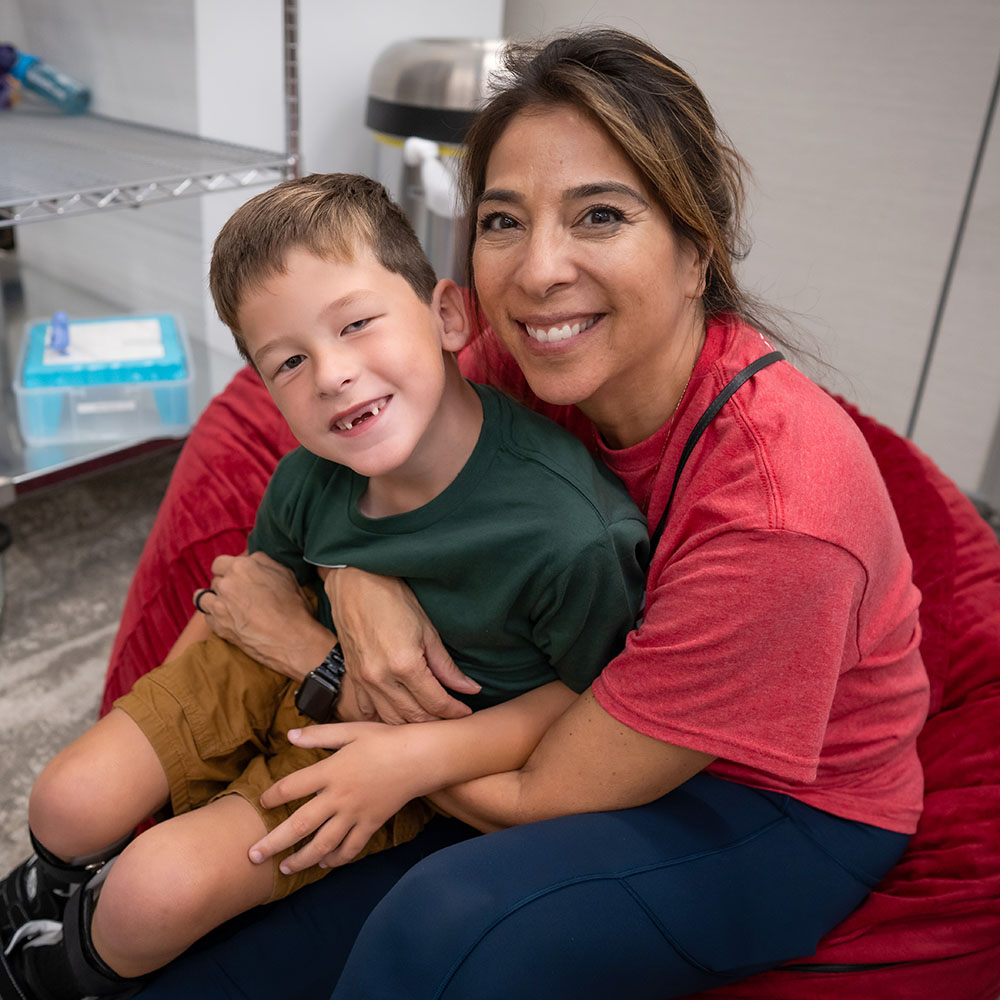
One of the most impactful and rewarding parts of her job is leading Luskin OIC’s annual Cerebral Palsy Summer Camp, which launched in 2022 in partnership with Angel City Sports. The three-day camp brings creativity, play, and adapted sports to kids with cerebral palsy, allowing them to freely express themselves in a fun, supportive environment.
Shutting down a busy medical clinic for three days is certainly an unorthodox business decision, but Dr. Caron credits Luskin OIC’s mission-focused framework for making it a reality.
“Being able to shut down rehab for three days is not necessarily a financially smart thing to do for a business,” she laughs. “But because we’re mission based, the facility says, ‘Yes, shut it down and do this camp because it’s good for the kids and staff and it’s fun.’”
The blueprint of the camp is very intentional in its design. It pairs teams of three children with six dedicated volunteers recruited from pre-physical therapy, pre-occupational therapy, and pre-medical tracks. This high ratio allows the children to experience genuine team camaraderie and athletic competition while simultaneously giving future healthcare professionals foundational, real-world insight into disability care.
“The camp is packed full of mission,” she beams. “Every aspect of it is so intentional. We divide the kids up into teams so they can feel what it’s like to be part of a team because these kids don’t always get that, right? They’re in these schools where they’re sometimes pushed to the side, so it’s really neat to see them thrive.”
For the parents, the camp acts as a rare sanctuary. Knowing their children are in the hands of expert therapists who safely handle their children, parents are finally able to step back, let their guard down, and build community with one another.
“We had a couple parents talk to us [after camp this year],” Dr. Caron recalls. “It brought me to tears about how one parent could finally just relax. She said, ‘We’re always on guard trying to protect and help our kids, and we’re finally able to put them in an environment where I don’t have to be on guard. I can just relax.’ So the parents end up congregating and talking while these kids are impacted. And our therapists are so skilled at transfers and handling skills that they know their kids are safe.”
The Adapted Tennis Experience
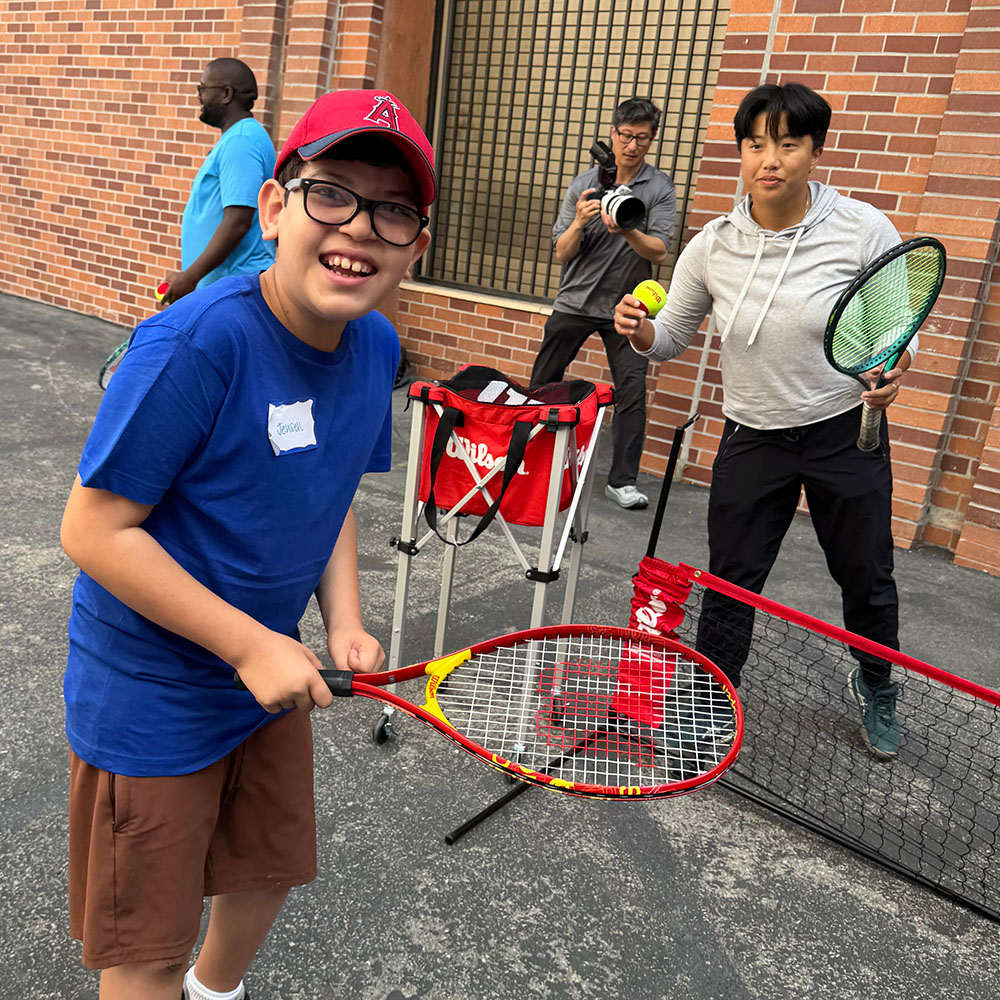
During camp, one of the many adapted sports the children play is tennis. While Dr. Caron humorously admits she is “horrible” at playing the sport herself, she recognizes the immense physical and cognitive benefits it offers her campers. In its inaugural year, Laura Goodkind—two-time Paralympian, wheelchair tennis athlete, and coach for Angel City Sports—introduced adapted tennis to Dr. Caron and the Luskin OIC team, which continues to be a staple of the camp under the partnership of Angel City Sports and USTA Southern California each year. Together, the three organizations work in tandem to create an experience fit for all levels and skillsets.
The goal is to dismantle tennis’ traditionally fast-paced barrier-to-entry to match the motor planning, vision, and timing realities of children with cerebral palsy. With a makeshift court, the program breaks tennis down into scalable, achievable developmental milestones. Rather than standard tennis balls, medium-sized beach balls are used to give children the critical processing time required to practice racquet control. Physically, the repetitive mechanics enhance core balance, strength, and bilateral movement coordination. Psychologically, the sport builds self-confidence through incremental success.
By merging the movement expertise of Luskin OIC with the specialized adaptive knowledge and equipment of organizations like Angel City Sports and USTA Southern California, the camp delivers a premium and specialized experience.
For Dr. Caron, who is over three decades into her professional career, watching kids with cerebral palsy play tennis reframed her thinking about the opportunities within the sport.
“I realized a little bit more about what our kids with cerebral palsy could do,” she reflects. “I think I had initially assumed that they wouldn’t be able to play tennis…I guess it challenged my biases. Even I had biases when it came to treating kids with cerebral palsy. It was nice after 32 years of working as a physical therapist to continue to challenge those biases and come out of it with a broader knowledge.”
Shifting Perceptions and Disability Pride
As we recognize National Disability Pride Month, Dr. Caron views her work as vital to change public consciousness. After many years in the field, she has witnessed a steady shift where adapted sports have slowly migrated away from quiet siloes to authentic inclusion within mainstream conversations.
“When we see people with a disability, we automatically assume what they can’t do,” she says. “And I think we have biases because—out of the goodness of our hearts—people want to help. So we tend to over help sometimes. So it’s really neat to see people displaying what they can do and saying ‘I’m strong. I’m okay. I’m not a victim.’ This month is about that pride of what I can do, how I can contribute, what I can grow into. That’s what this month means to me. It’s not about what people can’t do, it’s about what people can do.”