

The Power of Connection: How Judy Dean Forges an
Inclusive Pathway for SoCal Tennis
USTA SOUTHERN CALIFORNIA
USTA SOUTHERN CALIFORNIA
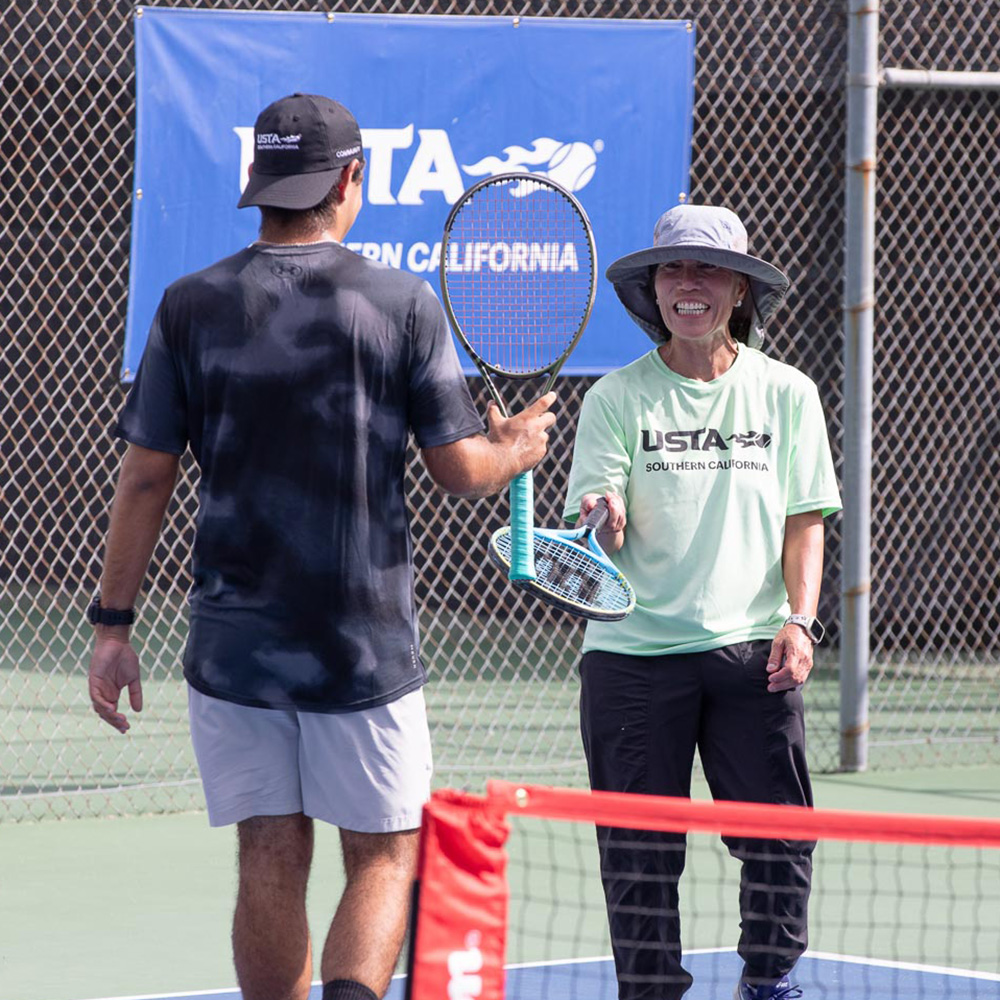

Top: Judy Dean smiles while tapping racquets with a fellow player at Marguerite Tennis Pavilion during the 2025 USTA Community Social.
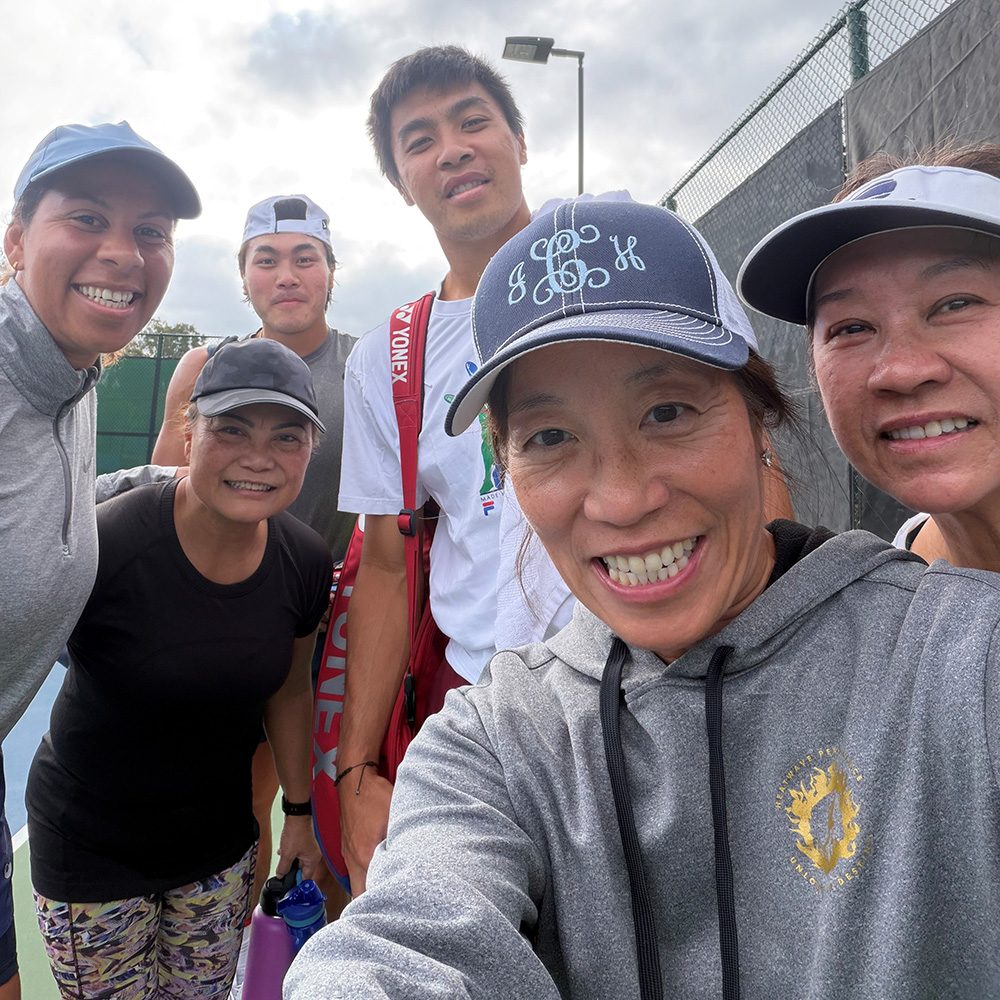
Middle: Judy poses with friends alongside Brandon Nakashima and Bryce Nakashima at Racquet Club of Irvine.
Bottom: Judy and Mira at BNP Paribas Open in Indian Wells.
Coming from the chilly climate of Milwaukee, Wisconsin, Judy Dean gladly traded in her childhood ice skates for a tennis racquet at age 11 when her father began reading books about the game to teach his children the fundamentals. What started as a family pastime eventually became a lifelong passion rooted in connection, community, and opportunity. After moving to Southern California for work, Judy has spent countless hours giving back to the sport that shaped her life in so many ways—serving as a parent, volunteer, grassroots coach, USTA official, and player —helping create spaces where athletes of all backgrounds and abilities feel welcome on and off the court.
Family Ties and Finding Community Through Tennis
Growing up, Judy and her brother regularly rode their bikes to the public courts before eventually joining a local tennis club that offered discounted memberships for junior players. She entered her first USTA tournament at age 14, competed at the high school varsity level, and later walked onto the Wellesley College Division III tennis team, where she played for four years.
Like many players balancing work, family, and other responsibilities, Judy stepped away from the baseline for nearly 30 years after her college graduation.
The catalyst for her return wasn’t a professional match or a personal resolution, but her daughter, Mira, who discovered a love for the sport.
“When we had Mira, she tried a few different sports, but tennis is what she gravitated to,” recounted Judy. “Southern California has so many opportunities for play — the number of courts and quality of the tennis instruction. It was the logical sport since I was already familiar with it.”
Judy’s return to tennis also reignited another passion: service. Reminiscing about her experiences volunteering with the Special Olympics while living on the East Coast, Judy wanted to find a similar opportunity to share with Mira, now an avid high school tennis player and member of the USTA Southern California Youth Leadership Council. In 2023, the pair began volunteering with the Irvine Eagles tennis team, a local program under the Special Olympics Southern California (SOSC) in Orange County that offers sports training and competition for individuals with intellectual and developmental disabilities (IDD). With tennis only being offered during the fall season, Judy and Mira began searching for year-round opportunities to stay involved in adaptive tennis—a search that would eventually change the trajectory of Judy’s involvement in the sport.
“I’m grateful that Mira and I have shared interests and can contribute in a meaningful way,” said Judy.
Discovering Serving Advantage and Expanding Adaptive Competition Opportunities
Shortly after working with the SOSC, Judy and Mira discovered Serving Advantage, a youth-led nonprofit organization that uses tennis to foster inclusion, awareness, and acceptance for individuals with IDD.
Founded in 2020 by high school students Natalie Rodriguez, Andy Loughran, and Jacob Eusebio who have since graduated, Serving Advantage focuses on improving access to quality, consistent adaptive tennis opportunities for the IDD community, while creating meaningful connections between adaptive athletes and their neurotypical peers. The program is a testament to the potential of young leaders to create real impact and build unity both on and off the court. Serving Advantage’s mission is to help people of all abilities develop a love for tennis, while strengthening the social and life skills that support confidence, independence, and everyday success through sport.
Judy quickly recognized an opportunity to help athletes continue progressing beyond introductory clinics. She saw a void where her experience could help: the need for a “competitive pathway.”
“One thing that Mira and I realized was that there wasn’t progression in the students’ tennis. There were a lot of drop-in clinics but not necessarily the opportunity to develop skills over time,” explained Judy.
As Judy and Mira worked more closely with players, they noticed many athletes had the ability to rally, keep score, and compete.
“We’d met a lot of really talented students who could hit well, keep track of scores, and play matches. We wanted to develop the more advanced players so they could play in competitions and tournaments,” Judy recalled.
That realization helped spark the development of a competitive pathway within the organization. High school varsity and tournament-level volunteers now work closely with the athletes, helping them to develop tennis skills longitudinally. The program includes instruction and drills that prepare them for Unified Doubles tournaments, where a neurotypical player partners with a player with IDD, allowing them to work together as a team.
“It’s fun because some players may have some difficulty keeping score or knowing court positions, so this allows you to have a partner to help you with those things,” said Judy. “It also allows for more prolonged point-play.”
The program has already produced meaningful results. In October of 2025, Serving Advantage brought nine teams to the USTA Unified Doubles qualifying tournament held at the Peninsula Racquet Club in Rancho Palos Verdes. Two of the Serving Advantage teams finished in the top three, allowing them to participate in the National USTA Unified Doubles tournament at the USTA National Campus in Orlando, Florida. Alongside the opportunity to compete at this level, the experience cultivated a strong bond and support system between the adaptive players and their doubles partners, with their families and coaches courtside to cheer them on.
“Judy has played an instrumental role in shaping adaptive tennis through Serving Advantage and our Competitive Pathways program, helping to create a space where athletes with intellectual and/or developmental disabilities can grow, compete, and truly feel a sense of belonging on the court,” lauded Wendi Eusebio, President and Parent Advisor of Serving Advantage.
“What makes her impact even more meaningful is that it extends beyond her own work. Her daughter, Mira, is an outstanding youth coach with Serving Advantage, carrying forward that same passion and care. Judy and her family truly embody what Serving Advantage stands for: using tennis to build connection, confidence, and a strong sense of community for everyone,” she added.
Continued Advocacy Through USTA Officiating
Judy’s commitment to the game is truly 360-degrees. Beyond coaching, she serves as a USTA official, acting as a volunteer roving umpire for Serving Advantage’s annual ‘Share the Love’ Level 6 junior charity tournament, which was mostly recently held in March 2026 at the Anaheim Tennis Center. In 2025, she also officiated for the USTA SoCal Wheelchair Sectionals at the Great Park and the USTA Youth Leadership Council’s annual discounted Level 7 tournament held at Blair High School in Pasadena.
“All of my roles are intertwined. I don’t see that as a challenge,” reflected Judy. “In terms of officiating, I use it as another opportunity to volunteer, but I am also starting to play again, so it helps me understand the game better.”
She recognizes that as an official, she is often the face of the USTA for a young player or a parent. “You are an ambassador for the sport. You want to make sure the junior players are having a good experience. You want to cultivate their interest and love and encourage them to remain in the sport,” Judy explained.
Inclusion, Identity, and the SoCal Perspective
Judy’s commitment to inclusion isn’t just professional; it’s a reflection of her life as a Korean- American and the hurdles of finding a sense of belonging. Growing up in Milwaukee, she recalls that “inclusion meant assimilation,” where fitting in was interpreted as distancing herself from her Korean culture.
“One of the things that struck me while growing up as a Korean-American, there weren’t that many Asian people, let alone Koreans, in my community,” noted Judy. “A lot of what my parents took as inclusion meant assimilation, meaning we didn’t learn Korean and weren’t exposed to Korean culture. Inclusion meant fitting in.”
Moving to Southern California fundamentally reshaped that worldview. “Living in SoCal, I’ve really come to understand that inclusion means celebrating diversity,” Judy explained. “It’s a completely different way of looking at it. The opportunity to be in an area where there are Korean and other Asian cultures and groups, it’s a very special area of the U.S.”
This shift from “fitting in” to “celebrating diversity” fuels her belief that encouragement is a non-negotiable part of the game. She wears many hats—parent, volunteer, grassroots coach, official, and player —but her mission remains singular: to be the voice of motivation. She recognizes that while the roadmap for an athlete with an IDD might look different than that of a neurotypical player, the destination is the same: a place where every athlete feels empowered to reach their full potential.
“A lot of times we underestimate their abilities,” Judy said. “In the Competitive Pathways program, it’s important to encourage all students to reach their potential.”
She recalled a moment when the Serving Advantage volunteers introduced footwork drills that initially felt too challenging. However, once the players saw the demonstration, they executed the drills with precision. “We saw huge improvements in their ability to get to the ball and get the ball in the court,” she said.
That experience reinforced a vital philosophy that Judy now carries across every role: high expectations are a form of respect. “That was a learning experience for me, to not underestimate the adaptive player,” Judy noted. “Why shouldn’t we have expectations and push everyone to be better and to improve?”
By bridging the gap between her personal history and her work with adaptive athletes, Judy ensures the destination remains the same for every player: a place where they are given the support to fully realize their capabilities.
Continuing to Learn and Grow the Game
Today, Judy is back in the competitive mix herself. With more time now to pursue her own interests as a player, she currently plays in a 3.5 USTA League out of Irvine. However, her personal play hasn’t slowed her drive to help others; continuing to refine her grassroots coaching skills remains a top priority.
To keep those skills sharp, Judy utilizes USTA Coaching, a resource launched in the summer of 2025. Designed to support everyone from recreational staff to high school and college coaches, the platform has become a vital tool for Judy’s mission.
“There’s so many different levels and groups that can benefit from playing tennis. USTA Coaching emphasizes that,” said Judy. “That’s unique – we want to be able to bring opportunities to play tennis to all different types of people, be it the social player, a high-performance junior, high school and college teams, or the IDD community.”
While she may not be training elite professionals, Judy’s goal is to ensure the “bridge” of tennis remains open to everyone. “I certainly can help beginners and anyone who wants to learn how to play,” she says. Through every role she takes on, Judy Dean continues to demonstrate that in Southern California, there is room for every player to shine.