

Micah Velte: A Young Leader
in Wheelchair Tennis
USTA SOUTHERN CALIFORNIA
USTA SOUTHERN CALIFORNIA
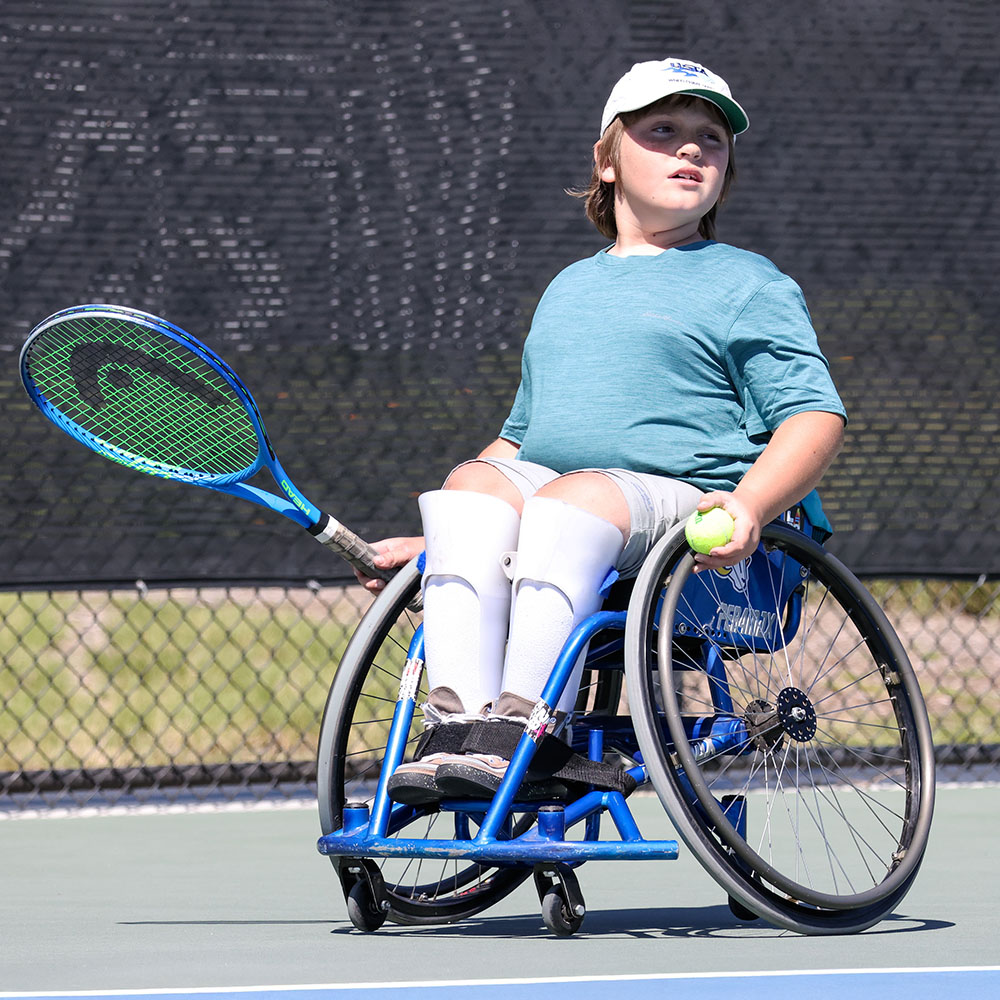

Top: Micah Velte competing at USTA Southern California Wheelchair Sectionals in Irvine. (Photo – Jon Mulvey/USTA SoCal)
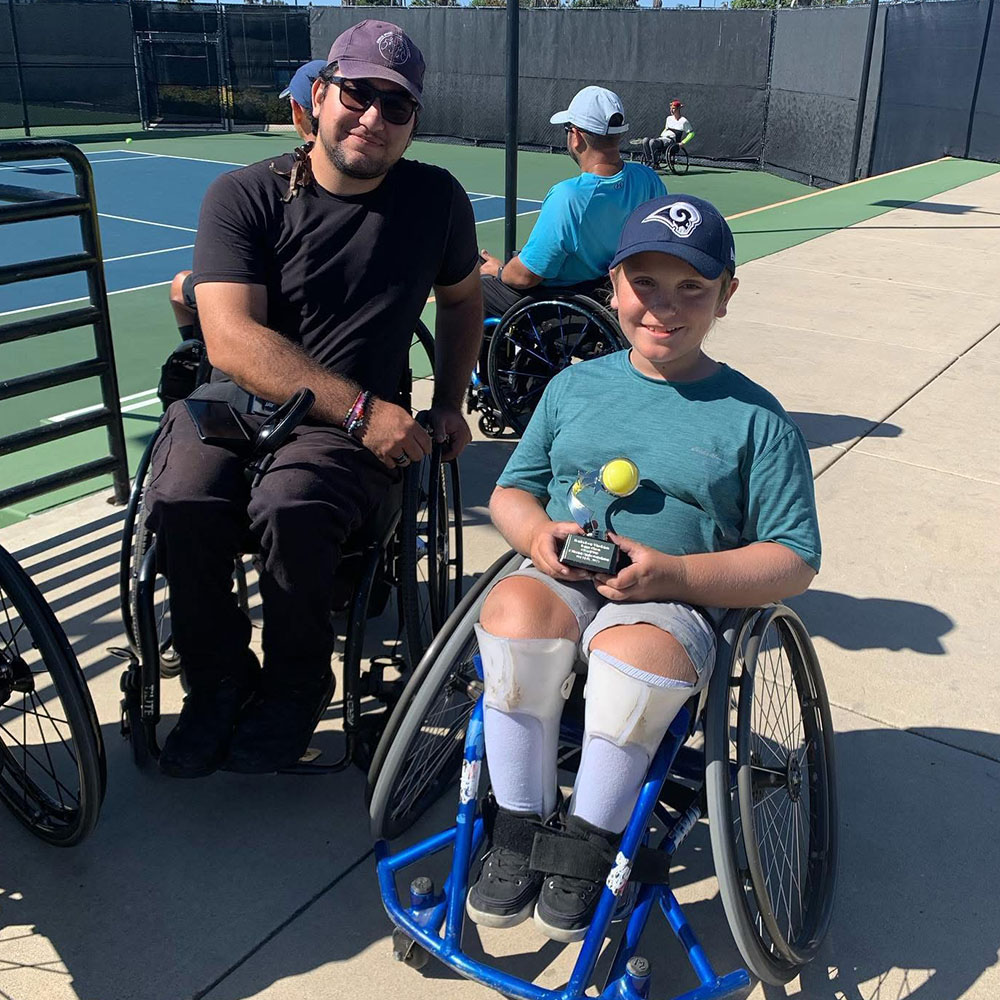
Middle: Micah with Coach Henry Reyes.
Bottom: Micah with Coach Dee Henry.
Top: Micah Velte competing at USTA Southern California Wheelchair Sectionals in Irvine. (Photo – Jon Mulvey/USTA SoCal)
Bottom: Micah with Coach Henry Reyes.
As wheelchair tennis celebrates its 50th anniversary this year, this milestone represents five decades of progress and a history of changemakers who have carried the sport forward for the next generation.
Among this new class is rising talent Micah Velte, a Fullerton native and nationally ranked junior wheelchair player with big ambitions. This National Adaptive Sports Month, we recognize Micah’s accomplishments and the passion he brings to compete and improve on court every day.
Discovering Tennis
At just 13 years old, Micah has already been playing tennis for nearly a decade. Born with spina bifida, he faced medical challenges early on, but his parents, Jonathan and Megan, were determined that their son’s life would not be defined by limitations. From the beginning, they made sure Micah had access to the same opportunities all kids find through sports—competition, friendship, and confidence.
“We really wanted Micah to experience sports and to know there’s opportunities for anybody who has a disability,” Jonathan says. “There are programs and options out there to help people thrive in all areas of their life.”
One of the programs dedicated to helping people thrive in adaptive sports is the annual Angel City Games, an adaptive sports festival hosted by Angel City Sports in Southern California. This multi-day event offers adaptive sport clinics, competitions, and community activities for people of all ages and skill levels with physical disabilities or visual impairments, providing opportunities to try a wide range of sports and connect with others in the community. Each year, USTA Southern California leads the wheelchair and adaptive tennis programming during the Games.
It was at the Angel City Games that Micah first discovered wheelchair tennis at four years old and learned about the late Dee Henry, a beloved tennis coach whose career left a profound impact on Micah and the larger tennis community. “We figured out who Dee was at the Angel City Games. Then we showed up to one of her practices and she said, ‘Cool, get him in a chair and let’s see how he does,’” Micah recalls. “I now play four to five days a week. I love competing in tournaments and I want to keep getting better and better. I’ve always loved it. It’s such a fun sport.”
Influential Coaches
Through Dee’s program, Micah found a deep love for sport. Practices were filled with creative games to make playing joyful, and Dee’s energy was infectious on court. “We would play all these fun games,” Micah shares. “She made it really exciting to come to practice.”
Known for her relentless passion to grow wheelchair and adaptive tennis, Dee dedicated countless hours to introducing new players to the sport and building pathways for young athletes. Her passing three years ago from complications following surgery was felt deeply across the wheelchair tennis community.
For Micah, her belief in his potential remains a powerful motivation. “She really inspired me to keep playing and get better,” he shares. “Right before she passed away, once I started getting better and playing in tournaments, she knew I had potential and she believed in my potential.”
That same belief was carried forward by Henry Reyes, a coach alongside Dee who continued Micah’s development after she passed. “What stood out to me during that time was his natural athletic ability and his desire to one day beat me in a match!” Henry says. “His desire and passion to become better is what I as a coach and I’m sure many other coaches love in a student.”
Physical and Mental Toughness
Today, Micah trains with Henry several days a week. While Micah’s technical skills have progressed significantly, much of his growth has come on the mental side of the sport.
“Micah had an amazing foundation working with Coach Dee beforehand,” Henry shares. “I needed him to focus on the mental aspect, on and off the court. He’s now thinking about tournament preparation, match preparation, game plans, how to stay focused during a match, and even how to take a loss.”
Micah has embraced that challenge. “I’ve read mental toughness books, stories, and articles about how to keep yourself mentally going in a match. I hear something about mental resilience sporadically here and there, and over time, it just kind of came together for me.”
After years of intense training and learning about the game, Micah is now competing against adult players at the B level in tournaments, oftentimes competing against players much older than him. “Before when I was playing juniors, I was used to playing people around my age. Now it’s interesting to play people that could be my grandfather—they’re that much older than me,” he laughs. “So it feels like I have more bragging rights when I beat them because I beat an adult. It’s a very interesting feeling.”
A Breakthrough Match
The challenge of playing at a higher level has helped accelerate his development. Micah has embraced the competition and experiences that come with it, traveling to tournaments and camps across the country—from California and Arizona to Ohio and Washington D.C. One of his favorite tournament memories came at the 23rd Annual USTA Southern California Wheelchair Sectionals Championships in September last year. Not only did he go undefeated in Coed B singles and doubles, but he also won his first career singles match decided by a match tiebreak.
“It was a very close match,” he shares. “I lost the first set and then I won the second set and then I barely beat the guy 10-7 in the third in the match tiebreaker. It was an amazing experience because that was the first time I’ve ever won a singles match through a match tiebreaker. I’m very proud of myself and how I kept going even though I lost the first set. I didn’t give up.”
These moments reflect not just his talent, but his emotional maturity on court—something Henry emphasizes as a key part of his development. “He knows a lot better now when it’s time to be serious and focus. He still wants to have fun any way he can, but he’s learning how to balance that.”
Academics, Extracurriculars, and Leadership
Off court, Micah’s personality is just as dynamic as his game. “Goofball, goofball, goofball,” Henry laughs. “And I don’t blame him. What 13-year-old kid doesn’t want to have fun?”
That balance of personality and discipline continues to shape who he’s becoming, both as a player and a person. A seventh-grade student at Parks Junior High in Fullerton, he balances academics, tennis, and playing a musical instrument called the euphonium—basically a smaller tuba—with discipline and maturity. Last year, he also served as Student Council President at his elementary school, Fern Drive Elementary. In February 2025, he was even recognized as one of Fullerton School District’s “Dream Catchers,” an honor awarded to just ten students out of roughly 10,000 across the district.
The award recognizes students who demonstrate exceptional leadership, perseverance, and community impact. Micah received the recognition in part for his athletic accomplishments in wheelchair tennis and contributions to the school’s community. “I was honored at a Fullerton School District Board Meeting with all the principals, board of directors, and the superintendent. That was very cool,” he says.
He also had the opportunity to share his story during a speaking engagement at California State University, Fullerton, where he was selected as one of eight students to present—using the platform to share his passion and help educate the community about wheelchair tennis. “I honestly did it because I would really like people to know about wheelchair tennis. When people hear the word ‘tennis’, they [often] think of Novak Djokovic, Rafael Nadal, and all the ambulatory players. But I also want—maybe with the help of other wheelchair players—people to think of wheelchair tennis, not just ambulatory tennis.”
A Community That Matters
For Micah and his parents, visibility and representation in wheelchair tennis matters greatly. His father says one of their biggest goals is to help others discover adaptive sports opportunities that many families simply don’t know exist.
“It’s been a real focus and goal to help other families with kids who have disabilities find these opportunities because so many people just don’t know what’s out there,” says Jonathan. “Unfortunately in the world of adaptive sports, most of us start in the same place, trying to figure out what’s out there. So it’s been our goal to make that process easier by increasing visibility to show there’s opportunities out there for people with special needs.”
Organizations like Angel City Sports have been instrumental in not only introducing adaptive sports to individuals with physical disabilities and visual impairments, but also providing a space where families can connect and build a community.
“Community is so important,” Jonathan shares. “To be honest, when most of these kids go to school, they’re probably the only ones in a wheelchair. We don’t want anybody to be excluded or to feel different, but the reality is when you have a disability, it is different. So having that community is super important for Micah to grow up in—knowing other kids and having friends that have a disability just like him.”
Visions and Goals
Looking ahead, Micah’s goals are clear. “In the short term, I want to move up to the A division to give myself more of a challenge. And I also want to start playing in the international junior wheelchair division. The long term would be to go to a university to play college tennis and then eventually win a Paralympic medal,” he shares.
Henry believes Micah’s ceiling is very high. “His potential in wheelchair tennis is limitless,” he says. “As a player, I wouldn’t be surprised if he wins all four majors and wins gold at the Paralympics. If he decides to do anything for the sport outside of playing, he would definitely leave his mark. Ultimately I want him to do whatever makes him happy in life.”
Leaving the Sport Better
As wheelchair tennis celebrates its 50th anniversary and enters its next chapter, players like Micah represent exactly what the sport’s pioneers envisioned: continuing to push tennis forward by empowering people to pick up a racquet regardless of their age, skillset, or physical ability.
“Coach Dee wanted to make wheelchair tennis more known. Her main goal was to grow the sport as much as she could and she worked very hard to do it. I want to grow the sport because that’s what she would’ve wanted,” Micah remarks.