


A Little Thing Like a Handshake Goes a Long
Way for USTA Official Maureen Regan
USTA SOUTHERN CALIFORNIA
USTA SOUTHERN CALIFORNIA

Match point has been clinched and both players head to the net for the post-match handshake, a tradition as old as the game itself.
The handshake doesn’t always look the same and comes in different forms – a racquet tap, fist pump and most often a clasp of hands. In a one-on-one sport, the handshake acts as formal closure for both players to acknowledge a match well played despite the outcome.
USTA Southern California official Maureen Regan has had a front row seat to hundreds of congratulatory gestures and is used to both players then turning to her in the umpire chair and also extending a hand along with a thank you or acknowledgement of a job well done.
“You get a good feeling even when a player – when maybe the match didn’t go their way – they still shake hands with you at the end of the match, and they really mean it. You want them to think, ‘Hey, you don’t always get it right but 99 percent of the time you do and in the long run I trust you.’”
Entering her 15th year as an official, Monrovia resident Regan subscribes to the theory of her fellow officials and is happiest when she completes a match and no one remembers her and is reminded of the simple motto: “Let’s get through this together and not be noticed.”
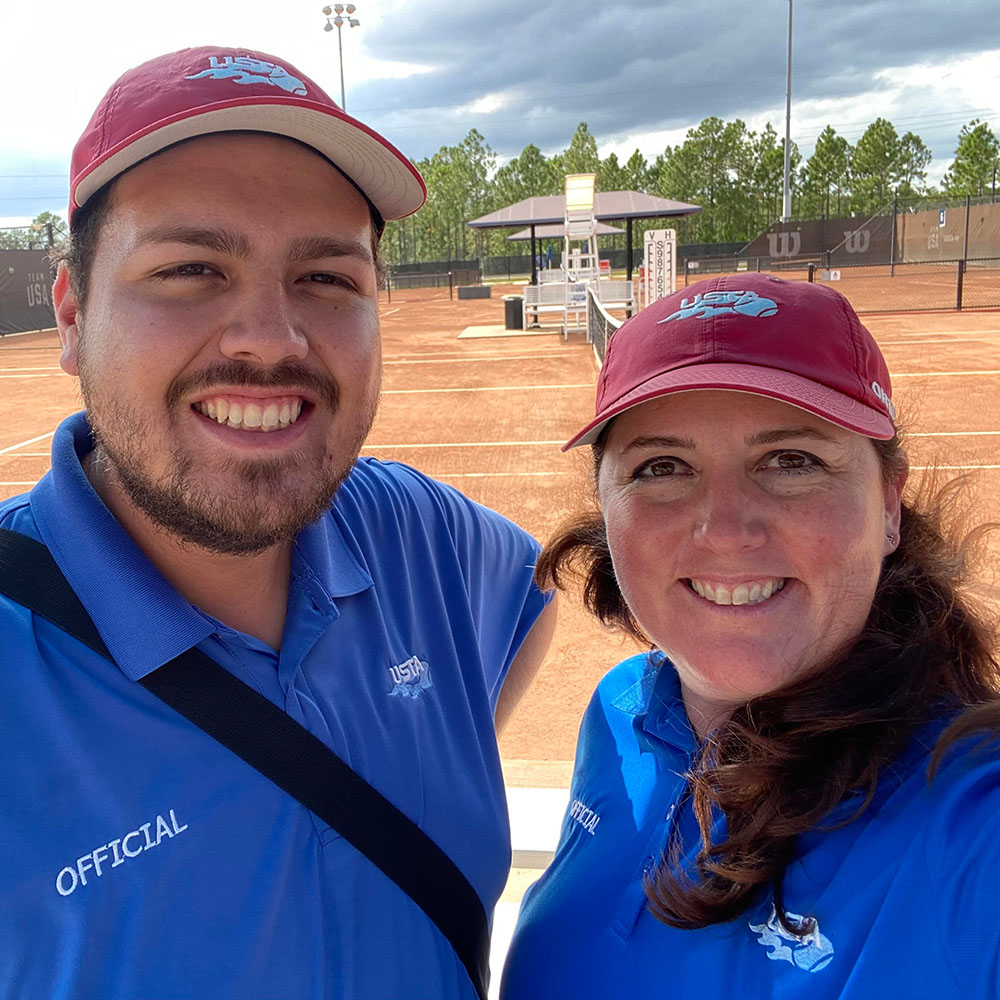
Regan recently took time out of her busy workday at a Tallahassee, Florida, men’s Futures event to answer a few questions and how the US Open indirectly played a key role in her discovering a career as a USTA official.
Regan’s parents are natives to Ventura County and her father attended Villanova Prep in Ojai. Her mother played the famed Ojai Tennis Tournament growing up and Regan’s grandparents were married at a church across the street from Libbey Park where the tennis tournament is held.
Maureen was born in the San Fernando Valley but moved east at just eight years old because of her father’s corporate job. There were stints in Minnesota and New Jersey before the family settled in Maryland where Regan played on the high school tennis team and went on to study at Boston University.
She returned to California 20 years ago and started playing tennis recreationally and joined a USTA League team. Regan attended the US Open as a fan and ran into some friends who were working the event as officials. With the thinking that she’d like to attend the US Open each year, she thought what better way than as an official.
In 2018 she finally achieved that dream and has worked the season’s final Grand Slam in New York City each year since then except for the COVID-19 year in 2021.
A diehard Boston Red Sox fan, Regan said she loves sports in general, but that tennis is special because it’s a sport you can play. “There’s something about watching Wimbledon with the family, and then saying, ‘Let’s go out and play this weekend,’ ” she said, adding that she watches professional tennis now with a keener eye than when she was a recreational player and not working in the sport.
“It’s interesting. You’re in tune to different things. You’re looking at different aspects to it, but you can still enjoy being a fan but you know being an official you’re not so much a fan anymore. You still have to maintain some impartiality, but I still enjoy watching it.”
Improvements have been made in officiating over the years and with the advent of Electric Line Calling, but Regan is all for the evolution of technology. “If it’s fair and it’s just, then it’s better,” she said.
Regan rates each match she works the same. “Every match means something to the player involved and every match means something to me. Even if it’s a lower-level ITF qualifying match or it’s a final. If you’re not nervous then you’re not honest with yourself.”
Regan is careful not to take a match home with her, but to only learn and move on. “You think about it because you never want to make a mistake or you never want that feeling of uneasiness,” she said. “You are constantly trying to self-evaluate and think, could that have gone better? You learn from that, and you grow from that. You think maybe if I had said this, when I meant that but that’s not what I said at the moment.
“We all know tennis players can be volatile. They are in the moment and competitive and want to win every point, but they know they aren’t going to win every point and they will make a mistake here and there. And so will officials. We’re in every point. We are just like you. We get set, we prepare, we train.”
There are times that bad language creeps onto the court with young players who often don’t even realize they are using colorful words to express their displeasure on the court. She has often heard an obscenity uttered, followed up with, “But I didn’t mean it.”
A warning and sometimes a point penalty can ensue. “It was said, and I know what you meant,” Regan explained. “I’m not mad at you, but it was loud and it can’t be ignored. Let’s clean that word up. Let’s choose different words. This may be a different level for them, and they may have gotten away with that at lower level junior tournaments. You have to be held accountable and rise to the level. You get better, officials get better. Grow with it.”