

From Courtside Curiosity to Lifelong Purpose:
How Jason Harnett Helped Shape Wheelchair Tennis
USTA SOUTHERN CALIFORNIA
USTA SOUTHERN CALIFORNIA
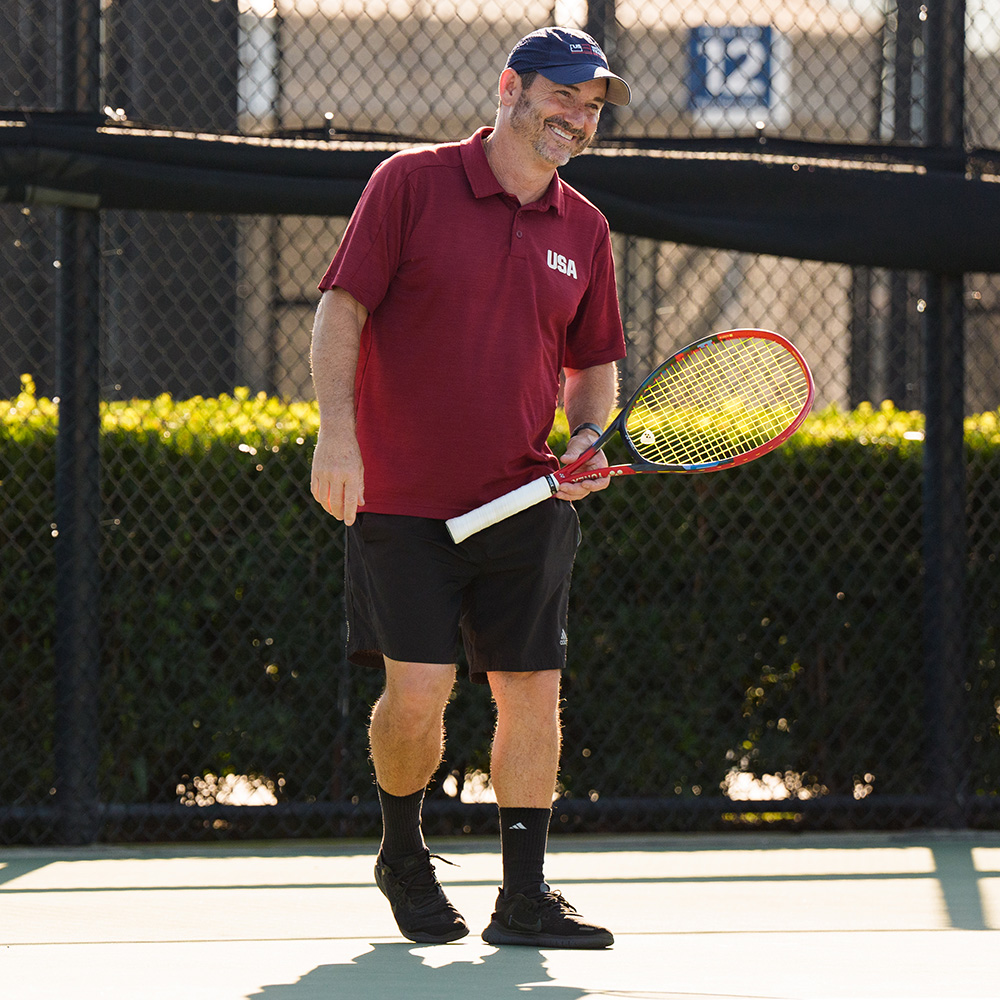
Top: Jason Harnett coaches at a wheelchair tennis clinic at the USTA National Campus in Orlando. (Photo: Conor Kvatek/USTA)
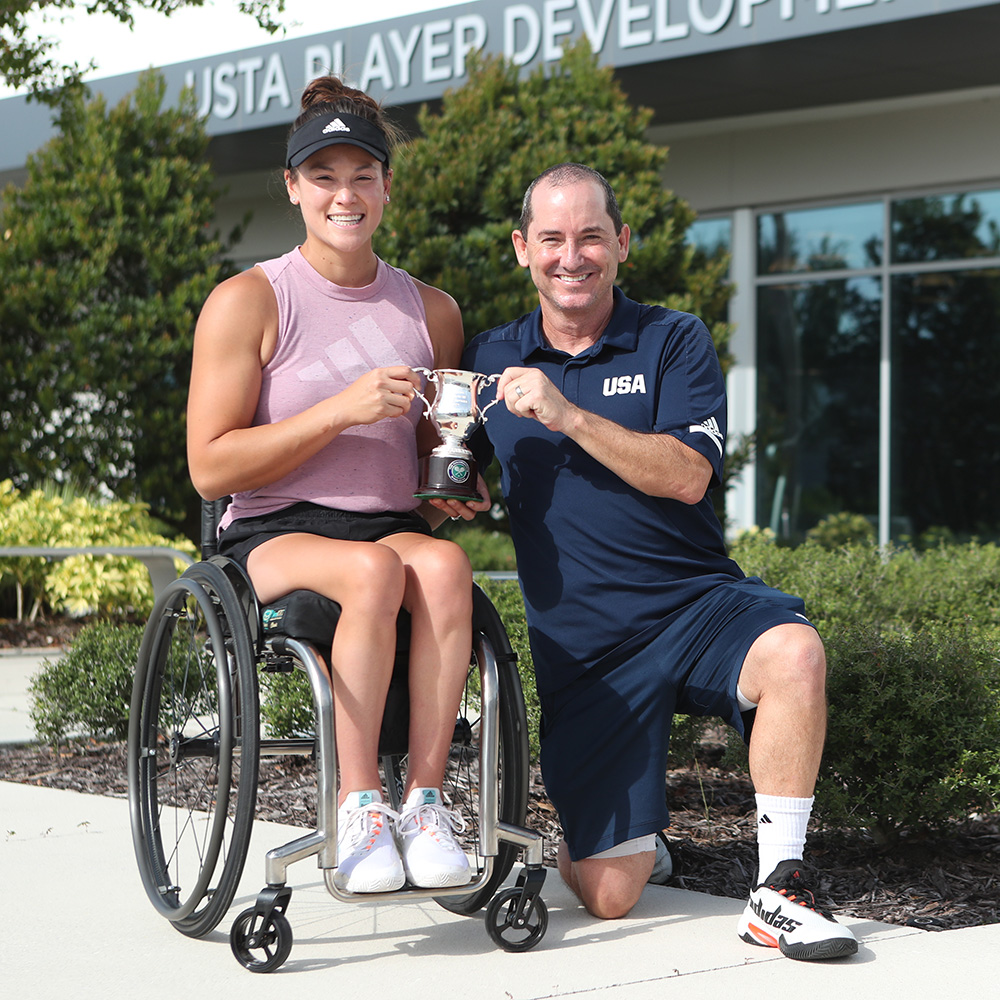
Middle: Dana Mathewson and Jason Harnett at the USTA Player Development headquarters.
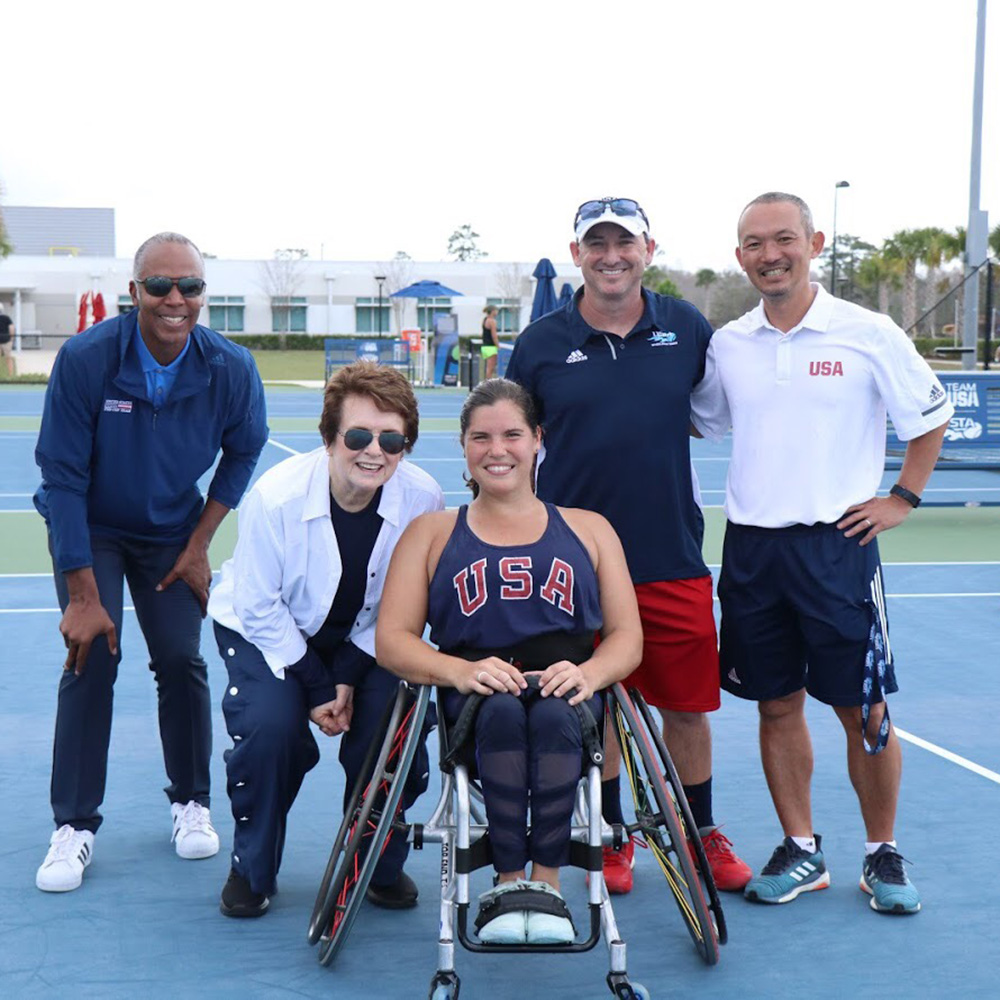
Bottom: L to R: Martin Blackman, Billie Jean King, Mackenzie Soldan, the first wheelchair athlete to live and train full time at the National Campus through Player Development, and Satoshi Ochi.
In the summer of 1984, the Olympic Games brought the world to Los Angeles, while an hour south in Orange County, 12-year-old Jason Harnett discovered a different kind of history. Expecting a routine day of tennis at his hometown tennis club, Racquet Club of Irvine (RCI), he instead found hundreds of wheelchair athletes filling the courts with an intensity that stopped him in his tracks.
“I remember it vividly,” Harnett says. “All of a sudden there’s 250, 300 wheelchair athletes everywhere. It caught me because I didn’t know anybody with a disability at school, church, or in my family. It wasn’t a common occurrence to see that many people with disabilities in one place.”
Today, as wheelchair tennis celebrates its 50th anniversary, Harnett stands as the USTA Director of Wheelchair Tennis – USA Tennis. His path from curious observer to global leader reflects the sport’s journey from a grassroots movement to the world stage.
Growing Up in a Tennis Hotbed
Harnett grew up amid a regional tennis boom in Irvine’s Woodbridge community, where he and his brothers, Pat and Dan, lived close to neighborhood courts they could reach by bike. In the 1970s and 1980s, Southern California stood alongside Texas and Florida as one of the nation’s most prominent junior pathways.
“You could play every weekend,” he recalls. “It didn’t matter what level you were playing. The culture of tennis in SoCal made it enticing to stay on the player track.”
His youth was defined by Junior Sectionals at Los Caballeros, train rides to Morley Field in San Diego, and the prestigious Ojai tournament. For Harnett, the moments around the sport mattered as much as the matches. “A lot of my favorite memories had almost nothing to do with playing,” he says. “Sometimes it was just the experience of traveling with your brother and your dad.”
Ojai, in particular, served as a rare convergence where juniors, college programs, and elite teams shared the same courts. As a high schooler, Harnett watched legends like Patrick McEnroe and Luke Jensen and set a singular goal.
“I absolutely loved The Ojai. Having the Big West, the Pac-10, and the juniors all in one place created this incredible atmosphere where everyone supported each other,” he recalls. “I remember looking at the front court at Libbey Park and thinking, ‘One day, I want to play there.’ At the time, the US Open or Wimbledon didn’t even feel like a possibility, but playing college tennis? That was the dream I could see.”
That dream came true while competing for the University of Washington, when he faced Jon Leach and Wayne Black on those very courts during the Pac-10 Championships. “You didn’t realize it at the time, but you were surrounded by something special,” he shares.
Finding Direction Through Coaching
After college, Harnett pursued coaching, a path paved by three distinct Southern California mentors. His childhood coach, Tom Luncford, taught him the art of connection, showing him how to keep kids truly engaged with the sport. Later, a pivotal year at the Vic Braden Tennis College shifted his technical perspective.
“I learned so much about coaching from Vic,” Harnett says. Victor “Vic” Braden Jr. was a master technician, using high-speed cameras and biomechanics long before they were standard. “He really put it on us to use our own teaching methods and instincts yet utilize the information he was providing because it was correct and objective.”
Yet, even with Braden sharpening his edge, Harnett’s long-term direction remained unsettled until he met Butch Young. Young viewed coaching as a responsibility to families, not just athletes. Under Young’s wing, Harnett worked with elite talents like NCAA champion Keri Phebus and PAC-10 champion and Stanford standout Geoff Abrams. The experience was an immersion in high-level structure and a masterclass in adaptability.
“Butch brought that professionalism and that understanding that every athlete is going to maybe need something different in your approach,” he says.
It was a philosophy that recognized the individual behind the athlete—a mindset that would soon define his life’s work in the wheelchair game.
The Spark and the Legacy
Wheelchair tennis existed in that same vibrant world, but it remained just outside his awareness. The memory of that day at RCI lived as a quiet hum in the background of his career, waiting to resonate. It finally did in 1995, when Braden asked him to set up ball machines for local athletes Jerry Jencks and Richard Yarborough. Braden’s seemingly simple request sparked a lifelong passion.
When Harnett and Young launched their weekly clinic in Mission Viejo, they expected a small turnout. Instead, they were met by nearly twenty players including the sport’s founder, Brad Parks. A former standout freestyle skier as a teenager, who pioneered wheelchair tennis in the late 1970s after a skiing accident, Parks had spent years establishing the legitimacy of the game throughout Southern California. For Harnett, pioneers like Parks, Steve Everett, Kelly Wong, and Bill Fairbanks were far more than historical figures because they were the community that welcomed him into the sport.
A Reciprocal Mentorship
Stepping into this world required Harnett to unlearn his assumptions. The wheelchair athletes at the Mission Viejo clinic, veterans and pioneers alike, became his teachers, guiding him through the engineering of tennis chairs, the equipment, movement, and the nuances of the adaptive game.
“We call that reciprocal mentorship,” Harnett explains. “They shared their world with me that I didn’t know… and I think they saw me as a young able-bodied coach with some skills who could help them.”
As the clinic grew, Harnett realized the community was the primary draw. “If I had had a bad experience with them, I probably would have found my way out,” he explains. “But it was so positive that it confirmed this is where I was supposed to be.”
What began as curiosity turned into routine, and routine into a deeper sense of responsibility within the sport. At the time, he was still coaching across all levels of able-bodied tennis, but he began to see a structural gap: the sport had plenty of volunteers but lacked formally trained professionals to elevate development. For him, closing that gap became a personal mission.
“It just wasn’t going to become what it is today without young professionals coming in and helping raise the level,” he shares.
Learning Through Community
Entering wheelchair tennis gave him access, but what came next required something different. He had to rethink how progress worked for different athletes and listen in ways he had never needed to before.
“I had to slow down,” he says. “I had to become a better listener.”
Each athlete brought a unique perspective, shaped by different physical realities. Harnett found that there was no universal approach. “You can’t generalize,” he observes. “Two players might both be in wheelchairs, but their lives and needs can be completely different.”
Harnett found himself learning as much as he was teaching. The experience reshaped how he viewed leadership, emphasizing adaptability and empathy. It also revealed a larger truth about accessibility; as his involvement grew, he saw that many clubs were simply not equipped to support these players. “Everyone’s invited,” he says. “Until you get to a place where they say, ‘We don’t have anything for you.’”
Rather than stepping away, he used the Mission Viejo clinic as a foundation for what inclusive programming could look like when done intentionally. “I saw that the community was starving for it,” he explains.
From Local Courts to National Impact
In 1998, Harnett joined the USTA wheelchair national coaching staff, a move that coincided with a historic shift: the USTA became the first national governing body in the world to manage wheelchair tennis. “I knew I was in it for the long haul,” he says.
His career has since mirrored the staggering growth of the sport. After wheelchair tennis became a medal sport at the 1992 Paralympic Games in Barcelona, the game expanded across all four Grand Slams. Over the decades, his role has spanned the globe—from the World Team Cup to multiple Paralympic Games—yet his focus often returns to the Southern California talent shaped by this system. He has watched local stars like David Wagner (Chula Vista) and Dana Mathewson (San Diego) become world-class icons, while a new generation, including La Quinta’s Charlie Cooper, prepares to take the mantle.
Despite the sport’s move from local clinics to international stadiums, Harnett’s core motivation remains grounded. “It’s always the people that keep you in it,” he says.
The “RCI” Philosophy and the “Box Check”
Harnett’s leadership is defined by a refusal to settle for optics or simple “box-checking” by organizations. He often notes the irony that his career began at RCI, as he now uses those letters to define his vision for the sport’s future.
To him, R stands for Relationships: “You start everything with relationships… building trust and figuring out what makes them tick.” C represents Collaboration, because, as he says, “We’re better together than we are apart. You prove that proof of concept by us coming together.” Finally, I stands for Integration, the ultimate goal: “There is nothing beyond that. We’re now one team working together, strategizing together, building budgets together…because we all buy into one common vision.”
This drive for integration is born from a frustration with shallow “inclusivity.” “I didn’t want to be isolated or segregated anymore,” Harnett says. “Sometimes organizations do a ‘box check’—you put out a little post…but what do you really do? We want skin in the game in every business unit.”
He recalls a masterclass in this kind of instinctual storytelling when colleague Amy Barnhart strategically slipped wheelchair slides into a presentation for Billie Jean King. “Billie Jean saw the athlete and went, ‘Whoa, whoa, hold on…’ She went on for eight minutes,” Harnett recalls. “Amy knew the room, she knew how Billie Jean thinks, and she knew she’d stop.” To Harnett, this intentional exposure is what brings these athletes to the “kitchen table” to finally become household names.
Transformative Figures and the “Mecca” Legacy
As the sport evolves, Harnett reflects on the “transformative figures” on wheelchair tennis’ Mount Rushmore. Beyond the pioneering work of Brad Parks and the magnetic superstar personality of Randy Snow, he credits David Hall and Esther Vergeer with bringing elite professionalism to the game. He also highlights Rick Draney, who championed the Quad Division, a “minority within a minority” with upper-body deficits, to ensure their place in the sport was legitimized.
Harnett describes the bond between these athletes as something unique. “I really do compare it to combat veterans,” he says. “If you had a room of a thousand able-bodied people but two people in wheelchairs, they’d find each other from across the room… that’s the connectedness.”
The “Mecca” of the sport remains Southern California, the place where it all began in Mission Viejo and Irvine, and that legacy continues to fuel a global expansion. Junior participation is exploding, driven by the inclusion of junior divisions at Grand Slams. Harnett personally advocated for this at the US Open to ensure wheelchair kids weren’t hidden on back courts, but were instead given a stage to show they are the next generation of greats.
Building the Future
Wheelchair tennis is entering a new era, bridging grassroots clinics and the professional stage. For Harnett, this growth is about breaking barriers of perception: “Anyone who loves high-level tennis will love the wheelchair game.”
The next frontier is the collegiate game. With the Intercollegiate Tennis Association (ITA) now governing the sport, the push for official NCAA status is underway. Central to this is the USOPC/NCAA Para-College Inclusion Project, a joint effort with the USOPC and NCAA to recognize wheelchair tennis, para-track and field, and wheelchair basketball as the first intercollegiate para-sports. Harnett has been strategic, even inviting Jean Merrill from the NCAA’s Office of Inclusion to the USTA National Wheelchair committee to ensure the sport fits “like a glove” within the collegiate structure.
For Harnett, the mission transcends the court. “Sending a thousand juniors to college to get a degree is the goal.” He is troubled by the stark reality that nearly four out of five people with disabilities do not have a college degree, a barrier that contributes to the 75% of the community who are currently not in the workforce. “What community tolerates that?” he asks. “Tennis could be a pathway to a degree so they can buy a house and join society. Otherwise, you’re on the sidelines. It’s not okay.”
Looking ahead, Harnett envisions a professional tour with complete integration, sharing the same pensions, healthcare, and stages as able-bodied counterparts. He encourages fellow coaches to lean in, noting they already possess 80% to 90% of the necessary knowledge. “They’ll learn the rest through experience,” he says.
What began as a way for individuals to play alongside family has evolved into a global sport featured at all four Grand Slams and the Paralympics. “I don’t think Brad [Parks] ever dreamed it would get to this level,” Harnett says. Four decades after that first day at the Racquet Club of Irvine, his mission remains clear: ensuring that for the next young player watching, the moment grows into a lifelong purpose.