

In or Out? A Conversation on Sportsmanship
and Gamesmanship
USTA SOUTHERN CALIFORNIA
USTA SOUTHERN CALIFORNIA
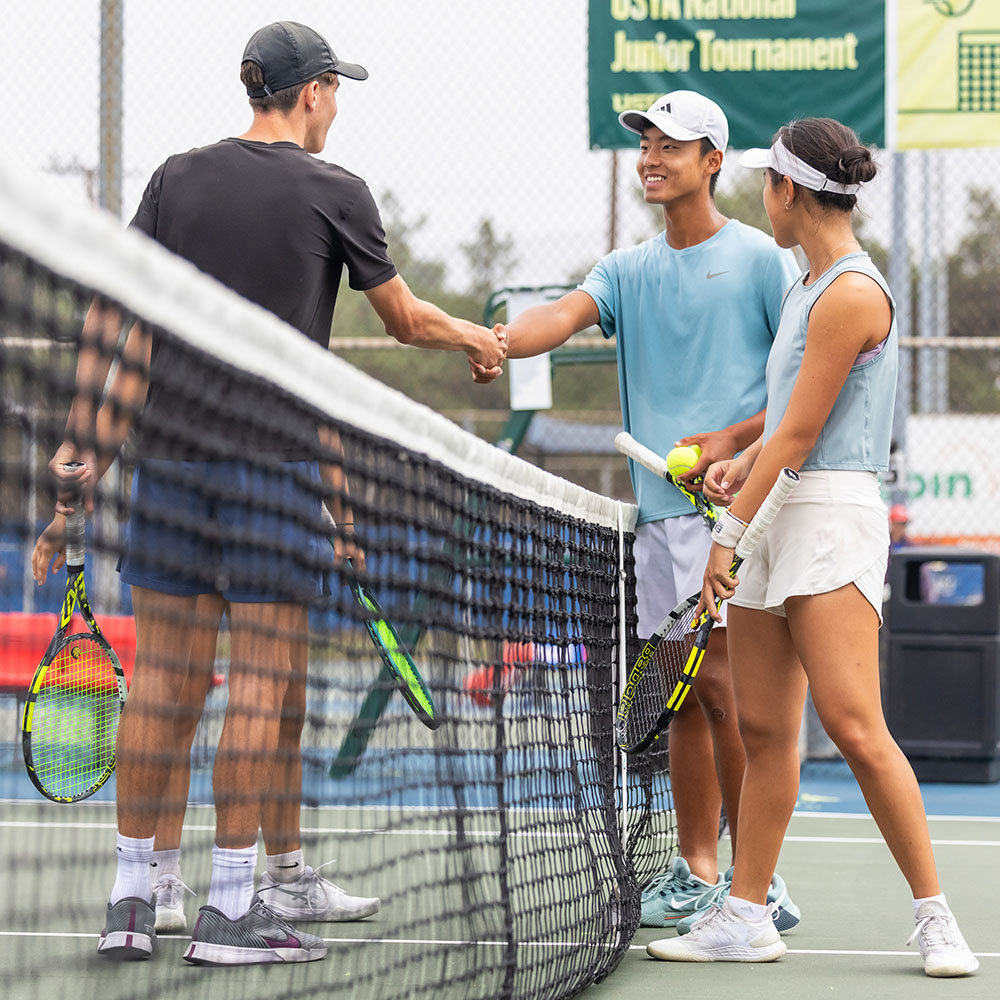
Above: Player shake hands at the net after a match at Junior Doubles Sectionals in Lakewood. (Photo – Jon Mulvey/USTA SoCal)
Match point. You’ve got one serve left and everything on the line. The ball clips the line—but it’s called out. You pause. No one saw it clearly. No one’s going to stop the match. It’s your word against theirs. But deep down, you know the truth.
Do you argue? Do you accept it? Do you do the same next time?
This isn’t just about a point. It’s about what kind of player you are, because the scoreboard tells one story and your choices tell another.
In tennis, character is as visible as a backhand winner. Every close line call, handshake, eye roll, or delay tactic leaves an impression, not just on the scorecard, but on everyone watching. People notice. From junior tournaments to center court at Wimbledon, how you play the game can matter as much as whether you win it.
That’s what makes tennis both beautiful and, at times, complicated.
Honor on the Line: What Is Sportsmanship?
Sportsmanship is about respect—for your opponent, for the officials, for the coaches, for the rules, and for the game itself. It shows up when a player corrects a call in their opponent’s favor, claps after a dazzling rally, or when they show genuine appreciation for a great point, even if it means losing it.
It’s a quiet kind of strength. One that says: I value the game more than the scoreboard.
This behavior reflects more than just who you are on court. It echoes into locker rooms, car rides home, and the minds of everyone who sees it.
Mind Games at Match Point: What Is Gamesmanship?
Gamesmanship, on the other hand, thrives in the gray areas of competition. It’s the art of gaining an advantage by pushing the boundaries of what’s acceptable without technically breaking any rules. This can include tactics like taking extra time between points to disrupt an opponent’s rhythm, repeatedly questioning line calls to plant seeds of doubt, or calling “not ready” just as an opponent is about to serve. Some players may use exaggerated grunting, pacing, or over-the-top celebrations as a way to rattle nerves.
While none of these actions violate the rulebook outright, they often go against the spirit of fair play. And in a sport where matches are decided by inches and milliseconds, the temptation to gain even the smallest edge—even in ethically murky ways—is very real.
The Fine Line: When Gamesmanship Helps and When It Hurts
Gamesmanship isn’t always a negative thing. When used with the right mindset, it can serve as a useful part of a player’s overall strategy. At its best, it reflects a player’s ability to stay composed and mentally tough during moments of pressure.
In these cases, the focus is on managing one’s own emotions and energy. A player might take a few extra seconds before a serve to breathe, follow a consistent routine to stay calm, or use confident body language to remain focused. These habits are not meant to interfere with an opponent but to maintain control of the moment.
The concern arises when the purpose of these actions changes. If a tactic is used to disrupt an opponent’s rhythm or throw them off mentally, it starts to move away from fair competition. Even if it doesn’t violate a rule, it can undermine the respect and integrity that tennis relies on.
The difference comes down to intention and outcome. Is the behavior helping the player stay centered, or is it being used to unsettle the person on the other side of the net? The answer doesn’t just reflect a strategy, it reveals a set of values.
A Moment to Remember: Lucas Cortez-Jin at El Dorado
At the USTA National Level 2 Boys’ 12s semifinal on May 19 at El Dorado Tennis Center, longtime Official and Sportsmanship Committee member Marcia Jones served as Chair Umpire for a thrilling match between the No. 4 seed Matthew Kolomeyer and unseeded Lucas Cortez-Jin.
Both players had already taken tumbles during the intense match, but one moment stood out above all.
Lucas hit a sharp shot. Matthew dove near the net to return it. Lucas followed up with what appeared to be a clean cross-court winner. Marcia awarded the point to Lucas and called the score, but what happened next surprised everyone.
“He looked at me and said, ‘No, I think Matthew was ahead. That was a double bounce for sure. He won that point.’”
Marcia, stunned, admitted she hadn’t seen the double bounce.
“I missed the call. And with Matthew rolling and tumbling, I’m not sure he saw it either. But Lucas did. And he owned it immediately.”
In the middle of a national semifinal, with everything on the line, Lucas made a choice that brought the crowd to its feet.
“Now that is what good sportsmanship is all about,” Marcia said.
It wasn’t a highlight-reel winner or a match-clinching point. It was something better, a moment that showed integrity isn’t just part of the game, it is the game.
That’s the kind of sportsmanship that stays with you, long after the final score fades.
Why This Matters, Especially for Juniors
Simply put, young players are always watching, taking mental cues from what they see. From what happens on court to what’s whispered in the stands, they’re picking up messages about what matters most.
When they see pros and parents put integrity first—competing fiercely, yet fairly—it teaches that ambition and ethics can coexist. But when they see gamesmanship and bending rules rewarded, it sends a different message: winning is everything.
That’s not the legacy tennis wants to build.
An Interview with Chuck Kingman, Chair of the USTA SoCal Sportsmanship Committee and Head Coach at Marina High School
To gain insight from someone leading the charge for integrity in tennis, we spoke with Chuck Kingman, Chair of the USTA Southern California Sportsmanship Committee and Head Coach at Marina High School. With decades of experience as a coach, official, and mentor, Chuck has seen firsthand how sportsmanship and gamesmanship play out on today’s courts.
When asked how he reinforces sportsmanship in high-pressure moments, he shared:
“I emphasize the importance of sportsmanship, character, and fair play whenever I’m working with a player. Hopefully, this has an impact on the player’s decision-making when faced with those moments on the court.”
On the subject of gamesmanship, Chuck noted that while it’s not new, it’s taken on new forms:
“Gamesmanship has always been around. Today, players, parents, and coaches know the rules and know how to manipulate them to try and gain a competitive advantage, which is the definition of gamesmanship.”
Chuck emphasized that parents play an essential role in shaping young athletes’ integrity:
“Parents are the most important influence a young person has in instituting character and integrity, whether that young person is an athlete or not. Parents are also responsible for making sure that the coaches who are chosen to work with their kids have these values as well and instill and reinforce them in the players they coach.”
Despite the challenges, he says the good still outweighs the bad:
“I see many instances of good sportsmanship every day when I’m on the court. Players competing fairly, treating their opponents with respect, and displaying good sportsmanship in both victory and defeat. Unfortunately, sometimes the lack of sportsmanship from both players and parents has a tendency to overshadow all of the great things tennis has to offer our young players.”
Chuck’s message is clear: the values we model and reinforce today shape how our athletes compete tomorrow. It starts with honest conversations and a commitment to doing things the right way.
What Parents Allow, Players Learn
Let’s be honest: a lot of gamesmanship doesn’t start with the players—it starts with the adults watching from the sidelines. Parents and coaches often have more influence than they realize. When they stay silent after a missed call, quietly applaud questionable tactics, or brush off poor behavior with a shrug and a “well, everyone else does it,” they’re sending a powerful message—louder than any coaching tip ever could. That message? Winning matters more than integrity. And in a sport where character is shaped as much as strokes, that lesson runs deep. For every child learning how to hit a forehand, there’s a parent (consciously or not) teaching them how to carry themselves.
But influence doesn’t come from shouting across the net or debating line calls. It comes from example. Parents don’t have to coach from the sidelines to shape their child’s game, they do it by showing what it means to compete with class, grace, and respect, even when the pressure is on. The values reinforced today become the foundation of how a young athlete competes tomorrow—not just in tennis, but in everything they do. It’s not about policing every point or correcting every misstep. It’s about showing, day in and day out, what true sportsmanship looks like.
Tennis Officials and the Gray Areas
Officials do their best to enforce fairness, but even they are limited when behavior lives in the margins. Gamesmanship thrives in places that are hard to penalize but easy to feel. It makes officiating more difficult, tensions run higher, and trust in the game erodes.
That’s why promoting a culture of integrity is not just a player’s job—it’s on everyone: coaches, parents, tournament directors, and fans alike.
Serving Up Match Point: What Kind of Competitor Will You Be?
Sportsmanship won’t always win the match. But it wins respect. It builds community. And it creates a game that’s bigger than any one player.
Gamesmanship might work in the short term—but it erodes the very foundation of fair competition. Over time, it breeds distrust, resentment, and regret.
Tennis is scored in love and advantage. May we always strive to honor both.
So the next time you’re at the baseline, one point away from the win, and the ball lands close to the line—ask yourself not just what you saw, but who you want to be.
Because in the end, how you win matters just as much as winning itself.