


Braun Levi’s Legacy Lives On Through Braun’s Law
USTA SOUTHERN CALIFORNIA
USTA SOUTHERN CALIFORNIA

Jenn Levi, mother of Braun Levi, sits alongside California Governor Gavin Newsom as he signs “Braun’s Law” (SB 907) and a broader package of legislation cracking down on repeat DUI offenders.
(Photo – Trent Barboza and Susanna Gill Photography)
There are many ways a community can remember someone. For Braun Levi’s family, friends, teammates, coaches, and the countless people who have come to know his story, remembering him has never meant simply looking backward. It has meant moving forward: showing up, playing tennis, giving back, supporting young people, creating opportunities for others, starting conversations about impaired driving, and finding joy in the same way Braun did. It has meant choosing, again and again, to Live Like Braun.
Now, that legacy has reached California law.
On September 25, 2026, Governor Gavin Newsom signed Senate Bill 907, which includes a provision known as Braun’s Law, named in honor of Braun Levi, the 18-year-old Loyola High School student, nationally ranked tennis player, team captain, and beloved member of the Southern California tennis community whose life was cut short in May 2025.
For the people who knew Braun, the signing represents another milestone in a story that began on Southern California tennis courts and has since reached high school campuses, college athletic programs, professional tennis tournaments, the US Open, communities across the country, and now the California State Capitol.
At the center of that story is Braun’s mother, Jennifer “Jenn” Levi, who has spent the past year and a half finding ways to honor her son’s life while helping others understand the person behind the name.
Before There Was a Law, There Was a Legacy
Long before Braun’s name appeared in legislation, it was already woven into Southern California tennis. Braun grew up playing junior tennis throughout the region and developed friendships that stretched from childhood tournaments to high school competition. He competed in USTA Junior Team Tennis Sectionals from 10 & Under through 18 & Under. At Loyola High School, he became a four year varsity starter and three year captain, helping the team win four consecutive league championships. He was also a student leader, mentor, volleyball manager, and member of USTA’s Youth Leadership Council during the 2022-2023 term.
Yet those who knew Braun best rarely start with rankings or trophies. They talk about his magnetic smile, contagious enthusiasm, unwavering commitment to his friends, instinct for making newcomers feel welcome, and habit of showing up for the people around him. He had a rare ability to make even a fierce, high-stakes athletic environment feel like a warm and supportive community. That is what made Braun’s story resonate so deeply.
When Braun’s life was tragically cut short in May 2025, that sense of community became an outpouring of solidarity across Southern California. In the weeks that followed, Live Like Braun Levi: The Bright Legacy of Loyola High School’s Tennis Star captured the early response from the tennis community and the growing effort to honor Braun by carrying forward the qualities that defined him.
That spirit soon showed up on the court. At Loyola’s CIF Southern Section Open Division playoff match against Harvard Westlake, players from both teams wore Live Like Braun shirts, while Braun’s longtime friend and doubles partner, Cooper Schwartz, took the court carrying Braun’s racquet in a deeply moving tribute. The match became about more than a result. It became a way for a tennis community to stand together.
As that support continued to grow, A Community’s Commitment to Live Like Braun Levi documented how Braun’s friends, teammates, coaches, and fellow players were turning remembrance into action, creating a movement rooted in his spirit, kindness, and ability to bring people together. What began with a community mourning the loss of one of its own evolved into a lasting commitment to honor Braun through meaningful action and continued connection.
“Living like Braun is being a connector, not a disrupter. Living like Braun is bringing smiles to those who are having a bad day. Living like Braun is the pursuit of an unachievable balance between life in the classroom, on the court, and on the dance floor,” said Cooper Schwartz. “If I can live 1 percent of the life Braun lived for, I’d call that a great life. Levi/Schwartz forever.”
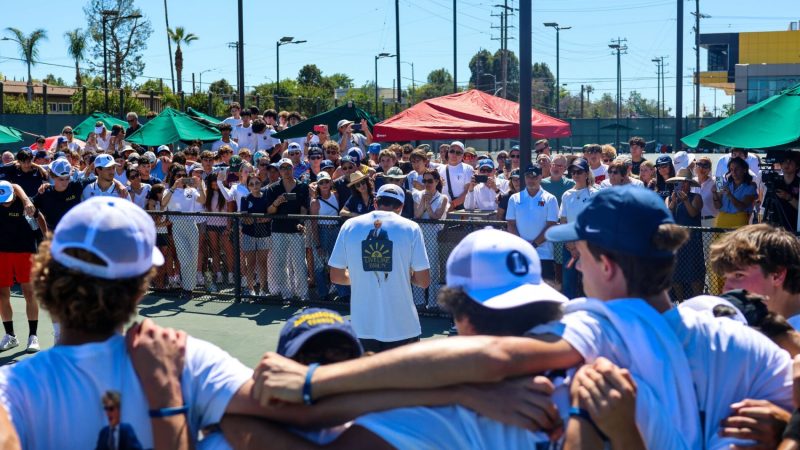
Friends, family, and teammates showed up to support Loyola Tennis at the 2025 Open Division playoffs. (Photo – Loyola High School Athletics)
Jenn Levi: Turning Grief Into Purpose
For Jenn, carrying Braun’s legacy forward has meant something different. It has meant learning how to live with a loss she never could have imagined while finding a way to make that loss meaningful for other people. The Levi family had already lost its Pacific Palisades home in the 2025 Palisades Fire. Months later, on May 4, 2025, they lost Braun. In December 2025, Jenn stood alongside Los Angeles County prosecutors and publicly called for changes to California’s DUI laws. She spoke openly about the devastation of losing her son and vowed to work with lawmakers to pursue reform. “His death haunts my every breath, every day,” Jenn told the Los Angeles Times at the time. She also said that the experience of identifying her son’s body would never leave her and that she would not remain silent.
That moment became the beginning of a new chapter in Jenn’s life. She had never planned to become a legislative advocate or imagined herself walking into meetings with senators, prosecutors, district attorneys, legislative staff, consultants, and lawyers. But grief gave her a new sense of urgency.
In an August 2026 essay for Maria Shriver’s Sunday Paper, Jenn reflected on what happened to her after Braun’s death. People often tell her she is strong, she wrote, and ask how she finds the courage to continue. But Jenn does not describe herself as stronger because of tragedy. Instead, she says she is permanently changed. “I didn’t find courage or strength in the face of my fears; I lost my fear,” she wrote.
That distinction has shaped everything she has done since. Jenn began walking into rooms she never expected to enter. She spoke at press conferences, met with lawmakers, shared Braun’s story, and learned about California’s DUI laws and the gaps she believed had contributed to the circumstances surrounding his death. And when she was told no, she kept going. For Jenn, the answer became surprisingly simple. “I think once the worst thing that can happen to you has already happened, the word ‘no’ becomes a lot less frightening,” she said. “I had already lost my son. A difficult meeting, a bureaucratic roadblock, somebody telling me it was impossible, none of that could hurt more than what had already happened.” There were still moments when she questioned whether one mother could really change California law. “But then I would think about Braun and about the fact that he didn’t get another chance,” she said. “I knew that if there were gaps in the law that could be closed, I had to keep pushing.”
So she kept showing up. “I asked questions. I learned a system I knew nothing about. I called people again and again. And eventually, ‘too difficult’ became law,” she explained.
For Jenn, that persistence has never meant that grief disappeared. There are still days when she does not want to leave the house. “There are mornings when I would much rather stay home, cry, walk my dogs and disappear from the world for a little while,” she said. But showing up does not mean she is not grieving. “I can be devastated and productive at the same time,” Jenn said. “I can miss Braun every second and still walk into a room and fight for somebody else’s child.”
She also thinks about what Braun would expect from her. “He lived with so much energy. He participated in life. He spoke up. He loved people,” she said. “I don’t think honoring him means becoming frozen in the moment we lost him. I think it means continuing to participate in life the way he did.” Some days, she said, she shows up feeling powerful. Other days, she is barely holding it together. “Both count,” she said. “I’ve learned that courage isn’t always feeling brave. Sometimes courage is simply getting dressed, walking through the door, and saying, ‘Okay. What can I do today?’”

The Southern California community came together for a heartfelt paddle-out following Braun’s passing. (Photo – Bo Bridges)
Keeping Braun’s Spirit on the Courts
Over the past 18 months, tributes have expanded from local high school courts to college programs and the biggest stages in professional tennis. At the 2025 US Open, Jenn, Braun’s father Dan, and his sister Adelle were invited onto Arthur Ashe Stadium for the coin toss ahead of Novak Djokovic’s fourth round match against Jan Lennard Struff. The moment carried an especially meaningful connection for the Levi family. Years earlier, when Braun was just 8 years old, he had worked as part of the ball crew at a UCLA exhibition featuring Djokovic. During that event, Djokovic handed Braun his racquet and encouraged him to play a point. Years later, Braun’s family stood on one of the biggest stages in tennis in his memory.
Professional tennis player Emilio Nava has also carried Braun’s name around the world. Nava, who grew up in Woodland Hills, began wearing a Live Like Braun patch on his sleeve during the 2025 clay court season and continues to use his platform to raise awareness about Braun’s story and the dangers of impaired driving.
The tributes have not been limited to professional tennis. Braun’s connection to volleyball created another opportunity for athletes to celebrate his life. In March 2026, UCLA and USC men’s volleyball came together for Live Like Braun tribute matches, with players from both programs wearing Live Like Braun shirts and using the rivalry as an opportunity to honor Braun. Braun had served as a manager for Loyola’s boys volleyball program, and many of the athletes he supported went on to compete at UCLA and USC. In a sport separate from the one where Braun made his name, his influence was still bringing people together.
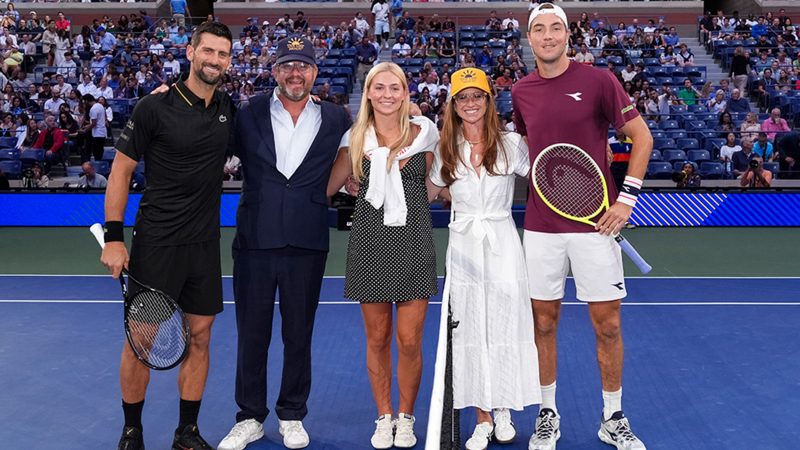
The family of Braun Levi, father Dan, sister Adelle, and mother Jenn Levi, pose with Novak Djokovic and Jan-Lennard Struff before a men’s singles match at the 2025 US Open. (Photo – Darren Carroll/USTA)
Bringing Braun Home Through Tennis
Perhaps nowhere has Braun’s tennis legacy been more visible than at the Live Like Braun Memorial Tournament. The first tournament was held in August 2025 on what would have been Braun’s 19th birthday. More than 300 people attended, with more than 140 players taking the court for hours of live ball doubles. USTA Southern California helped support the event, bringing together the community Braun grew up in for a day centered on the sport he loved and the people who made it meaningful.
The tournament returned to Peninsula Racquet Club in August 2026, on the eve of what would have been Braun’s 20th birthday. The event brought together 120 players and approximately 250 attendees for five rounds of doubles, laughter, competition, and camaraderie. In 2027, the third annual Memorial Tournament will return to the Palisades, the community Braun called home for most of his life.
For Jenn, the tournament has become something much larger than a memorial. “[It] has become so much more than tennis; it’s like a big family reunion,” she said. “It is one of those rare days when grief and joy are allowed to exist right next to each other.”
“We miss Braun desperately, but we are also surrounded by people laughing, competing, hugging, telling stories and being together, and that feels exactly like him,” she added.
Braun loved tennis, Jenn said, but even more than that, he loved people. “Tennis was one of the ways he connected with them.”
Bringing the tournament back to the Palisades next year will be especially emotional for the Levi family.
“That community raised Braun. It was his home for most of his life, and after everything our family and the Palisades have lost, returning there feels like coming full circle,” Jenn said. “What began as a memorial is becoming a tradition. And I love that.”
The tournament has become a way for the people who knew Braun, and those who have come to know his story, to gather around the things he loved most: tennis, friendship, competition, laughter, and connection.
“Because every year people will step onto those courts, say Braun’s name, reconnect with one another and hopefully leave wanting to live a little more like he did, with courage, kindness, inclusivity, joy and love,” Jenn said. “That is exactly what we want Live Like Braun to be.”
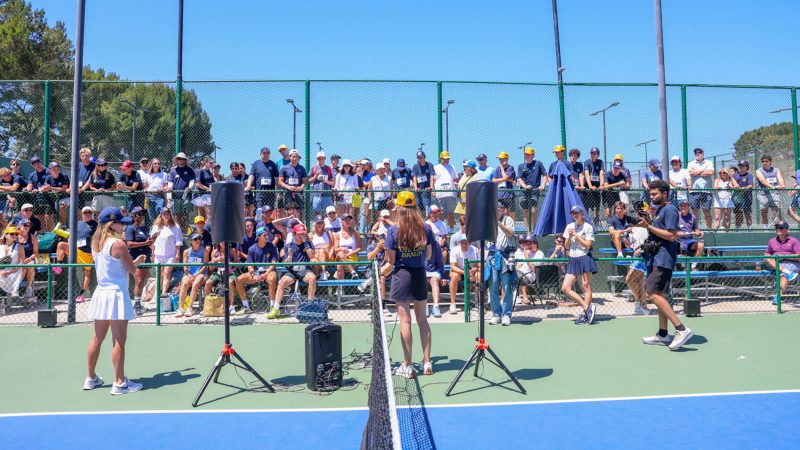
Jenn Levi addresses a large crowd of participants and supporters gathered at the second annual Live Like Braun (LLB) Memorial Tennis Tournament. (Photo – Olivia Sullivan)
Honoring How Braun Played
That same philosophy lives on through the Braun Levi Memorial “Live Like Brauny” Award, which recognizes participants who embody the qualities Braun brought to tennis and to the people around him. The award celebrates joy, sportsmanship, support, connection, and the kind of competitive spirit that makes everyone around you better.
For Jenn, seeing those qualities recognized in young players is especially meaningful. “It means everything because tennis was such a huge part of Braun’s life, but what made me proudest was never simply whether he won,” Jenn said. Of course, Braun loved winning. He was incredibly competitive. “But Braun understood something bigger about sports. He understood that how you make people feel matters.”
One of Jenn’s favorite memories is watching Braun walk to the net after a match. “Whether he won or lost, that Braun smile was often there as he took off his hat and shook hands with his opponent,” she said.
That is why recognizing young players for more than rankings or trophies feels so true to Braun. “For young players to now be recognized not simply for rankings or trophies, but for sportsmanship, joy, kindness and connection, that feels incredibly true to him,” Jenn said.
“There will always be another tournament and another champion. But the way you treat people stays with them. If young players hear Braun’s name and think, ‘Be competitive. Be courageous. But also be kind,’ then that is a legacy our family is incredibly proud of,” she continued.
Because Braun’s legacy is not simply about how good he was at tennis. It is about the kind of teammate he was, the kind of opponent he was, the kind of friend he was, and the kind of person he chose to be.
The Live Like Braun Foundation: Purpose in Action
To channel that momentum into lasting impact, Braun’s friends and family established the Live Like Braun Foundation as a tax-exempt charitable organization, creating a way to carry his values forward through opportunities for young people and communities. Kept strictly nonpartisan and independent from legislative lobbying, the foundation focuses on three core areas: youth opportunity, public tennis access, and impaired driving prevention.
In 2026, the foundation awarded its inaugural class of 12 Live Like Braun Scholarships, providing financial support to students pursuing a range of higher education and vocational paths. The foundation also honors Braun’s love of public tennis courts through grants and repair projects aimed at restoring public tennis facilities and expanding access to free, high-quality places to play, particularly for under resourced youth. Its third focus is impaired driving prevention, with peer focused educational programs and high school workshops designed to help young people understand the consequences of impaired driving before they get behind the wheel.
The foundation’s work has also created additional ways for people to participate in Braun’s legacy. Its Run Like Braun team brought together runners, volunteers, and donors from across Southern California for the Los Angeles Marathon, while custom athletic gear collaborations have helped support the foundation’s community grant programs. Together, these efforts reflect the values Braun brought to the people around him: creating opportunity, bringing people together, and helping young people find their own paths forward.
And for Jenn, that work represents something deeply personal. “I never wanted Braun’s name to become synonymous only with the way he died,” she said. “He was so much bigger than the worst thing that happened to him. He was kind, funny, mischievous, inclusive, competitive, generous and completely alive.”
Through Live Like Braun Foundation, she said, his name gets to represent possibility. “Scholarships, young people getting opportunities, kids learning to make safer choices, tennis, friendship, community and joy.”
And through Braun’s Law, his name also represents protection.
“So in one place his legacy is saying, ‘Go live fully.’ And in another it is saying, ‘Your life matters, and we should do everything we can to protect it.’ To me, that feels like a much more complete reflection of who Braun was.”
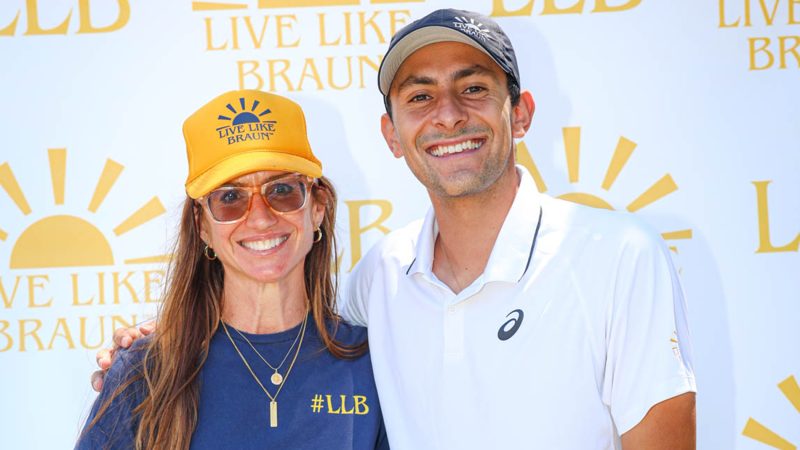
Jenn Levi and Emilio Nava at the second annual Live Like Braun (LLB) Memorial Tennis Tournament. (Photo – Olivia Sullivan)
A Separate Stand for Accountability: Braun’s Law (SB 907)
Separate from the foundation’s charitable work, Braun’s name is now part of California legislation. On September 25, 2026, Governor Gavin Newsom signed Senate Bill 907, known as Braun’s Law, as part of a package of legislation addressing repeat DUI offenses. The provision is named in honor of Braun, who was struck and killed by a suspected repeat drunk driver while walking in Manhattan Beach in May 2025. At the time, Braun’s family had recently relocated to Manhattan Beach after their Pacific Palisades home was destroyed in the 2025 Palisades Fire.
Authored by Senator Bob Archuleta, SB 907 addresses what lawmakers and prosecutors identified as a gap in California’s DUI laws. The law focuses on the Watson advisement, a formal warning given to people convicted of DUI that impaired driving is extremely dangerous to human life and that driving impaired again and causing a death can lead to a murder charge. Before Braun’s Law, that warning was generally tied to DUI convictions. When a DUI case was resolved through a plea to a different or lesser offense, the same formal advisement was not necessarily given.
Braun’s Law changes that. Drivers whose DUI charges are pled down to a lesser or different charge must still receive the formal warning about the consequences of driving impaired again. The goal is to ensure that the warning remains part of the record even when the original DUI charge is resolved through a different offense.
That distinction is central to why the legislation carries Braun’s name. According to the Los Angeles County District Attorney’s Office, the legislation was developed in response to concerns surrounding repeat impaired driving and the consequences that can follow when an earlier DUI case is resolved without a Watson advisement. The office supported SB 907 alongside the Orange County District Attorney’s Office, Mothers Against Drunk Driving, and the California Safe Roads Coalition.
SB 907 is broader than Braun’s Law alone. The legislation also strengthens penalties for certain repeat DUI offenses and increases penalties for some hit and run offenses involving drivers with qualifying prior DUI or vehicular manslaughter convictions.
For Jenn, getting the legislation across the finish line required continuing to show up even when the process felt overwhelming. She had asked herself whether one mother could really change California law, and her answer came through persistence.
“I knew that if there were gaps in the law that could be closed, I had to keep pushing,” she said. “I kept showing up. I asked questions. I learned a system I knew nothing about. I called people again and again. And eventually, ‘too difficult’ became law.”
Following the signing, Jenn thanked Governor Newsom and the First Partner, Senator Archuleta, and the Los Angeles County District Attorney’s Office for their support of SB 907 and Braun’s Law.
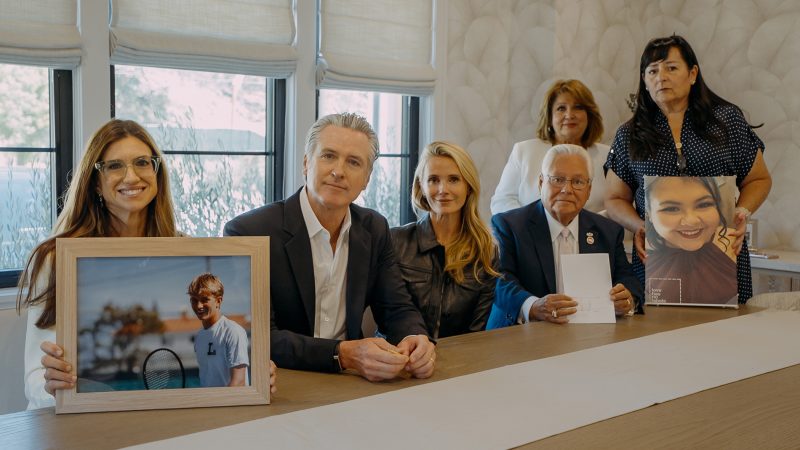
Jenn Levi, California Governor Gavin Newsom, First Partner Jennifer Siebel Newsom, and victim advocates pose together at a conference table for the signing of “Braun’s Law” (SB 907) and related DUI legislation. (Photo – Trent Barboza and Susanna Gill Photography)
A Legacy That Keeps Moving
Braun’s Law cannot change what happened to Braun. It cannot return him to his family or erase the loss his loved ones continue to carry. But his name now appears in California law because his story became part of a larger conversation about impaired driving and the consequences of repeat offenses.
And that is only one part of what his community has built in the 18 months since his death. His name has appeared on tennis courts, volleyball courts, professional tennis apparel, scholarship announcements, community events, and now in the California State Capitol. His friends continue to play. His teammates continue to compete. The young athletes he mentored continue to grow. The people who knew Braun have continued to find ways to celebrate the qualities that made him who he was.
A tennis community lost one of its own, but it did not let his story end there. It kept playing, showing up, and finding ways to create something meaningful from the life Braun lived. And now, more than a year after his death, his legacy has reached a place few could have imagined when he first stepped onto a Southern California tennis court.
For Jenn, seeing Braun’s name connected to both the foundation’s community work and the passage of Braun’s Law represents the two sides of the legacy her family has worked to build. Through one, Braun’s name represents possibility, connection, opportunity, and joy. Through the other, it represents protection. Together, they offer a reflection of a life that was always bigger than the tragedy that ended it.
Braun’s story keeps moving. His name keeps traveling. And his community keeps showing up.
Live Like Braun.

Braun Levi smiles on the court.