

More Than Records: Inside Dana Mathewson’s
Lasting Influence
USTA SOUTHERN CALIFORNIA
USTA SOUTHERN CALIFORNIA
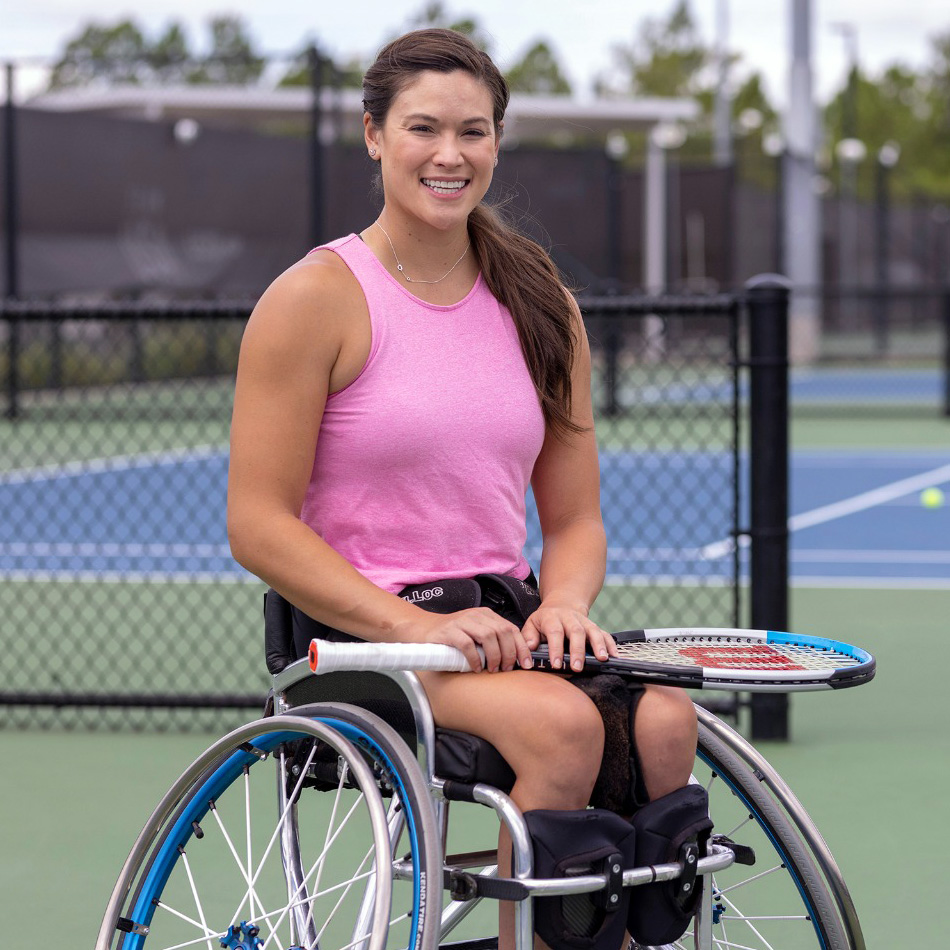
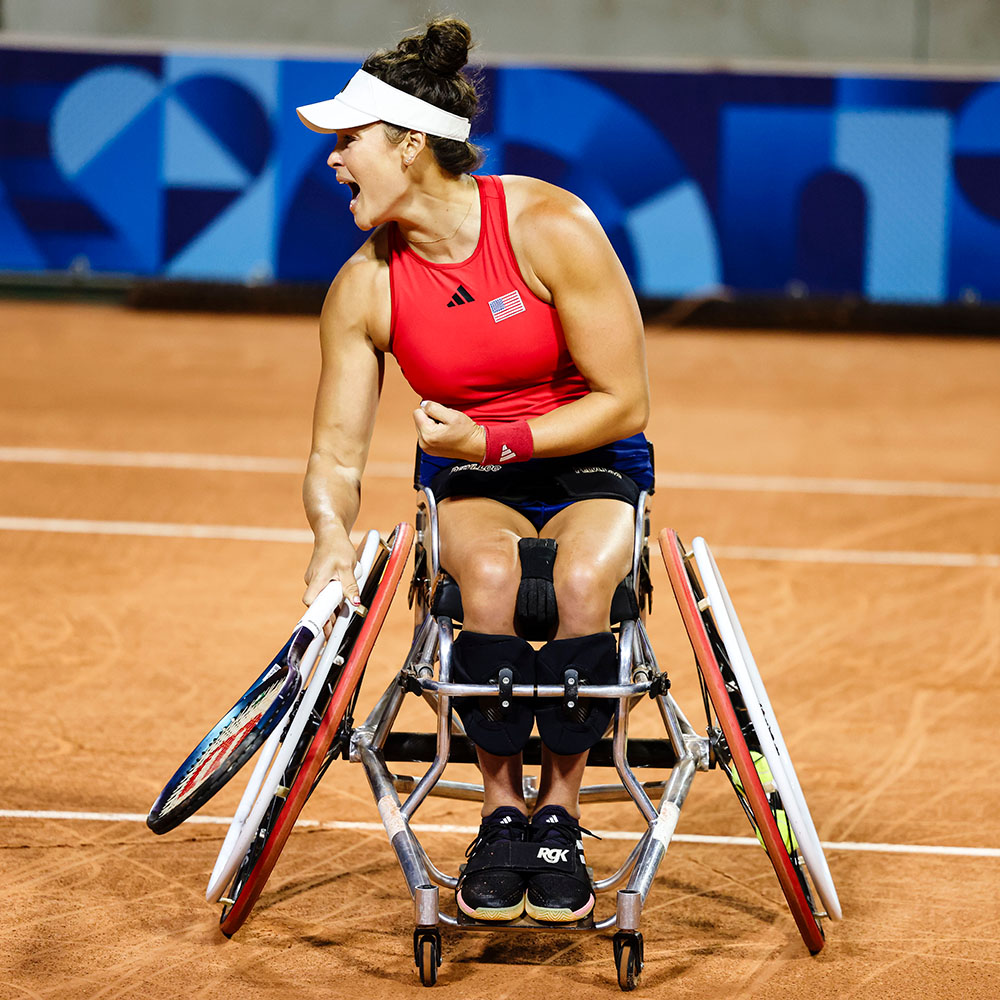
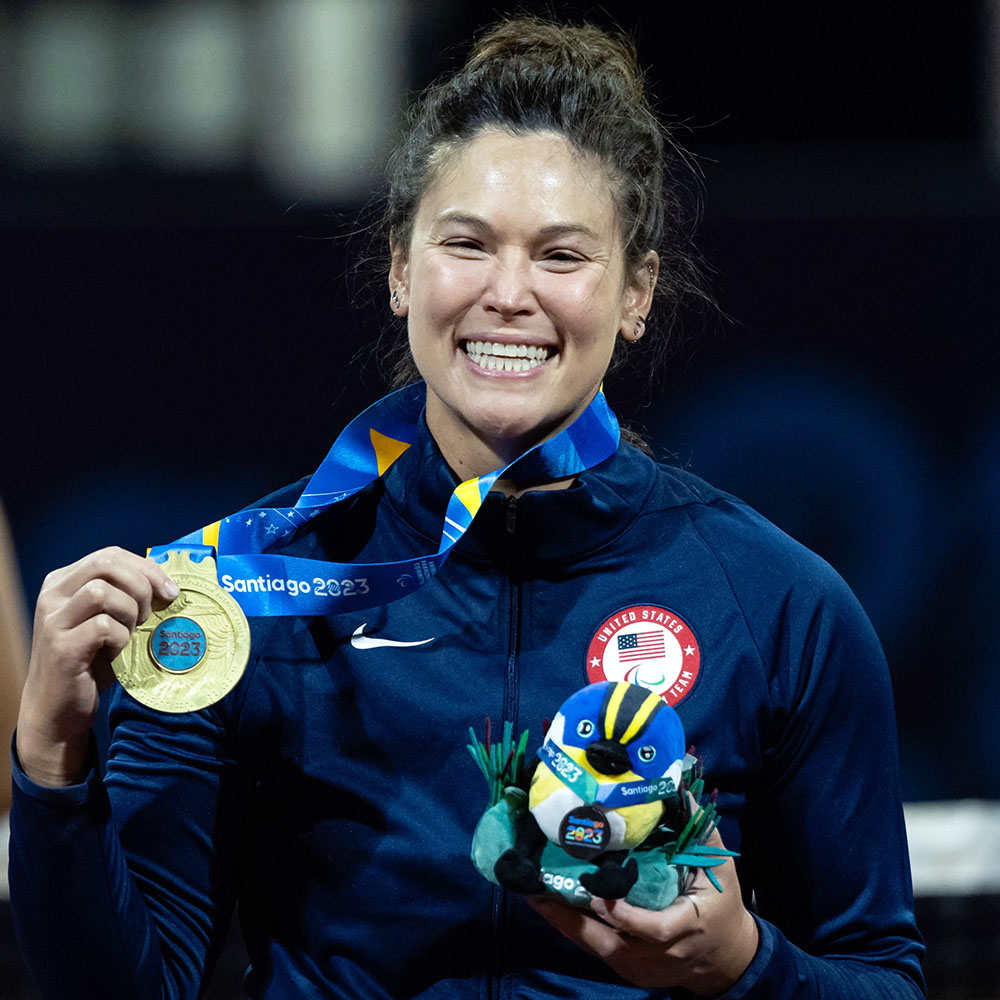
Dana Mathewson is, without question, one of the most influential figures in wheelchair tennis history: a former American #1 women’s player, Grand Slam doubles champion, three-time Paralympian, and global ambassador for the sport. On International Wheelchair Day and during Women’s History Month, it feels especially fitting to honor Dana, whose impact on wheelchair and adaptive tennis transcends rankings and trophies. Because to those who know her best, Dana’s greatest legacy is her kindness, relatability, and commitment to opening doors for the next generation.
Discovering Capability Through Sport
Born and raised in San Diego, Dana was an active young girl when her life drastically changed at 10 years old. “I was an able-bodied kid. I was a soccer player…and then in a matter of hours I suddenly had a disability. I needed to use a wheelchair, and everything in terms of sports just seemed kind of impossible for me,” she recalls. Dana was diagnosed with transverse myelitis, a rare neurological disease which causes the immune system to attack the spinal cord, leaving her partially paraplegic.
The sudden change and new reality was difficult to conceptualize, altering her relationship with movement and sport overnight. Refusing to accept a sedentary lifestyle for her daughter, her mother was eager to meet with recreational therapists to explore Dana’s athletic options. “I’m so thankful that she asked the right people and that San Diego was actually a really big hub for adaptive sports…so tennis was one of the sports that my mom signed me up for,” she says.
At 13, Dana picked up her first tennis racquet, still unsure of how to embrace this new normal. But once she started playing, she began to rediscover joy, crediting tennis as “that pivotal piece” to figuring out her identity again while demonstrating her capabilities both physically and mentally. The realization that her body was still capable of competing, improving, and belonging was euphoric as it shifted her focus from loss to potential.
From joining weekly wheelchair clinics at Barnes Tennis Center in San Diego to playing Division 1 tennis at University of Arizona, Dana quickly made a name for herself. Figures like Greg Hasterock, Head Coach of wheelchair tennis at San Diego State University; Todd Hanover, Founder and President of 2 Bounce Tennis in Indio; and Steve Halverson, her first tennis coach at Park Hyatt Aviara Resort in Carlsbad; were instrumental in her formative playing years. “They were like my big brothers and they taught me everything about tennis,” she shares.
Steve still vividly remembers the clarity of Dana’s ambition, even as a teenager just beginning to understand what was possible. “I asked her, ‘What do you want to do with your tennis game?’” he recalls. “Immediately she answered, ‘Play internationally!’” What stood out most wasn’t just the goal itself, but the conviction behind it—an early glimpse of the self-belief that would come to define her career.
Betting on Herself
After competing at the collegiate level, doors began opening to the world’s biggest stage. But her ascent in professional wheelchair tennis didn’t come without significant obstacles. At the time, infrastructure for American wheelchair players was limited and the financial burden was substantial in terms of equipment, travel, and tournament fees. Despite the challenges, Dana opted to travel and compete on tour without a dedicated coach at the start of her professional career. “I made the unilateral and executive decision to be like, do you know what? I want to travel. I want to get a ranking. I want to see the world. I want to play tournaments. I’m going to bank on myself, go without a coach, and learn from everybody else. I think that’s been a real characteristic of my whole career: self-reliance…I taught myself almost everything about the tour,” she reflects.
Etched in History
Even without abundant resources during her first few years on tour, Dana spent the majority of her career ranked inside the world’s top 20 and top 10, peaking at world no. 7 in women’s wheelchair singles and no. 4 in doubles. She competed in 12 World Championships, won 16 singles and 32 doubles titles, and earned gold medals in both singles and doubles at the 2023 Parapan American Games. She also competed in three Paralympic Games (2016, 2020, and 2024), a time she describes as one of the greatest honors of her life. “I think any tennis player would tell you when you put a flag on and you’re walking onto a court, it’s just different. You play a little bit harder and it matters a little bit more,” she shares.
Perhaps the most special achievement in Dana’s professional career came at Wimbledon 2022 when she won her first Grand Slam in women’s wheelchair doubles with partner Yui Kamiji of Japan against Dutch superstars Diede de Groot and Aniek Van Koot. Not only was it her first time hoisting a Grand Slam trophy, but it was also a historic moment for the U.S. as she became the first American woman to ever win a Grand Slam title in wheelchair tennis.
“They were a team that just never lost anybody; we were definitely the underdogs,” she recalls. “So the fact that we did that was just so surreal. And then to do it at Wimbledon, I didn’t even realize the gravity of what I’d done when we won. I didn’t go into that match thinking anything other than God, I hope I play okay today. So to have that be the result is really cool.”
The Best in the United States
Looking back on her incredible career, Dana doesn’t take the gravity of her accomplishments lightly. Today, she is incredibly proud of her résumé, including being the top American wheelchair player for over a decade. “It’s kind of nuts,” she laughs. “It’s something I’m definitely really proud of.”
She credits her fellow American women on tour for pushing her to raise her level and compete at her very best. “When I was playing, there were a lot of really good women that I was competing against within our country. I was fortunate that when I was learning to play and when I was competing, I had a lot of great competition to make me better. So being able to say I was number one [against that caliber of talent] is amazing.”
The Importance of Representation
Despite all her success, what matters most to Dana is the legacy she builds for the next generation of wheelchair and adaptive athletes, especially among young girls entering the sport. She hopes to be a role model and source of inspiration for junior athletes, just like she had growing up. “There’s not a lot of women in wheelchair tennis—and wheelchair sports in general—for young girls to look up to. I remember when I was first starting, there were a few [women wheelchair players] in tennis that changed everything for me. Karin Korb was a big one and Sharon Clark. They were the best players in wheelchair tennis for our country at the time. And they were at that first camp that I ever went to in San Diego where I picked up a racquet for the first time,” she says.
Dana recalls meeting Karin, who was wholeheartedly and unapologetically herself. “I remember seeing Karin and I was like, ‘Oh my God.’ She was this really strong fit girl, but then she was putting on lip gloss and had all this jewelry on. I found her so fascinating. She was so outgoing and nice to me. I think that was the start of me seeing someone that I wanted to be like.”
Inspiring the Next Generation
For Dana, it’s a “pinch me” moment that young girls idolize her, serving as a reminder of how powerful representation truly is. “It means so much that I’ve had a career that someone else wants to emulate because I think mentorship is such a big deal—especially for girls—whether you have a disability or not. Having someone you can look up to that you can try to model your life after is such a powerful thing,” she says.
She continues, emphasizing the significance of showing up and bringing awareness to disability in sports: “If I could inspire a handful of girls, that means more to me than if you were to say that I could win another [Grand] Slam. And I know that sounds crazy because the average tennis player would be like, ‘Um, excuse me, you’re nuts,’” she laughs. “But I think just knowing what the stakes are when you have a disability and not really having that representation, that’s so important to me.”
Life After Professional Tennis
Dana’s efforts to advocate for and increase visibility in wheelchair and adaptive sports haven’t slowed down after retiring from professional tennis in 2024. She’s now a coach, hitter, and mentor at the USTA National Campus in Orlando, working with prominent American wheelchair rising stars like Southern California’s Charlie Cooper, Tomas Majetic, and Maylee Phelps. She’s also been involved in several USTA Coaching workshops and currently sits on the USTA’s Elite Athlete Committee, helping shape the future of USTA through long-term strategic thinking. She remains closely connected to the Southern California community that first gave her a pathway into the sport, continuing to support and uplift the region’s growing network of adaptive athletes whenever she can.
Besides coaching, Dana envisions a future in tennis broadcasting, on-court commentary, tournament directing, and public speaking. She has already worked as an on-court host and announcer at the 2025 US Open, an experience she describes as crucial to disability integration: “I want to be that example. I want to be the first one that proves that anyone like me can do anything. So I look at commentators and I’m like, where are people like me? I’m noticing that wheelchair tennis is at that pivotal moment where it’s starting to get bigger. It’s getting a little bit more recognized. Is it a huge household thing yet? No. But is it on its way? Yes, I think so.”
Finding Her Frog Prince
Away from the court, Dana loves the simple life: baking, coffee shops, brunching, and going to Target, of course. She’s also a dog mom to Riley and Beau with her husband Dristin, whom she met in the most unique way. One day, she opened the trunk of her car and a frog was inside. After several days with no luck removing it and feeling terrified, she saw a man walking by and asked for help. Initially, he assumed she needed help with her wheelchair, but the reality was quite different. After explaining the situation and without hesitation, he captured the frog and safely removed it for her. The following day, she discovered a note on her car door. It had a drawing of a frog, his phone number, and a message. “The rest is history,” she laughs. “He’s my frog prince.”
A Legacy Shaped by Kindness
On International Wheelchair Day and during Women’s History Month, Dana Mathewson’s story reminds us that history is not only made by breaking records, but through empathy, representation, and the courage to show up as yourself. For Southern California, Dana is more than a champion—she is proof of what access, community, and belief can unlock, not just for herself, but for generations to come.
To Steve, Dana’s impact has always extended far beyond her results. “I can’t say, ‘I’m proud of you, Dana!’ That doesn’t even get close to how I feel about her and what she has accomplished,” he says. “Most importantly, it isn’t what she’s accomplished, but what she continues to accomplish—from sharing her tennis knowledge with kids to interviewing professionals at the US Open. Giving back to what has given her so much is such a positive way to show her respect and appreciation. Her positivity has always been infectious and so welcoming to everyone she knows or meets.”
When asked how she wants to be remembered, Dana’s answer is simple and telling: “I just want people to know I was a nice person.” Not untouchable, nor distant. Rather, a relatable “big sister” that makes people feel welcome and accepted in their own body.