

Sí Se Puede: How Tennis Reshaped
the Monzón Family
USTA SOUTHERN CALIFORNIA
USTA SOUTHERN CALIFORNIA
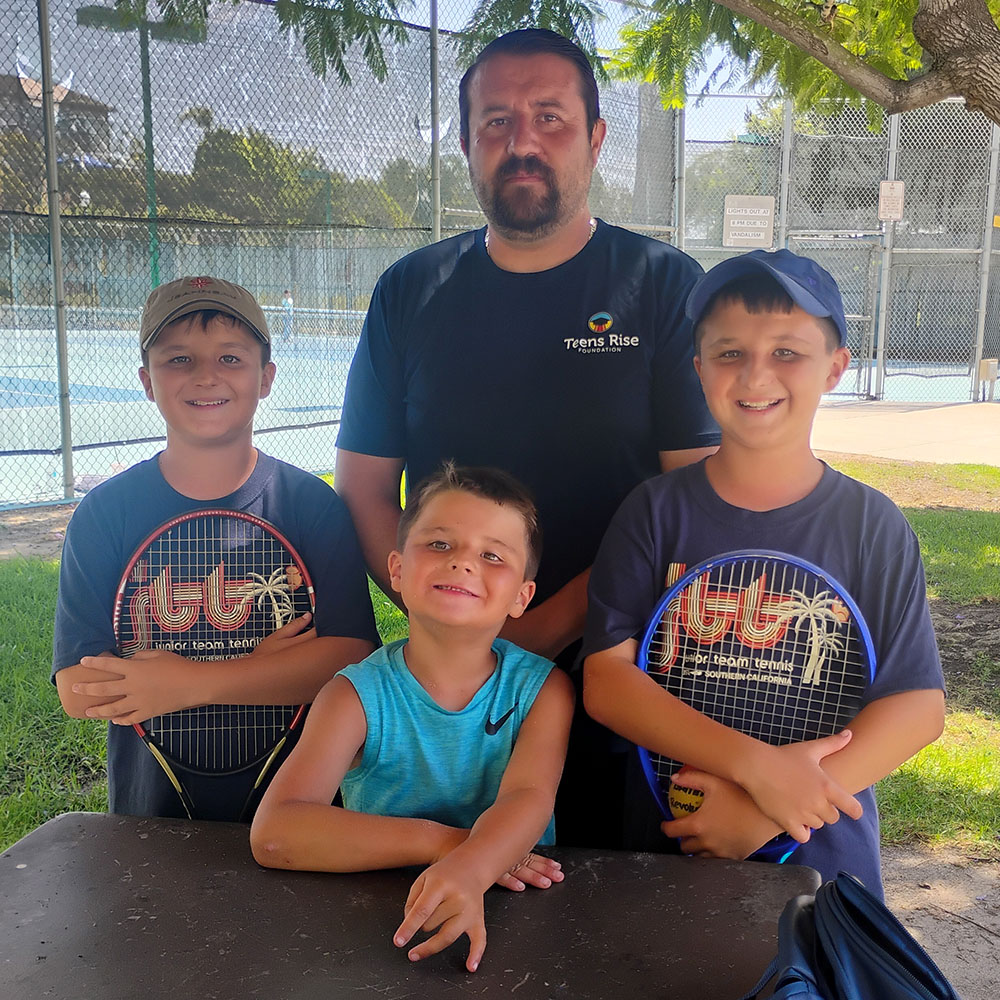
The Monzón family’s tennis journey began just over three years ago at a local park in Chula Vista. Looking for an activity they could all share, Alex Monzón, his wife Ashley Hall-Monzón, and their three sons—eleven-year-old twins Michael and Anthony, and six-year-old Emiliano—picked up racquets at their nearby Walmart and reshaped their family dynamic for the better. Little did they know, that decision would unlock a world of opportunity built on community and connection.
As we celebrate Hispanic Heritage Month, the Monzón family is a true example of how tennis can inspire and unite—regardless of age, skill level, cultural background, or socioeconomic status. Their story is one of grit, gratitude, and the transformative power of accessible programming for all.
Navigating Barriers
Alex’s journey into the sport was far from guaranteed. As a Mexican American growing up in the Southeast region of San Diego, he was raised with limited financial means and did not have access to tennis until later in life.
“Growing up Latino and working class gave us limited options as far as sport, and tennis was never an opportunity granted to myself until adulthood,” Alex reflects. “This sport is beautiful but access is not always easy. It’s been a great sacrifice and effort making it a daily part of our family life.”
For Alex, his heritage is defined by a relentless work ethic inherited from his mother, a Mexican immigrant who sacrificed everything to provide a better life. “My mother tried to give me the best options she could,” he says proudly. “I believe that Mexican Americans are some of the hardest grinders in life. We believe that we can do anything if we stay disciplined and focused. Sí se puede.”
Discovering Tennis
It was this exact mindset that fueled the family’s entry into tennis in 2023. Seeking a new way to stay active together, Alex bought a few racquets and took his sons to Terra Nova Park in Chula Vista. Though they knew very little about tennis, the family put their signature work ethic into action, spending their weeknights and weekends teaching themselves how to play.
However, the sport initially presented difficult economic hurdles. Between the costs of coaching, tournament entry fees, and equipment, it often felt financially out of reach. For Alex, who works in medical billing and collections for the Castillejos Eye Institute, the choice between funding his sons’ newfound passion and managing household expenses was a constant balancing act.
Building a Community Foundation
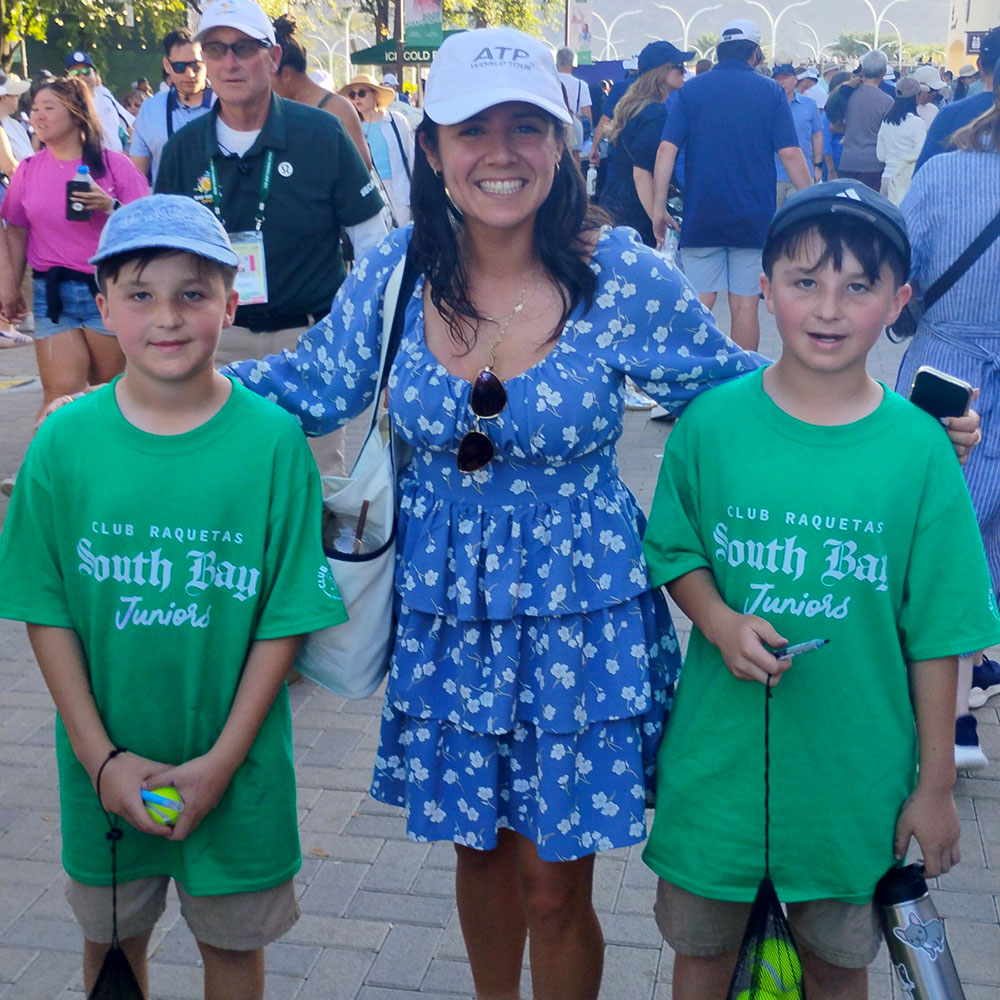
The turning point came through a local grassroots community connection. One day during a hitting session at the park, the family met Antonio “Tony” Ley, founder and president of Club Raquetas, a cross-border athletic and social non-profit in the South Bay region of San Diego that seeks to grow Mexican American representation in tennis.
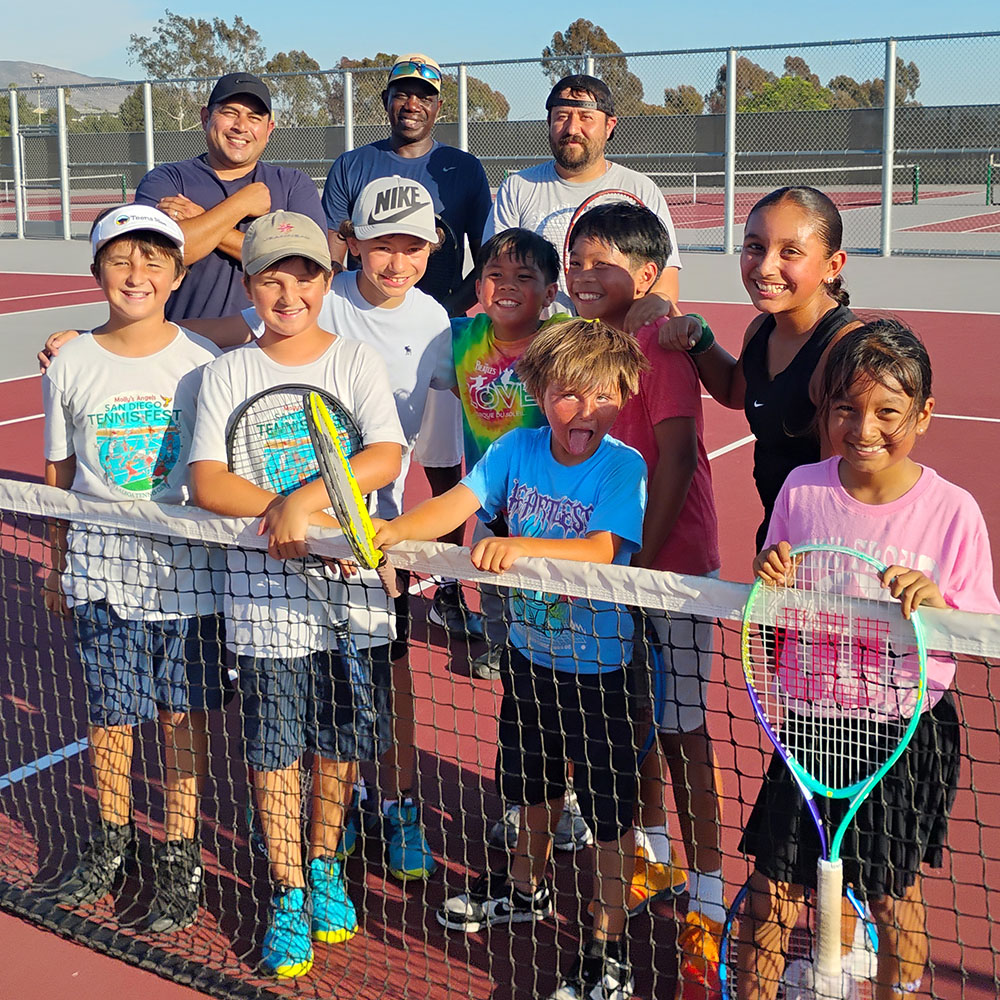
Inspired to bring tennis programming to their underserved neighborhood, Tony and Alex teamed up to help pioneer the concept of South Bay Juniors—a volunteer-run tennis program designed to offer free tennis instruction for underrepresented youth. Still active today, the program serves as a Junior Team Tennis (JTT) and high school preparation clinic, aiming to provide accessible coaching and instruction to local kids. Alex eagerly pitched in, gathering neighborhood kids from border towns like San Ysidro to experience the game for the first time.
It was during this foundational period that the twins also met the Castillo family. Naomi Castillo was the twin boys’ first coach, introducing them to the fundamentals of the game when they were nine years old. Naomi, who works alongside Tony, gave Alex the unique opportunity to be an assistant coach through Club Racquetas—an experience that Alex is tremendously grateful for.
Around the same time, the Monzón family also connected with Gaby Millán of Teens Rise Foundation, a local non-profit dedicated to expanding youth opportunities in the South Bay. Through this organization, the twins joined the organization’s “South Bay Serves” after-school program for elementary, middle, and high school students in the area. The program has been instrumental in shaping Michael and Anthony’s competitive skills and personal confidence, teaching them accountability on the court and leadership off of it. It’s also provided a meaningful outlet for Alex, who serves as the team’s volunteer assistant coach.
“Alex has been an incredible parent volunteer for Teens Rise, showing up without hesitation to support our free community court classes, special community events, and JTT matches,” Gaby shares. “But it’s truly a family effort; his twin sons have been amazing members of both the Teens Rise family and the South Bay tennis community as a whole.”
Family Time and Coaching
For Michael and Anthony, who are incoming sixth graders at Spring Valley Academy in La Mesa, tennis has quickly evolved into an everyday passion and formed an unbreakable bond with their father.
“It’s fun because it allows us to play with our family and friends almost every single day,” they share. “We love playing with our dad at the end of the day.”
“As a family, we found something that we enjoy doing together,” Alex remarks. “It’s something that brings us closer. We just have fun and unwind on the courts. That’s always how we finish our day. We get some exercise in and have family time.”
To support his sons’ involvement and growth in the sport, Alex recently completed a USTA Intro to Coaching workshop through the USTA’s partnership with Positive Coaching Alliance. The class taught him techniques both on and off the court, like how to help his boys navigate the intense emotions of competitive tennis without being overly reactive.
“The workshop teaches you the fundamentals like proper feeding techniques and how to coach kids,” he shares. “Now I know how to talk to these kids a little better. It’s taught me to not be too reactive and help them process their emotions. I try to let them have fun, and I tell other parents the same thing to not push their kids like robots. You have to let them laugh and have fun.”
“A lot of parents obviously spend money on coaching and I don’t have the economic means to do that,” Alex says. “So that’s the reason why I do it myself with the help of coaches from these [non-profit] organizations. Everything that I learn, I pass it forward to other kids that want to learn. It’s a win-win for me and my kids to have friends that are interested. Now we have a junior tennis team from playing at the same parks!”
The family’s positivity and genuine love for the game is exactly what keeps the local tennis community thriving.
“The Monzóns are some of Club Racqueta’s favorite members and we love them very much,” Tony says. “The family has had a huge and positive impact on both adults and children. We are very lucky to have the Monzón family as part of our project.”
Gaby echoes this sentiment, highlighting how the family mirrors her foundation’s core mission:
“At Teens Rise, our goal is to provide access to a sport that isn’t always easy to reach, offering our programs at no cost to families,” Gaby shares. “The Monzón family reciprocates that in every way, consistently showing up, engaging others to join the game, and giving back to build community.”
Carlos Alcaraz Academy Camp
The Monzón family’s dedication to tennis unlocked a monumental opportunity when Michael and Anthony were given a scholarship to attend a Carlos Alcaraz Academy Tennis Camp in San Diego. The experience proved to be a major turning point for the twins’ technical skills and confidence. Alex even took two days off from work to witness the transformation firsthand.
“I learned a bunch of different shots like an open stance, a slice serve, flat serve, and kick serve,” Anthony says. “My open forehand has improved the most, and my kick serve.”
Michael similarly advanced his tactical game: “I learned how to do a kick serve and to help solve my forehand. I also learned how to do a smash [overhead] better.”
Beyond the technical training, the camp demonstrated that tennis has the ability to transcend international borders. During camp, Michael made a connection with a player visiting from Mexico, proving that relationships made on court extend far past summer training sessions. “I met a new friend from Mexico,” he says proudly. “I’m going to go see him one day and we’re going to play tennis over there.”
Today, the boys’ dedication and diligence shows in how they present themselves on court.
“The twins Michael and Anthony have developed into great kids and players,” Tony notes. “Their enthusiasm, laughter, and will to win keep adults engaged and competitive with them, especially now that they’ve grown a bit. The junior players see their talent and work ethic as a source of inspiration and determination; they are some of the best juniors we have.”
Even Emiliano, the youngest brother, is finding his footing in the sport. “Emiliano is the funniest of the bunch,” Tony laughs. “He marches to his own beat and has developed quite a forehand.”
Inspiration, Culture, and Forming Leaders
For the Monzón family, tennis has also been a gateway to representation. Former and current NCAA Hispanic players like Thelma Sepulveda (Point Loma Nazarene University), Midori Castillo-Meza (University of Arizona), and Daniela “Dani” Borruel (University of Southern California) have been powerful role models for both Alex and his sons. The twins even served as ball boys during an exhibition match featuring Borruel and Castillo, watching high-level tennis right in Chula Vista.
Seeing elite Mexican-American athletes excel at the highest collegiate levels convinced the boys that their own dreams of playing high school, college, and professional tennis are entirely within reach—a realization that embodies the true spirit of Hispanic Heritage Month.
Ultimately, the Monzón family’s journey highlights the profound impact of inclusive programming and a strong community network. By lowering financial barriers and creating opportunities for free or low-cost programs, tennis can become an achievable reality for every family, while transforming young athletes into the next generation of community leaders.
As Gaby remarks, the true value of their presence extends well past the court: “What they’ve given goes beyond tennis. Tennis has a way of becoming so much more than a sport; it becomes a community, a friendship, a participant’s second home. The Monzóns have played a real role in making Teens Rise feel like a second home for so many other players through the friendships they’ve built.”
Alex understands firsthand the responsibility that comes with the opportunities their family has received, passing down a vital piece of advice to his kids: “Whatever you learn, you have to be a leader and teach other little kids the foundations. Make leaders.”
Through their passion, resilience, and heart, the Monzón family is doing exactly that—paving a welcoming pathway for the next generation of Southern California tennis players.