

at the 2026 US Open
USTA SOUTHERN CALIFORNIA
USTA SOUTHERN CALIFORNIA
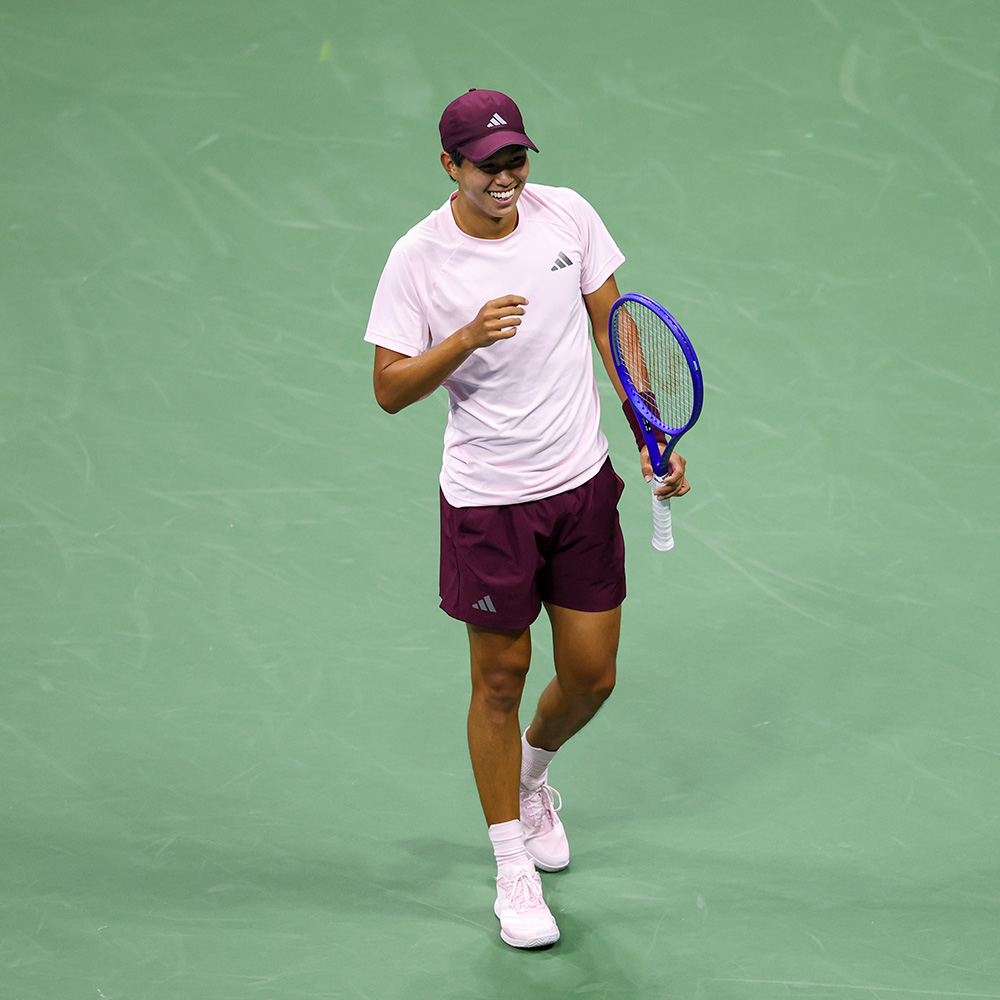
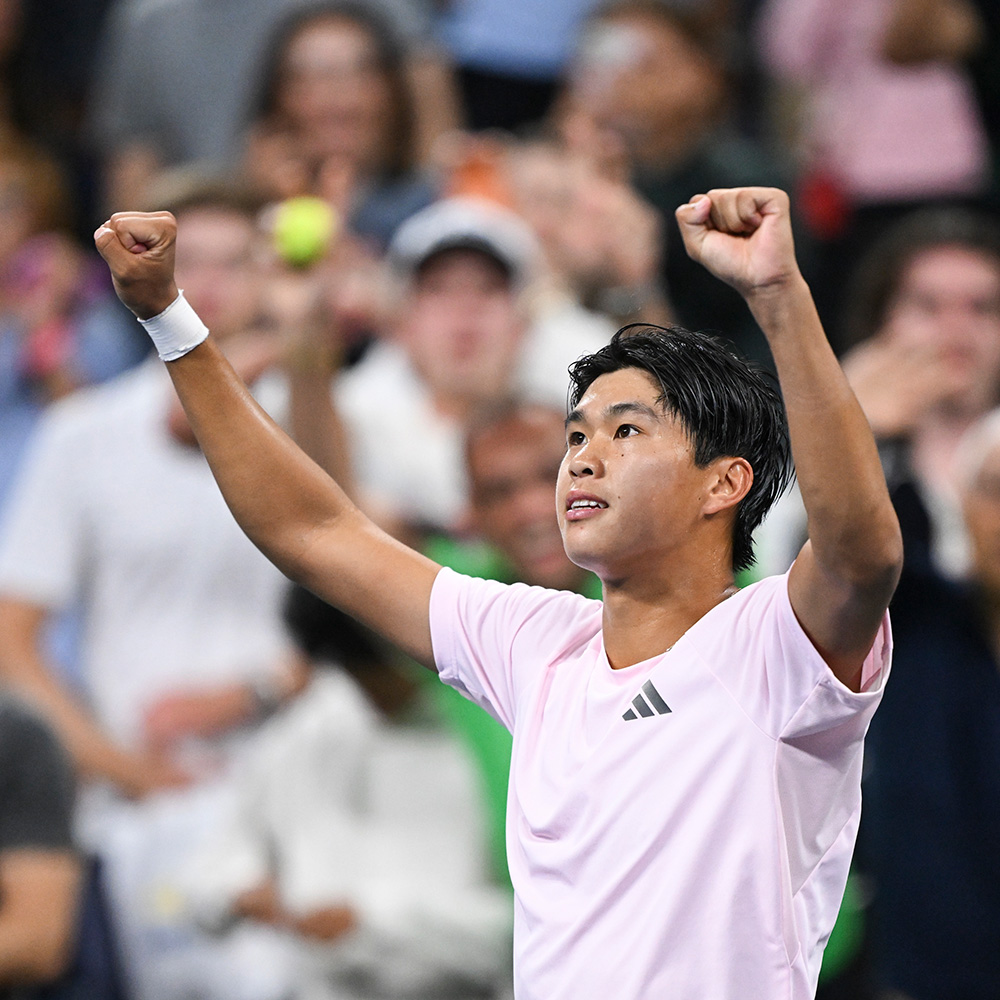
Top: Learner Tien smiles during a match at the 2026 US Open. (Photo – Shea Kastriner/USTA)
Bottom: Learner Tien raises his hands in celebration after his third round match victory (Photo – Ben Solomon/USTA)
Learner Tien smiles during a match at the 2026 US Open. (Photo – Shea Kastriner/USTA)
There is an eerie quiet to the way Learner Tien operates inside a stadium losing its mind.
As the noise peaks, the decibels spike, and the rallies stretch, the 20-year-old Irvine native seems to get calmer and calmer. While opponents burn engine fuel trying to hit through the hard courts, Tien absorbs the surrounding chaos, turning high-volume matches into slow-burn endurance tests.
On Saturday night inside a roaring Louis Armstrong Stadium, the No. 14 seed delivered another performance that is becoming increasingly familiar: five sets, three hours and 24 minutes, countless momentum swings, and Tien standing at the finish line. His 6-3, 1-6, 6-7(2), 6-3, 6-4 victory over No. 17 seed Jakub Mensik sent him to the US Open fourth round for the first time, making him the youngest American man to reach the second week in Flushing Meadows since Andy Roddick in 2002.
It was another masterclass in the subtle mechanics that make Tien one of the most difficult players on the ATP Tour to face.
At 5-foot-11 and 160 pounds, Tien is not overpowering opponents with 135 mph serves or overwhelming them with sheer baseline power. Instead, he has built his game around something more subtle, and perhaps more difficult to develop: the ability to outthink the player across the net.
His tennis IQ has quickly become one of his greatest weapons.
“I think it’s a big part of my game,” he said. “If I had to define it, I would say it’s a lot of problem-solving, a lot of adjusting. Both of those things are huge parts of tennis. Both guys prepare to play a match a certain way. They have a game plan. But from the first point, you’re pretty much adapting to what the other guy throws at you.
“I’d say ‘tennis IQ’ is navigating that. It could be shot selection, it could be where you serve from, what you expect, how you’re navigating the points. Whether I’m a favorite or whether I’m an underdog, I don’t really think about it. Once the match starts, you’re just out there trying to adapt to what’s happening. Rankings and previous matches go out the window.”
That ability to think his way through a match has only sharpened under the guidance of Southern California tennis legend Michael Chang, a true pioneer for Asian American tennis, who has coached Tien since July 2025. Chang, himself a master of solving problems on court, has helped Tien turn that tactical intelligence into one of the defining strengths of his game.
Against Mensik, that mindset was on full display.
Tien fell behind early in the first set before finding his rhythm and closing it out with five consecutive games. Mensik answered immediately, winning six straight games in the second before edging a tight third set in a tiebreak to move within one set of victory.
For most 20-year-olds facing a deficit against an elite server, that might have been the breaking point. For Tien, it was another problem to solve.
Down a break early in the fourth, he leaned into the Armstrong crowd and began turning the match around. He chased down balls, extended rallies, changed patterns, and produced fearless winners that sent the New York crowd into a frenzy.
Then came the fifth.
Mensik had the bigger serve, but Tien had the patience.
At 3-3, Mensik created three break points. Tien erased every one, held serve, and shifted the pressure back across the net. At 5-4, he broke Mensik and calmly served out the match.
Tien is now 5-0 in his career in five set matches.
His ability to remain composed through those moments has become a defining characteristic of his rise. The serve remains a work in progress and perhaps the most vulnerable part of his game, but Tien continues to compensate with elite movement, anticipation, patience, and an uncanny ability to figure out what a match is asking of him.
Two nights earlier, Tien had stood on the other side of the New York crowd as he defeated Gaël Monfils in straight sets, bringing the curtain down on the 40-year-old Frenchman’s final Grand Slam appearance. On Saturday night, that same energy belonged to Tien.
Every long rally brought another roar. Every Tien winner created another surge of momentum. By the fifth set, Louis Armstrong Stadium felt less like a neutral court and more like a home court.
Tien acknowledged the fans afterward, admitting their energy helped carry him through the match.
That connection with the crowd has become another unexpected part of Tien’s rise. So has his parallel ascent with fellow Southern California star Iva Jovic.
Featured together in Vogue earlier this summer as two of the young Americans helping shape the next generation of the sport, Tien and Jovic announced themselves on the Grand Slam stage at the Australian Open, where both reached their first major quarterfinals. Tien dismantled former world No. 1 Daniil Medvedev 6-4, 6-0, 6-3, while Jovic made her own history with her run in Melbourne.
Tien followed with a quarterfinal appearance at Indian Wells before falling to eventual champion Jannik Sinner, reinforcing that his Australian Open breakthrough was no one-off.
Now, nine months later, they are doing it again in New York. Jovic reached the fourth round for the first time after a three hour battle with Alexandra Eala, while Tien followed with his five set escape against Mensik.
At 20, Tien has reached the second week at both hard court Grand Slams this season, becoming the youngest American man to do so since Palos Verdes’ Pete Sampras in 1990. Both Southern California stars have shown an ability to thrive as the stage gets bigger, and both are learning to navigate the attention that comes with being the next generation of American tennis.
For Tien, that next chapter begins with Karen Khachanov.
The world No. 50 awaits Monday in the fourth round, having dropped just one set and upset No. 3 seed Felix Auger-Aliassime along the way. The 30-year-old is no stranger to deep Grand Slam runs, reaching the US Open semifinals in 2022 and the Australian Open semifinals in 2023. It will be the first meeting between Khachanov and Tien.
Khachanov brings a powerful serve and heavy groundstrokes. Tien brings movement, variety, anticipation, and the patience to make an opponent play one more ball.
Yet that is exactly where Tien has looked most comfortable. He has already beaten a former world No. 1 on the Grand Slam stage, taken down big servers, and survived five set battles that seemed to belong to someone else.
Now he gets another chance to see just how far this version of Learner Tien can go.
After Taylor Fritz fell to Francisco Cerundolo in the third round, Tien became one of five American men to advance to the second week, joining friend and fellow Southern Californian Alex Michelsen, as well as Tommy Paul, Frances Tiafoe, and Ben Shelton. The five men are part of the strongest American showing at this stage of the US Open in more than three decades.
For the first time in years, American men are filling the second week, chasing the elusive title that has remained out of reach since Andy Roddick won in 2003.
Tien is not talking about ending that drought. He does not need to.
Right now, he is focused on the same thing that has carried him through every challenge this week: solving the next problem, playing the next point, and discovering, match by match, just how good he can become.
For a player whose game is built on finding solutions, there may be no better place to keep figuring it out than New York.