


Into High Performance Apparel
USTA SOUTHERN CALIFORNIA
USTA SOUTHERN CALIFORNIA
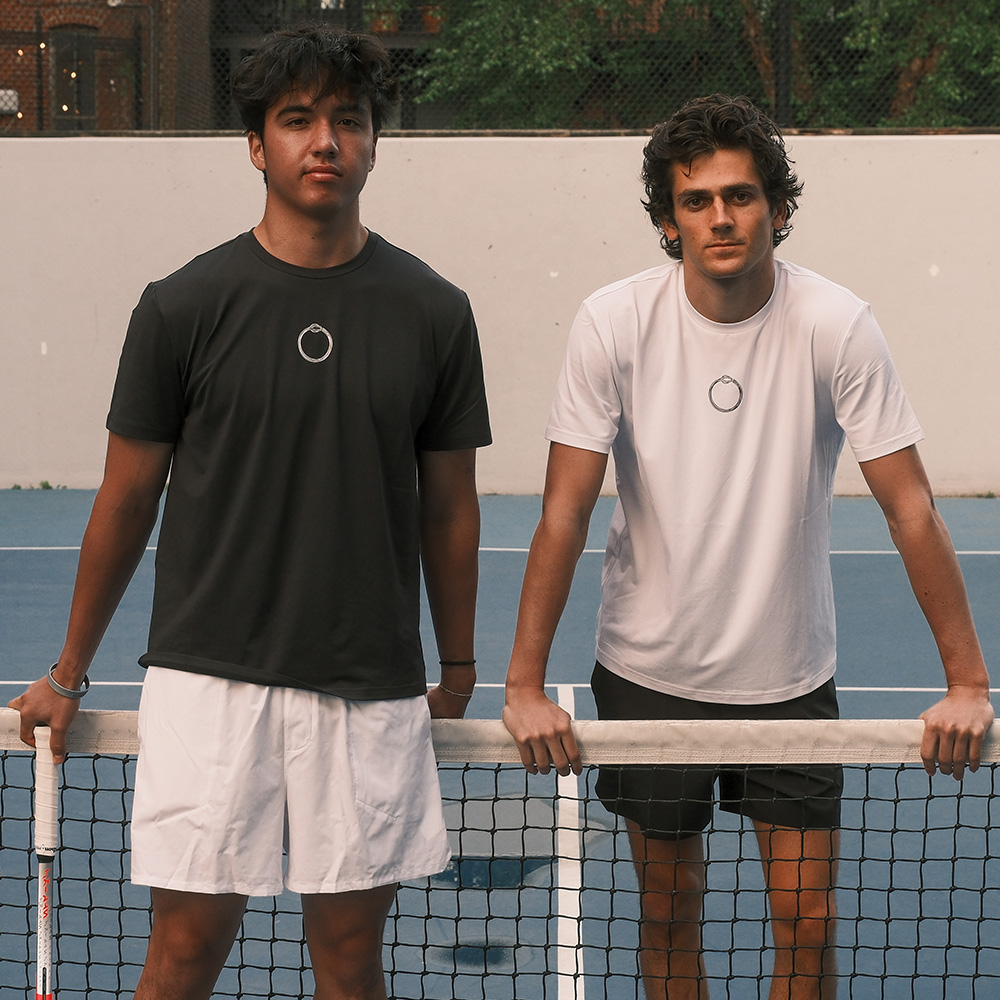
Top: LET Tennis co-founders Jakob Esterowitz and Jonah Dickson stand side-by-side wearing LET Tennis t-shirts.
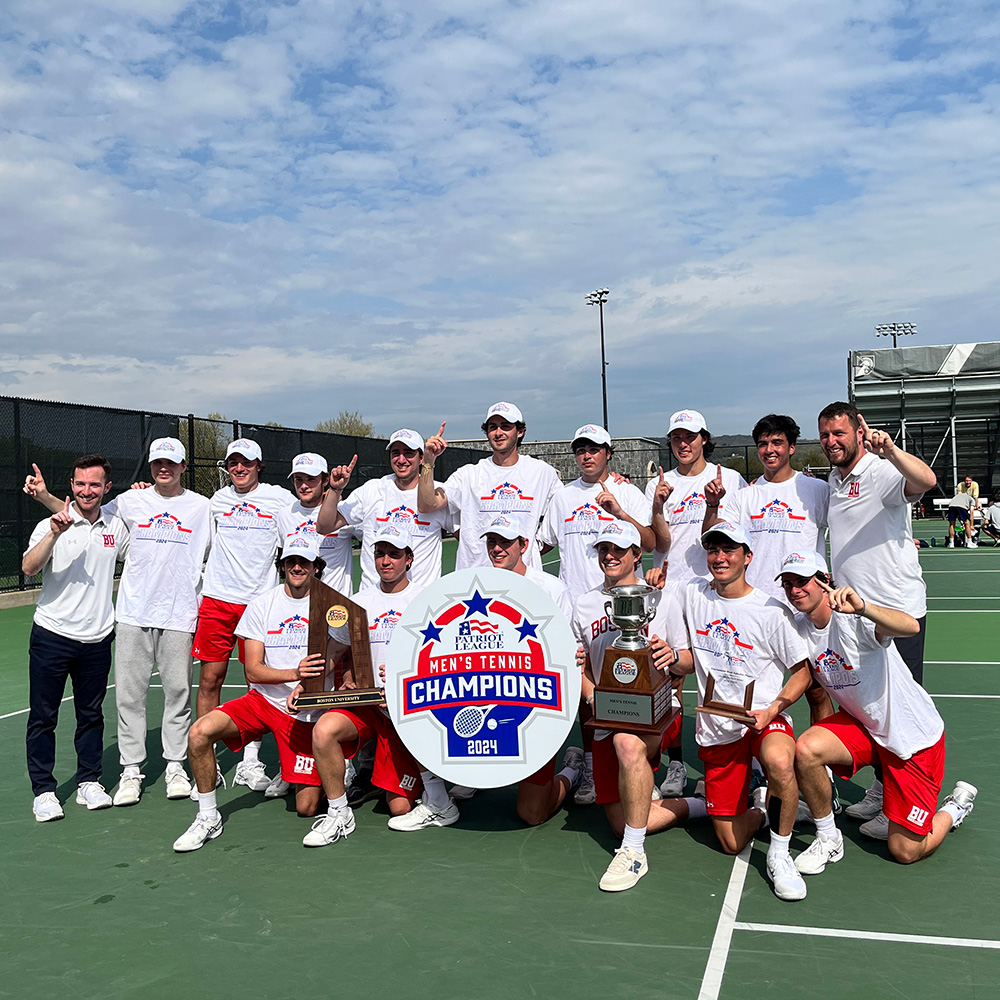
Middle #1: Jonah and Jakob celebrate with Boston University teammates after winning the 2024 Patriot League conference championship.
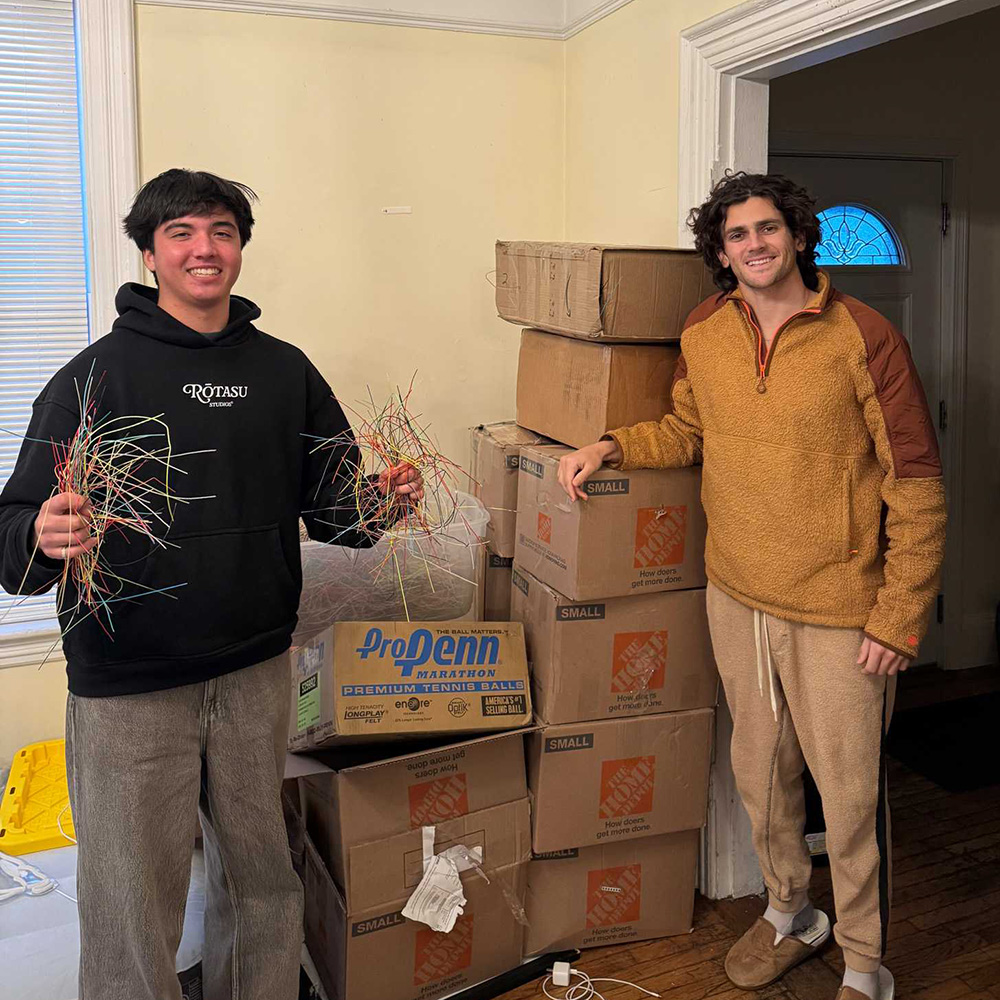
Bottom: Jakob and Jonah collecting used tennis strings during their college days at Boston University.
Above: LET Tennis co-founders Jakob Esterowitz and Jonah Dickson stand side-by-side wearing LET Tennis t-shirts.
In tennis, a let is called when a serve clips the net cord but still lands in the service box, or when outside interference halts play. It means one simple thing: replay the serve or point during a game. You take a pause, clear the net, and start over with a clean slate.
That fundamental rule of tennis is the exact philosophy behind LET Tennis (LET), a sustainable performance brand co-founded by former Division I Boston University tennis teammates Jonah Dickson and Jakob Esterowitz.
For decades, millions of feet of polyester and co-polyester string have been treated as single-use, garbage bound for landfills or municipal incinerators. By stepping in at the moment a racquet’s string is cut out, LET grants the discarded string a “let”: an opportunity to hit the replay button and re-enter the game as premium, circular performance apparel.
Through an expanding partnership with USTA Southern California, LET is collecting used strings across the region and leveraging advanced chemical recycling to give them a second life on court.
From Pacific Palisades to College Doubles
For Jonah, bringing this mission to Southern California hits close to home.
Growing up in the Pacific Palisades, Jonah’s parents introduced him to tennis around age three. Early on, he admits he “despised the sport.” But when he was 10 years old, watching fellow left-handed icon Rafael Nadal battle at the French Open changed everything. From there, Jonah caught the tennis bug, set his sights on college tennis, and threw himself into the competitive USTA SoCal junior circuit.
“SoCal tennis creates such an incredible sense of community and pride,” Jonah reflects. “Whether it was playing Zonals in Utah, competing in the Bryan Brothers Doubles Race, the Friendship Cup, or playing high school tennis—which is stronger in SoCal than almost anywhere else—you felt a real sense of team. Going to national events, we always wore being from SoCal as a badge of honor.”
That section pride extended to on-court swagger and local high school culture. “We’d show up to national tournaments like, ‘Oh, our UTRs in SoCal are better than a UTR from the Mid-Atlantic or Midwest,’” Jonah jokes. “Which was so not true, but that’s what we thought just because the competition in SoCal is so good. High school tennis in SoCal was huge, too. Some of my best memories, and a lot of the reason why I wanted to play college tennis, came from high school tennis. You don’t find that level of dedication to team tennis in many places outside of SoCal.”
For Jonah, growing up around SoCal’s legendary pipeline of professional talent also provided constant motivation. “So many American pros are from SoCal,” says Jonah. “Growing up, you’re playing the exact same tournaments and high school matches they did, which makes the pathway feel real and unique.”
During those formative junior years, key leaders left a lasting mark on Jonah, including his former Zonals coach, Cari Buck, and long-time tournament administrator and current Executive Director of USTA SoCal, Trevor Kronemann. “Cari led our team with an awesome attitude and pushed us, and Trevor always made you feel like you were a vital part of the section,” says Jonah.
That junior path eventually led Jonah to Boston University (BU). It was there that he connected with Jakob Esterowitz, a Mid-Atlantic native whose family roots in tennis run just as deep.
Unlike Jonah, Jakob loved tennis from the very first swing at age three, growing up playing tennis alongside his mom and two sisters across Maryland and Virginia. Jakob trained at the renowned Junior Tennis Champions Center (JTCC) in Maryland, hitting alongside future pros like Frances Tiafoe and Robin Montgomery. After a freshman year playing Division III tennis at Amherst College, where he also launched a small clothing brand, Jakob took a semester off to coach at OSSA Tennis Academy in Maryland before transferring to BU in the spring of 2024.
On the court, Jonah and Jakob helped BU capture the first conference championship in program history. The following fall, while Jonah was completing his Master of Science in Global Marketing Management, the two became doubles partners and bonded over a shared passion beyond the baseline: streetwear, fashion, and surfing. Today, at 22, Jakob is completing his Bachelor of Engineering in Mechanical Engineering while competing for BU’s club team after exhausting his NCAA eligibility.
The Spark: 14 Players, 5 Restrings a Week
The idea for LET was born out of a real-world problem both players witnessed daily, combined with an unexpected turning point.
In late 2024, an illness forced Jakob off the court for nine months. With extra time on his hands, Jakob revisited his interest in apparel production, researching textile supply chains and sustainable fabrics. Having resold sneakers and followed streetwear culture growing up, he quickly realized the staggering environmental footprint of traditional fashion and the glaring waste stream sitting right inside his own team’s locker room.
“At BU, we had a 14-player roster stringing racquets four or five times a week,” Jakob explains. “That’s dozens of sets of string being tossed in the trash every single week just from one men’s D1 college team.”
Jakob brought the concept to Jonah, whose family represents four generations in the fashion industry. Jonah instantly saw the potential: “We were going through so much string in our junior careers that it felt like the perfect mesh of two worlds I love: tennis and fashion.”
From Water Buckets to Chemical Recycling
Recycling tennis string is far more complex than recycling standard single-use Polyethylene Terephthalate (PET) plastic bottles and jars.
Standard single-use plastic water bottles already present a severe environmental challenge. In the United States, only about 29.1% of plastic water bottles are ever recycled, according to data from the U.S. Environmental Protection Agency (EPA), leaving the vast majority bound for municipal landfills or polluting ocean ecosystems. Producing bottled water requires up to 90 times more energy and carries a carbon footprint hundreds of times higher than municipal tap water. Worse, as these single-use PET bottles degrade, they shed thousands of microplastics and nanoplastics directly into the environment and water supply.
Yet, compared to tennis string, clear PET bottles are relatively simple: they are made of standard PET plastic that melts down easily into lower-grade recycled fibers. Tennis strings, by contrast, are engineered copolyesters packed with trade-secret additives, performance lubricants, and vibrant colorants that mechanical melting simply cannot process effectively without degrading fiber quality.
Turning this material challenge into a functioning supply chain required relentless grassroots hustle. In the company’s earliest days, Jonah and Jakob personally drove around Maryland and Boston collecting string boxes from local pro shops. When they returned to campus during winter break, they had all the collected string shipped directly to Jonah’s apartment.
Early sorting methods were primitive and labor-intensive. Working out of their apartment, the co-founders experimented with water-filled buckets to manually separate polyester string, which sank, from nylon and natural gut, which floated.
“We spent 12 or 13 hours sorting string in water one day,” Jonah laughs. “It was great team bonding, but a terrible business model.”
The team also sorts collected strings by color, helping reduce the need for additional garment dyeing as the material moves through the recycling process.
When they approached the Intercollegiate Tennis Association (ITA) about connecting with other college programs, they quickly realized they would have to build their network themselves. Without corporate funding to support outreach, Jonah took matters into his own hands and personally emailed every college tennis coach in the United States to build their initial collection network.
Recognizing the need for a scalable, science-driven solution, they connected with a university professor specializing in chemical recycling at Northeastern University. Instead of mechanically melting the string, LET’s room-temperature chemical extraction process separates pure PET components from the string, which typically make up 80% to 95% of its composition. The technology breaks the plastic all the way down to its base raw materials, compounds normally extracted from crude oil, and rebuilds them into virgin-quality yarn and performance fabric.
“Because we rebuild the material from the molecular level, there’s zero performance loss,” says Jakob. “It doesn’t feel like stiff plastic on your back; it’s a soft, premium shirt. And because of how it’s chemically constructed, it’s completely circular. If a player dives for a ball and tears a hole in their shirt, they can eventually send it back in a string box to be chemically recycled into a brand-new garment all over again.”
Turning recycled string into a viable performance garment also required extensive product testing. Before launching its debut Core V.0 Shirt collection, the team put the shirts through more than 400 hours of testing to help ensure the material could meet the demands of the sport. The collection features three colorways: chalk white, court black, and true navy. The result is performance apparel designed to connect the materials players discard on court with the clothing they wear back on it.
Real Environmental Impact: By the Numbers
What started as an idea in a college sublet has rapidly evolved into a nationwide environmental movement across the racquet sports industry. To date, LET has diverted over 13,000 pounds of polyester string waste from landfills and incinerators across more than 1,000 received shipments, backed by a growing network of over 270 collection partners across more than 38 states in the U.S. and over 5,000 in other countries, including pro shops, university teams, academies, and major tournament sites.
The environmental benefits of this closed-loop model extend far beyond keeping plastic out of landfills. By transforming discarded tennis string into high-performance apparel, LET reduces the need to produce new polyester while preventing the emissions associated with incinerating used string. Producing apparel from recycled tennis string generates 59% fewer carbon dioxide emissions than using virgin polyester, while the manufacturing process requires up to 75% less energy and 47% less water than producing standard virgin synthetic fabrics.
Celebrating the Unsung Heroes: The Stringing Community
While the science happens in the lab, the engine of LET’s collection network is powered by racquet stringers.
“Stringers are the most overlooked people in the tennis ecosystem,” Jakob notes. “They stand over a machine for hours every day so we can go play. But because every single player has to get their racquet strung, stringers touch the waste directly and know the community best.”
To give stringers a platform, LET launched a “Stringer of the Month” spotlight, sharing stories and interviews from stringers across the country.
Among their earliest champions are Albert Murata, a legendary Hawaii-based stringer who strung at the Tiburon ATP Challenger while wearing LET gear; Scott Nilsen, master stringer at Tennis Topia in Rockville, Maryland, where Jakob grew up stringing his racquets; and Andy Abell from Wound Tight in New York.
“Stringers have the absolute best stories in tennis,” says Jakob. “They hear all the tournament gossip and know the players better than anyone.”
By using any cardboard box they have on hand, from an old tennis ball can box to an Amazon delivery box, stringers can easily participate in LET’s recycling program. They simply fill the box with cut out polyester strings and download a prepaid shipping label from LET’s website to send it in.
Tournament Momentum & The USTA SoCal Partnership
LET’s collection network has reached the highest levels of the sport. At the US Open, championed early on by advocate Bina Indelicato, LET collected between 400 and 450 pounds of string across qualifying, main draw, mixed, and junior events—enough raw material to produce nearly 1,300 performance shirts. They have established similar collection operations at the Winston-Salem Open in North Carolina, the Hall of Fame Open in Newport, Rhode Island, and the Tiburon Challenger in Northern California.
Now, bringing that momentum home to Southern California is central to LET’s vision. USTA SoCal has integrated LET collection boxes across section events like the SoCal Pro Series and Billie Jean King Girls’ 16s and 18s Nationals, where on-site stringers can collect and recycle used tennis string. So far, those efforts have diverted more than 50 pounds of string, enough material to produce approximately 150 circular performance garments.
The initiative aligns with USTA SoCal’s broader environmental commitments, which include ball recycling, converting event vinyl banners into tote bags, and turning old ball cans into tournament trophies.
Looking forward, Jonah and Jakob envision closed-loop tournament models where events buy back official merchandise crafted directly from their previous year’s string waste. They also envision inter-section collection competitions complete with live leaderboards, where winning sections earn custom gear made from their own recycled waste.
“Southern California isn’t just one of the densest tennis regions in the world; it’s a section with immense pride and leadership,” says Jonah. “To build a model where local juniors, Adult League players, and club stringers can see their own discarded string transformed into apparel worn on court—that’s the ultimate full-circle moment.”
Looking Ahead: LA28 and Global Expansion
Jonah and Jakob have big ambitions for LET. Over the next five years, they aim to establish collection partnerships at all four Grand Slams, sponsor pro players on the ATP and WTA tours, and scale into pro shops and retail spaces worldwide, aiming to become a household tennis brand where sustainability is the standard foundation.
With Southern California preparing to host the LA28 Olympic Games, LET sees an unprecedented opportunity to collaborate with local organizers, quantify carbon emissions saved, and showcase SoCal as a global leader in sustainable sports innovation by capturing all string waste across the Olympic tennis events.
“When a young player buys a LET shirt because it feels great on court, and then realizes it was made from the strings cut right down the street at their local pro shop, that’s what drives us,” says Jonah. “We’re building a brand that proves you never have to choose between top-tier performance and doing right by the sport.”
+++
Want to get involved in string collection and help make tennis in SoCal sustainable?
Getting started is easy. Set aside a separate bin just for polyester and co-polyester string. All other string, such as natural gut and multifilament, can go in your regular trash. When your poly and co-poly bin is full, seal it with tape, go to Let Tennis’s website to print a prepaid shipping label, and drop it off at your local UPS or FedEx. For more details, visit Let.Tennis, or reach out to Julien Grigaux at jgrigaux@scta.usta.com with any questions.