

How Tennis Transformed Melissa Hoffman’s Life
USTA SOUTHERN CALIFORNIA
USTA SOUTHERN CALIFORNIA
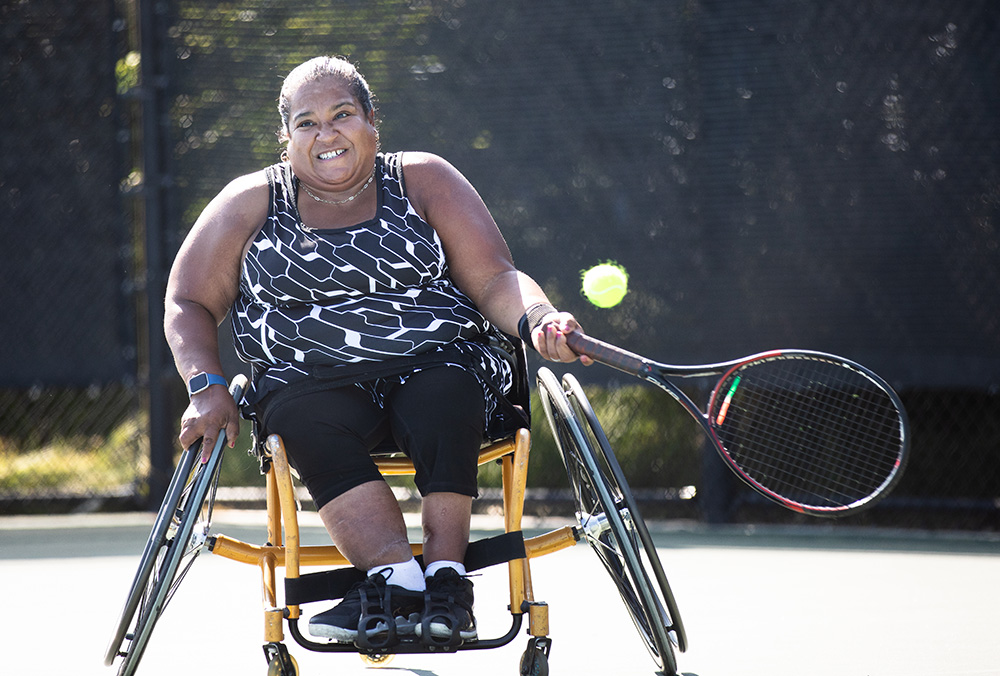
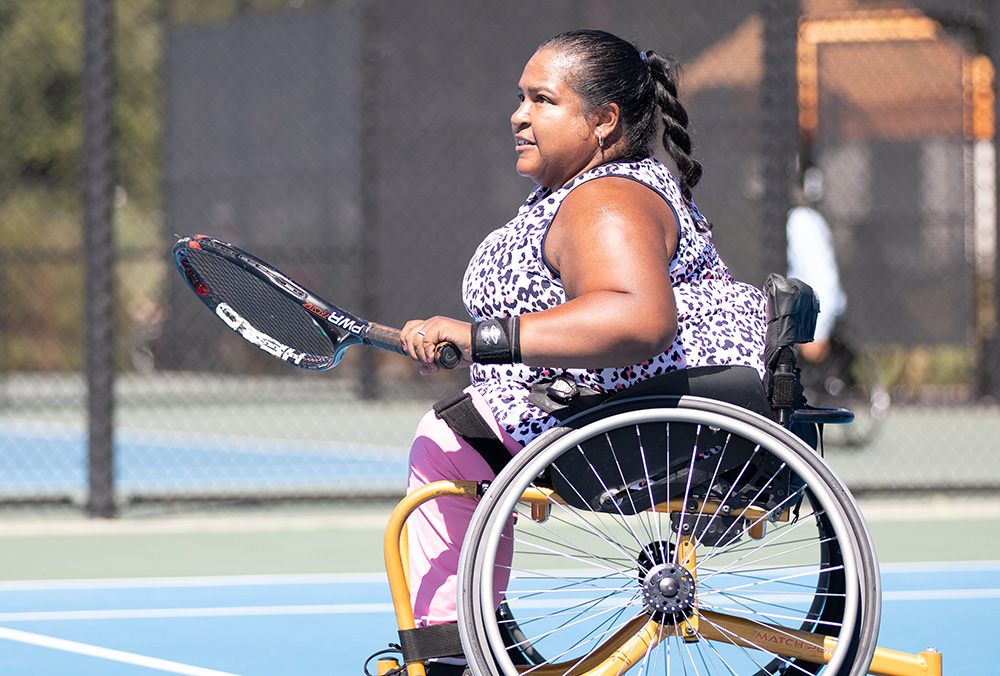
Photos – Rachel Scalera
In many ways, tennis saved Melissa Hoffman—physically, emotionally, and mentally. What began as a need to exercise after a type 2 diabetes diagnosis evolved into something far more transformative. The lessons she’s learned from tennis extend well beyond the court, from self-belief and discipline to resiliency and grit. “I live my life differently because I’ve learned so much about myself through the sport,” she says. “I think for some people it’s just a sport…but tennis can teach you so many things that carry with you when you’re off the court too.”
A Foundation of Strength and Self-Advocacy
Born with spina bifida, Melissa was faced with challenges early on in life. Doctors advised that her parents institutionalize her after birth, questioning her quality of life because of her condition. Her parents refused. As immigrants who had navigated societal injustices themselves, they instilled the importance of self-advocacy in Melissa from a young age. That foundation and refusal to accept limitations would later shape the way she approached the sport.
Tennis was a part of Melissa’s childhood long before she started to play. Growing up, she watched “Breakfast at Wimbledon” with her mother, a tradition that created a quiet attachment to the game. “I’ve always loved tennis since I was a little kid. My mom would wake me up early in the morning for Breakfast at Wimbledon. She is the reason why I fell in love with tennis,” she shares.
Rediscovering the Sport
It wasn’t until she was 37 years old in 2013 that Melissa picked up a tennis racquet for the first time. Faced with a diabetes diagnosis and a need to make a change, she turned to the sport that brought her joy so many years ago. Living in New England at the time, she Googled “wheelchair tennis near me” and found a three-day clinic happening that weekend where prominent wheelchair and adaptive tennis instructor Dick Lane—who became wheelchair-bound after a car accident in the 1990s—was one of the lead coaches. From that moment on, Melissa’s life drastically changed.
“I went from doing zero physical activity to six hours of pushing [my wheelchair]…I drove home and literally called my husband from the garage and I was like, ‘Can you come out here, please, and help me get into my wheelchair because I think I died 45 minutes ago,’” she laughs. “He comes out and says, ‘So I guess you’re not going to go back tomorrow then.’ And I was like, ‘Are you kidding me? I absolutely loved it. I’m going back.’ And that was the beginning of it.”
In a matter of months, Melissa went from playing once a week to four times, driving upwards of 45 minutes each way and nearly 400 miles every week just to play at the nearest courts to her. Much of that early growth, she says, came from Dick’s guidance. “Dick was the perfect coach to introduce me to the sport and help me fall in love with it. He helped me figure out what my body can do and to enjoy it. He’s the reason why I think I stuck with it,” she says.
“Melissa always attended every wheelchair session and event to improve her game. She never questioned any of the crazy tricks that I asked her to try and was always excited when I said it was time to move up to the next level,” Dick shares. “Her greatest improvement is that she now believes she deserves to win and knows she has the skills. She made me a much better coach and teacher. I measure my new students by her determination to learn the game.”
A Breakthrough Moment
Growing more sure of her game, Melissa began competing in USTA wheelchair tournaments. While she was initially insecure about the tournament scene, she quickly embraced the challenge and the social aspect of the sport. “I love being able to see how I compete against people that I’ve played multiple times to see how I’m progressing, but then I also love the challenge of playing against people I’ve never played against before. And I love the social component, which is something I didn’t anticipate being a big part of why I enjoy going to tournaments,” she shares.
One of her most meaningful tournament memories came in Baton Rouge, Louisiana in 2016. Still relatively new to the sport, she entered the women’s A wheelchair doubles division for the first time, partnering with her friend, Lisa Maddox. They faced two teenage opponents in a pro set that reached 6-6. Word quickly spread and spectators started gathering to catch the end of the set, a feeling Melissa describes as surreal. “We fought and we fought and we fought. We ended up losing the match 6-8, but it was the best loss I have ever had in my life because I had so much fun and felt so supported by my partner…It didn’t matter that I lost that match. It mattered that I showed up and competed,” she says with tears in her eyes. “I’m getting a little emotional talking about it because that was 10 years ago and that is why I keep working so hard to get better because I had an experience like that.”
A New Chapter in the Desert
After years of living in New England, the cold weather, long drives to play tennis, and overall inaccessibility were slowly starting to take a physical and emotional toll on Melissa. It wasn’t until February 2022 when she and her husband visited his parents in Rancho Mirage, California, that they realized they desired a change.
“We get out here and we’re like, ‘Wow, the weather is amazing and everything is accessible.’ And then slowly over the couple of weeks that we were here, we thought, ‘Wait a second, there are a bunch of wheelchair tennis players out here. Indian Wells is out here. We could literally be outdoors playing tennis all year round…What are we waiting for? If we want to make this move, we could really do this,’” she recalls.
By April 2022, they bought a house in La Quinta, and two months later, they packed their bags and made the cross-country road trip to their new home—a decision they’ve never regretted since.
Building Community and Elevating Her Game
It didn’t take long for Melissa to settle into her new community. After moving to La Quinta, Melissa joined the prestigious Indian Wells Tennis Garden (IWTG), played countless USTA and ITF tournaments, and worked with prominent coaches like Todd Hanover, Founder and President of 2 Bounce Tennis in Indio; Tom Ayala, Founding Board Member of the Adaptive Athletics Association in Palm Desert; and D’Wayne Begay, Director of Tennis at Silver Sands Racquet Club in Palm Desert—all of whom have been instrumental in shaping her game today.
“Melissa is disciplined, competitive, focused, and committed to the sport,” D’Wayne shares. “She is kind, smart, mature, and able to adapt to different situations and new information quickly. She’s a coach’s dream to work with, and wherever we train in the Coachella Valley, people stop and say, ‘She’s amazing!’ She represents the wheelchair tennis community well, and I feel lucky to work with her and watch her improve as a wheelchair athlete and competitor.”
The Value of USTA All-Comers
Melissa has also attended five USTA All-Comers Camps—wheelchair tennis camps focused on instruction, coaching, and awareness for players with permanent disabilities—including the last two years in Indian Wells. She values these camps highly, not only for the exceptional coaching and technical instruction, but also for the community and social aspect that brings players together.
“I love everything about the camps…I was initially really focused on learning the technical skills. But the community building is also really eye opening. Having access to elite coaches and players for three days and for them to generously give you information, talk about strategy, and work on adjusting your chair so maybe you turn a little bit faster…they are committed to every single player there—no matter what level they are—wanting them to be able to play and enjoy the sport as much as they possibly can. It’s been amazing,” she shares.
Melissa is not only an enthusiastic participant, but she’s also been a valued contributor to the camp’s growth. “Melissa has been instrumental in helping make sure the All-Comers Camps are successful with her helpful feedback and suggestions,” says Bryan Hudson, USTA Southern California Community Coordinator. “She has a great vibrant personality and many wheelchair tennis players look to her as a leader.”
Leading Beyond the Court
Melissa’s leadership on the court has translated off the court too. Shortly after moving to the desert, she joined the board of SoCal Adaptive Sports, a nonprofit dedicated to expanding access to sports and recreational opportunities for people with disabilities. “It’s really important from my perspective that disabled athletes are on these boards,” she says. “That voice matters.” She describes the organization’s growth as exponential, particularly in the Coachella Valley, as they continue to create opportunities for disabled athletes who might otherwise lack access to sports.
Redefining What an Athlete Looks Like
For Melissa, visibility and representation in sports are crucial, and taking up space matters. As a Latina woman with a disability, she recognizes she doesn’t fit the traditional stereotype of an athlete, which makes her presence all the more powerful. By occupying that space, she hopes to not only challenge perceptions but also inspire parents to see what’s possible for their own children, helping create a greater sense of belonging in the sport. This Women’s History Month, her story is an important reminder that progress is rarely straightforward and representation matters. She’s a compelling example of challenging societal norms and inspiring others to reach their full potential.
“As women, we occupy a different space in the world, and if I had been a disabled male, things might have been different for me. So I think this month means taking a moment to stop and recognize all the incredible things that women have done and continue to do. But also to remind ourselves that it has not been simple. We’re in a system that isn’t necessarily built to support us…and taking a moment to say no, it doesn’t have to be that way and it shouldn’t be, is important,” she states. “So I want to continue to be out there so people can see that [representation] and feel more comfortable seeing themselves in those spaces.”