

Hall of Fame Induction Class
USTA SOUTHERN CALIFORNIA
USTA SOUTHERN CALIFORNIA
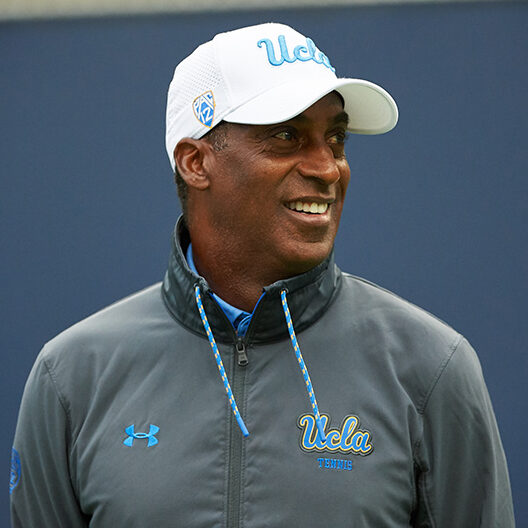
Top: UCLA women’s tennis associate head coach, Rance Brown. (Photo – UCLA Athletics)
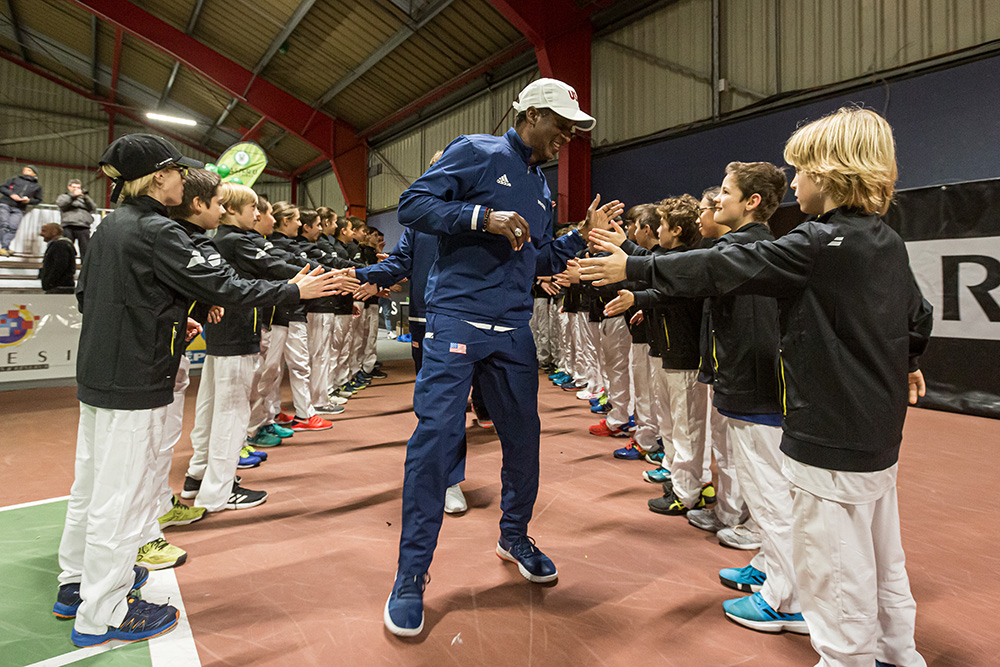
Middle #1: Rance Brown runs down a high-five line formed by young junior tennis players inside an indoor court facility. (Photo – UCLA Athletics)
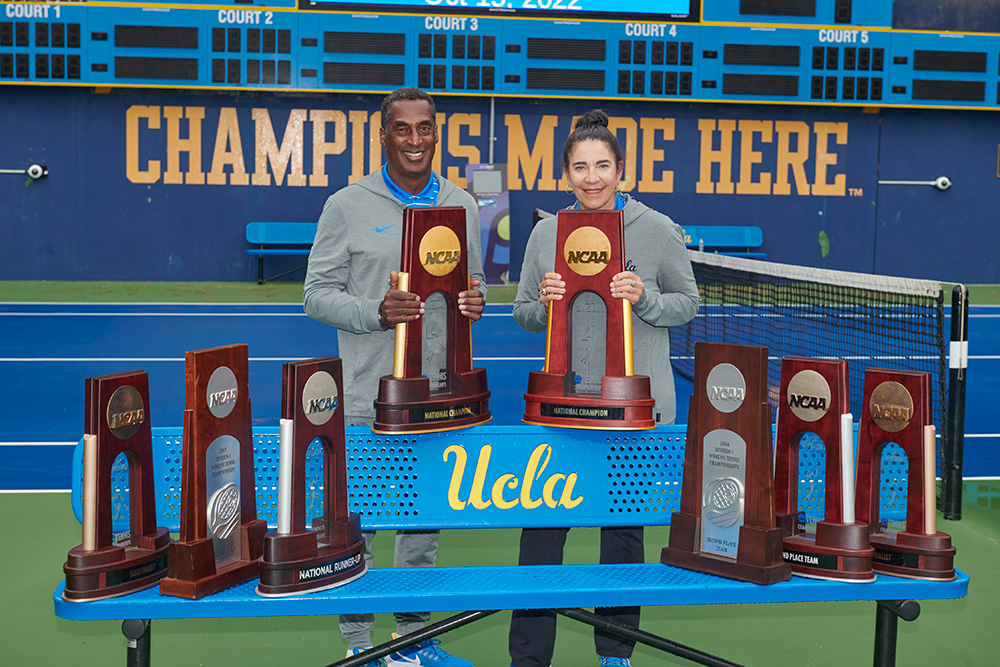
Middle #2: UCLA Women’s Tennis head coach Stella Sampras Webster and associate head coach Rance Brown pose together behind a table displaying eight NCAA team and individual trophies. (Photo – Don Liebig)
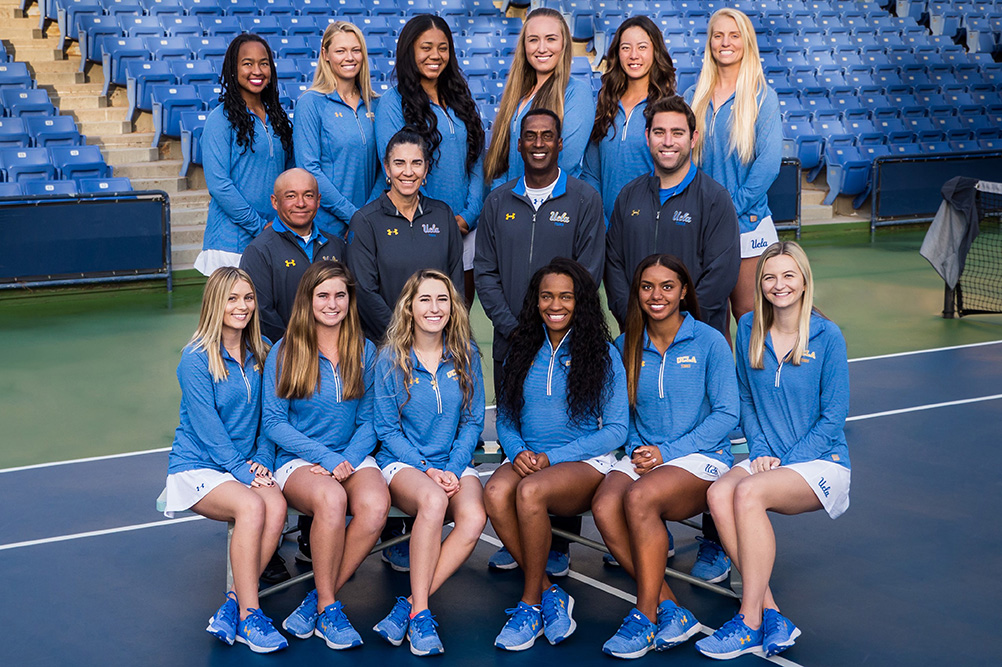
Middle #3: The 2017-18 UCLA Women’s Tennis team and coaching staff. Back row, left to right: Jada Hart, Sophie Bendetti, Gabby Andrews, Kelly Shaffer, Ena Shibahara, and Kristin Wiley. Middle row: Giancarlo “G.C.” Cava, Stella Sampras Webster, Rance Brown, and Max Hammer. Front row: Eliza Day, Abi Altick, Alaina Miller, Ayan Broomfield, Terri Fleming, and McKenzie Purcifull. (Photo – Ben Walter)
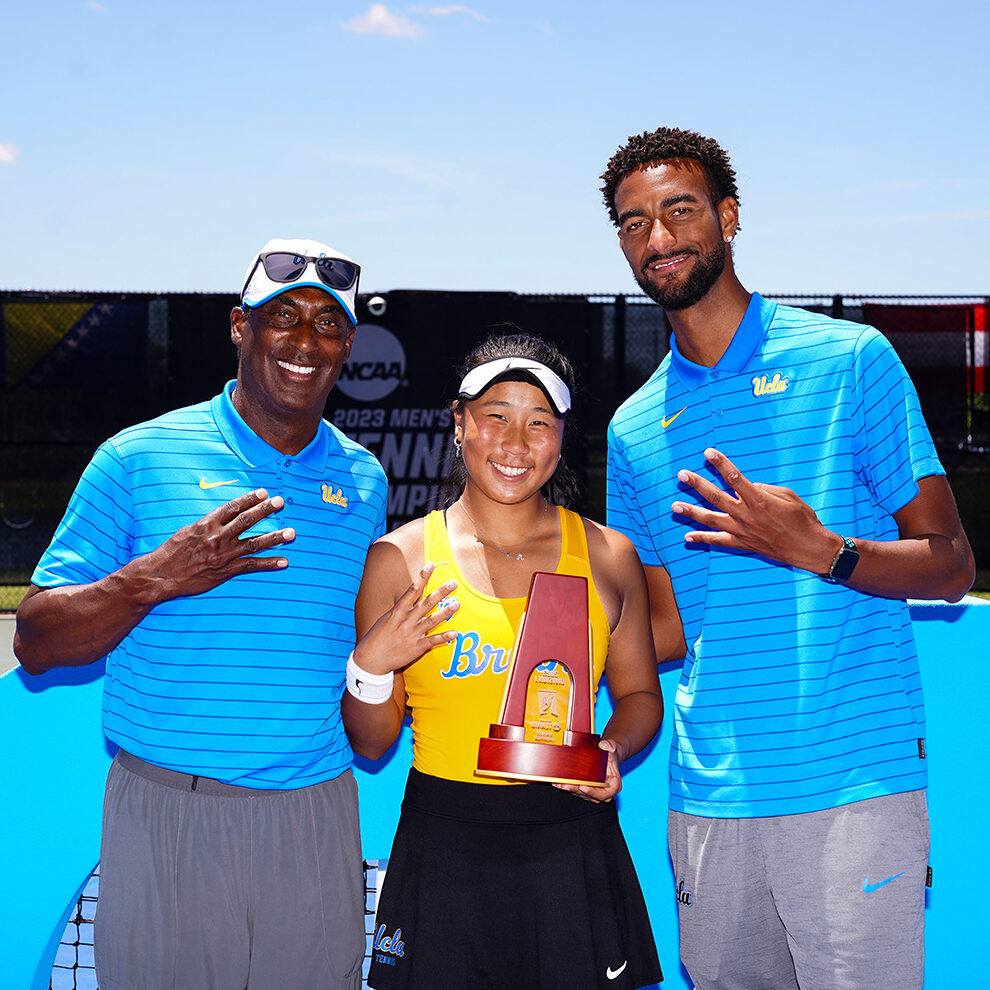
Bottom: 2023 NCAA Singles Champion Fangran Tian holds her NCAA championship trophy alongside her UCLA coaches after becoming the second Bruin to win the Division I women’s title. (Photo – Manuela Davies)
Above: UCLA women’s tennis associate head coach Rance Brown; Brown high-fives young junior tennis players.
(Photos – UCLA Athletics)
For nearly five decades, Rance Brown has built his life around tennis, investing in the sport as a player, coach, and mentor while serving as an ambassador and advocate for the game. From his early days on the junior courts of Orange County to 30 years on the UCLA sidelines helping the Bruins compete for NCAA titles and guiding future professionals, his impact across Southern California runs deep.
Now, Brown is being recognized amongst the most influential figures in the sport’s history. The UCLA women’s tennis associate head coach has been selected to the 2026 Black Tennis Hall of Fame induction class, honored in three distinct categories: Pioneer, Contributor, and Regional Legend.
Established in 2007, the Black Tennis Hall of Fame preserves the history of Black tennis and recognizes individuals who have made significant contributions to the sport, sportsmanship, human rights, and their communities, particularly those who overcame racial barriers. Members include legends like Arthur Ashe, Althea Gibson, and Dr. Robert Walter “Whirlwind” Johnson—“people whose courage, vision, and commitment helped change the landscape of Black tennis and opened doors for generations who followed,” Brown said. The induction ceremony will take place December 12 at the Virginia Museum of History and Culture in Richmond, Virginia.
Brown’s career reflects that legacy not only through his own accomplishments, but through the opportunities he has helped create for others. To be recognized alongside the pioneers who helped carve out a place for Black athletes in tennis is deeply personal for Brown and something he doesn’t take lightly.
“It is incredibly humbling to be recognized alongside those trailblazers,” Brown said. “My time in tennis would not have been possible without them, or without the enormous support of my family, mentors, players, and colleagues. As a Black man who has spent almost 50 years in a sport where there haven’t always been many people who looked like me, I understand the importance of representation and leaving the door open for the next person.”
He added that the recognition ultimately serves to reinforce his lifelong mission on and off the court.
“Personally, this honor represents both reflection and responsibility,” Brown said. “It allows me to look back with tremendous pride, but it also reminds me that the work isn’t finished. It strengthens my commitment to giving back, mentoring young players and coaches, and making tennis a more inclusive sport. If I can inspire even one young Black boy or girl to believe that they belong in this sport, to dream bigger, and to understand that they too can make history, then this honor means even more to me.”
A Southern California Tennis Foundation
Brown’s deep roots in Southern California tennis began long before his tenure in Westwood. After capturing two conference championships and a doubles title at Golden West Junior College, he played at Long Beach State in 1981 before competing professionally on the ATP Challenger tour.
Transitioning to coaching, Brown became Director of Tennis at the Newport Beach Marriott Hotel and Tennis Club, building one of the nation’s premier junior tennis programs. His players amassed over 25 national titles, with roughly 75 advancing to NCAA Division I programs, earning Brown a reputation as a master technician.
Among those juniors was Keri Phebus, who would go on to become the most decorated player in UCLA women’s tennis history and an inductee into the UCLA Athletics Hall of Fame. Brown’s dedication to her development—often showing up at 6:00 a.m. for early warmups—foreshadowed his commitment to the collegiate game. In 1993, Brown traveled to Westwood to watch Phebus, then a UCLA commit, compete and connected with then-assistant coach Stella Sampras Webster. Two years later, Phebus captured the 1995 NCAA singles and doubles titles while still working privately with Brown.
In 1996, after graduating from the inaugural USTA High Performance Coaching program, Brown officially joined the UCLA staff under Bill Zaima, eventually becoming Sampras Webster’s top assistant. The transition required immense sacrifice: as a volunteer assistant, Brown made the daily 66-mile drive from Laguna Beach to Westwood, waking up at 5:00 a.m. while earning a fraction of what he made in the private sector.
Brown credits much of his evolution as a leader to learning alongside Zaima and Sampras Webster.
“I felt I was a pretty good teacher prior to my time with them, but they made me into the coach I am today,” Brown reflected. “To be a good coach, you need to understand your players and how they learn. What motivates them could change from situation to situation. Being able to connect beyond the game plan is so important. I am so thankful to Stella; she is still teaching me new things after 30 years.”
That dedication helped build a powerhouse. Promoted to associate head coach in 2008, the same summer he was selected to coach the USTA Collegiate National Team, Brown’s UCLA resume includes two NCAA Team Championships (2008, 2014) and four runner-up finishes (2004, 2007, 2012, 2015). The Bruins have reached the NCAA Tournament in every completed season of his tenure.
Along the way, Brown earned ITA National Assistant Coach of the Year honors twice (2000, 2012) and ITA Southwest Region Assistant Coach of the Year five times (1999, 2000, 2007, 2010, and 2012). Beyond team trophies, he helped guide 36 student-athletes to 68 All-America honors and coached three NCAA doubles championship teams: Daniela Bercek and Lauren Fisher (2004), Tracy Lin and Riza Zalameda (2008), and Gabby Andrews and Ayan Broomfield (2019).
In 2023, Brown was on the sidelines for another historic milestone when freshman Tian Fangran went on a six-match run at the NCAA Championships without dropping a single set, becoming just the second Bruin in program history to capture the NCAA women’s singles title.
The two champion singles players represent the remarkable span of Brown’s career at UCLA: the junior he helped develop in Newport Beach in the 1990s and the international freshman he coached nearly three decades later.
“Before his coaching, he is such a generous and caring person,” Fangran said. “When I first came to UCLA, far away from home, he treated me like family. He is always dedicated to helping his players get better, and he is always willing to help at any time. Even during my NCAA individual tournament, I felt safe having him in my corner, knowing that if I needed anything, he would always be there. I was really lucky to have Rance as my coach during my two years at UCLA, and I truly enjoyed my time working with him.”
Beyond college competition, one of Brown’s most defining moments occurred on the international stage while leading Team USA at the World University Games. Thinking back to his parents’ sacrifices, he watched his player Kaitlin Ray gift a tennis racquet to a young girl from an underserved country and show her how to play—a moment that solidified for Brown that tennis was far more than a career.
Yet, despite the international stages and decades of accolades, Brown’s motivation remains anchored in the purity of the sport itself.
“It’s such a beautiful game because it remains a true one-on-one battle with two racquets, one ball, and a net,” Brown reflected. “How you get to that point whilst navigating through obstacles is such a reflection of life. There are ebbs and flows. Sometimes it’s easy; a lot of the time it’s hard. But at the end of the day, the one thing I hope never changes is the human element of tennis to bring joy… bringing together people from completely different backgrounds, generations, and walks of life, and creating connections that last a lifetime.”
Building More Than Champions
While the hardware is extensive, Brown’s true legacy lies in how he approaches the person behind the ranking.
“It’s simple,” Brown said when asked what he hopes former players remember about him. “How much I cared about them; not just as tennis players, but as people. Tennis was never going to be the whole book for any of them, but I hope coaching helped prepare them for those next chapters in life as parents, spouses, and leaders.”
That philosophy transformed his relationship with his athletes into lifelong mentorship.
For former Bruin standout Jada Hart, from Colton, California, Brown’s belief was pivotal from the very beginning. Rather than defining her strictly by her junior ranking, Brown recognized potential that extended far beyond her accomplishments on the court, challenging her to see past her own perceived limits and push toward a higher standard of discipline, accountability, and self-belief. Their time together in Westwood was defined not only by that constant drive for excellence, but also by a shared camaraderie and lasting memories that shaped her collegiate experience.
Similarly, national champion Ayan Broomfield recalled how Brown’s steady presence made him feel like a second father figure.
“Rance was one of those people who saw something in me before I fully saw it in myself, and I think that kind of belief can completely change the trajectory of a young person’s life,” Broomfield explained. “Becoming a national champion at UCLA will always be one of the things I’m most proud of, but Rance helped shape the person I became after tennis, too. He taught me about confidence, resilience, and believing that I belonged in whatever room I walked into.”
Years later, Broomfield can still see the impact of that belief in her life as a content creator, fashion influencer, and philanthropist.
“Looking at my life now, there are so many things I’m doing that I don’t think college-aged Ayan could have imagined, but in a way, I think Rance could,” Broomfield said. “He always made me feel like my potential was bigger than whatever was happening in that particular moment.”
For others, his leadership was taught through quiet example. Gabby Andrews from Pomona, California, remembers Brown as someone who was accomplished without ever needing his accomplishments to be the center of attention. Despite his immense success, he remained remarkably humble, teaching his team how to navigate both triumph and adversity with grace. He brought a steady, consistent presence to her corner, expecting the best from her while making sure she felt genuinely supported as a person. While the championships they won together will always hold a special place, it was those unspoken lessons about character that resonated most.
“Some of the lessons he gave me weren’t necessarily things he had to say out loud,” Andrews said. “I learned them just from watching the way he led and the way he treated people.”
Carrying the Torch of Representation
Brown’s induction into the Black Tennis Hall of Fame also highlights a vital dimension of his career: providing a model of leadership in a sport where Black representation at the head coaching level remains rare.
Nowhere was that impact clearer than during UCLA’s 2018 season, when the Bruins’ starting lineup featured four Black women: Hart, Broomfield, Andrews, and Terri Martin (formerly Fleming)—an environment Broomfield described as “incredibly special” and “pretty unique in college tennis at that level.” In a sport where minority athletes often navigate isolation, Brown created a culture where they felt understood, supported, and empowered.
“Being a Black tennis player competing at a high level was something I took a lot of pride in,” Hart said. “You realize that you’re not just representing yourself, but young Black athletes who might be wondering if there is a place for them. Rance made the other Black players and me feel seen and heard. He made us feel not only important, but proud to be Black tennis players at UCLA.”
Broomfield recalled that shared dynamic giving the team an unmatched sense of belonging, where players could show up completely as themselves.
“There was a comfort in knowing that the person in your corner understood certain things without you having to explain them,” Broomfield said. “He created an environment where we felt supported, but he also expected excellence from us. He never made us feel like our identity was something we had to minimize in order to belong in tennis.”
Having a Black coach in a position of authority took on deeper significance for Andrews as her career progressed. She noted that watching the widespread respect Brown earned across college tennis served as a powerful model of leadership during a formative chapter of her life.
In Martin’s eyes, Brown’s influence transformed how she viewed her own potential, describing representation as “the key that unlocked permission to think big and set audacious goals.”
“Seeing people that look like you, with similar upbringings and backgrounds achieving things once impossible, is always inspirational and incredibly invigorating,” Martin said.
That influence extended beyond the court. Martin said her relationship with Brown evolved from a player coach dynamic into a trusted friendship and mentorship, and that his guidance helped her see herself as more than an athlete while encouraging her to learn from those who came before her and ultimately create her own path.
“It was at UCLA where I began to think of myself as more than just a tennis player,” Martin said. “I am certain that that would not have been possible if it weren’t for having people, like Rance, a part of my journey.”
That sense of representation was also deeply connected to history. Brown frequently educated his players on trailblazers like Arthur Ashe, Althea Gibson, Lori McNeil, Zina Garrison, Robin Anderson, and Jamea Jackson—not just as a history lesson, but to empower them to carve out their own distinct paths.
“He reminded us of their courage and accomplishments, which helped make it possible for players like me to have opportunities that may not have existed for previous generations,” Hart reflected.
Connecting to that historical awareness directly inspires Broomfield’s current work bringing more Black women and young people into the sport.
“When you think about the Black players who came before us, you realize those opportunities didn’t just appear; people had to push through doors so that generations after them could walk through a little more freely,” Broomfield said. “So much of my life now is about making young people feel like this sport belongs to them, too. When I think about where that desire comes from, I have to acknowledge what I experienced at UCLA with Rance.”
As for Brown, that connection to history is grounded in his daily routine in Westwood, coaching at the institution where Arthur Ashe once played.
“I truly think every day about how I get to coach at the same place where Arthur made such a lasting impact,” Brown said. “He is the reason I picked up a tennis racquet. Seeing a Black man do what he did was what drew me in, but four words—integrity, dignity, grace, and class—are what kept him in the forefront of my mind at all times.”
He carries those same principles into his own mentorship, grounding his nearly 50-year career in faith, character, and service.
“There are definitely going to be barriers for Black tennis players and coaches,” Brown acknowledged. “My goal first and foremost is to be a good, godly person through whatever life throws at me. I stand on my faith and principles, which have led me this far. It is a difficult balance at times, but keeping my faith, walking with integrity, and loving people is of the utmost importance.”
A Career That Continues to Evolve
Brown’s Hall of Fame induction comes as he enters another season at UCLA, but it is hardly the conclusion of his story. The sport has changed significantly since he first arrived in Westwood. UCLA has moved from the Pac-12 to the Big Ten, winning the conference’s final outright regular season championship in 2024 before making the transition. The Bruins reached the NCAA super regional round in 2025 and advanced to the NCAA final 16 again in 2026.
The players have changed, the college tennis landscape has evolved, and the demands on coaches have continued to shift. Through it all, Brown has adapted alongside the game, while maintaining the same fundamental approach that has defined his career: help a player get better, help her believe in herself, and help her understand what she is capable of.
Then do it again with the next generation.
When reflecting on what advice he would give his younger self starting out decades ago, Brown’s answer comes back to trust and foundation.
“Trust the foundation your parents laid for you,” Brown said. “There will be moments when you question yourself, moments when the path ahead isn’t clear, and times when things don’t unfold the way you imagined. But stay grounded in your faith, stay true to your values, work hard, and treat people with respect. You don’t need to have all the answers or know where the journey will take you. Just keep moving forward, trust the process, and trust God. Looking back now, after nearly five decades in tennis, I can see that the journey had a purpose. Everything will be all right.”
The accolades will forever document Rance Brown’s achievements on paper. But his true legacy lives on in the lives he transformed along the way, and the doors he continues to hold open for those coming next.
As Broomfield noted, that is what makes his Hall of Fame induction feel especially fitting:
“Rance’s legacy isn’t just measured by wins, championships, or how many years he coached,” Broomfield said. “It’s also in the environments he created, the doors he helped keep open, and all of the players whose lives he impacted. I’m incredibly proud to be one of them.”