

Barrier to Competition and Success
USTA SOUTHERN CALIFORNIA
USTA SOUTHERN CALIFORNIA
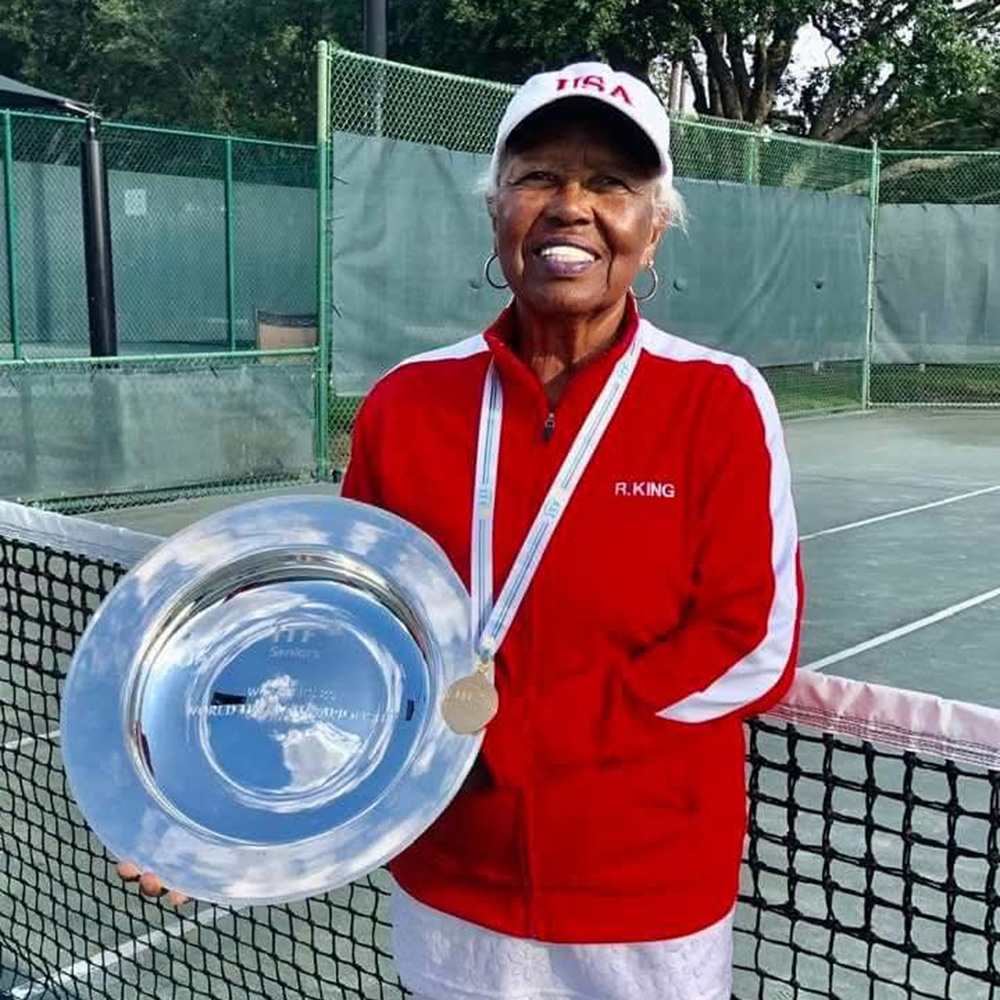
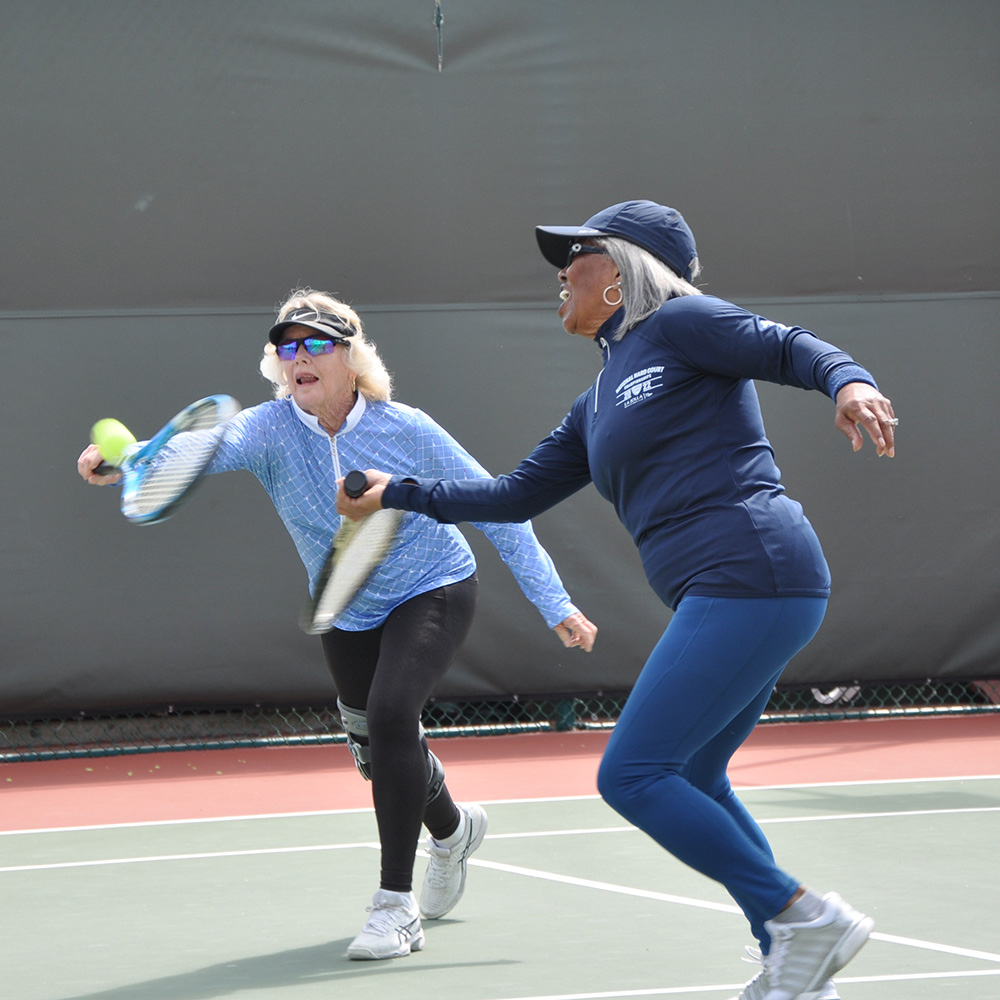
Top: Roz King representing Team USA.
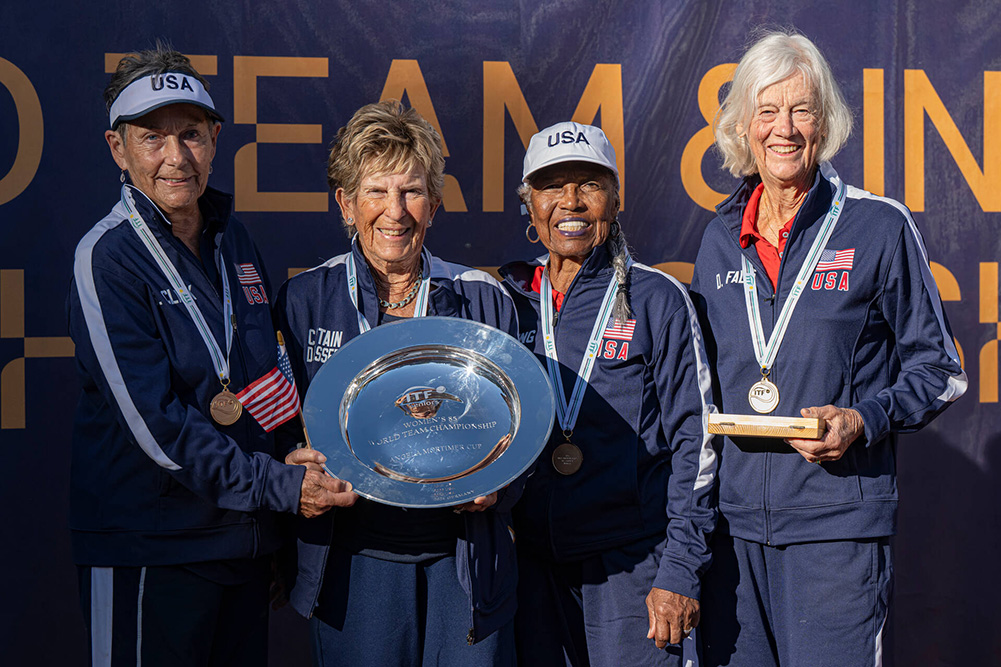
Middle #1: The Team USA Women’s 85 champions pose together with their trophy. From left to right: Susanne Clark, Dorothy Wasser, Roz King, and Donna Fales.
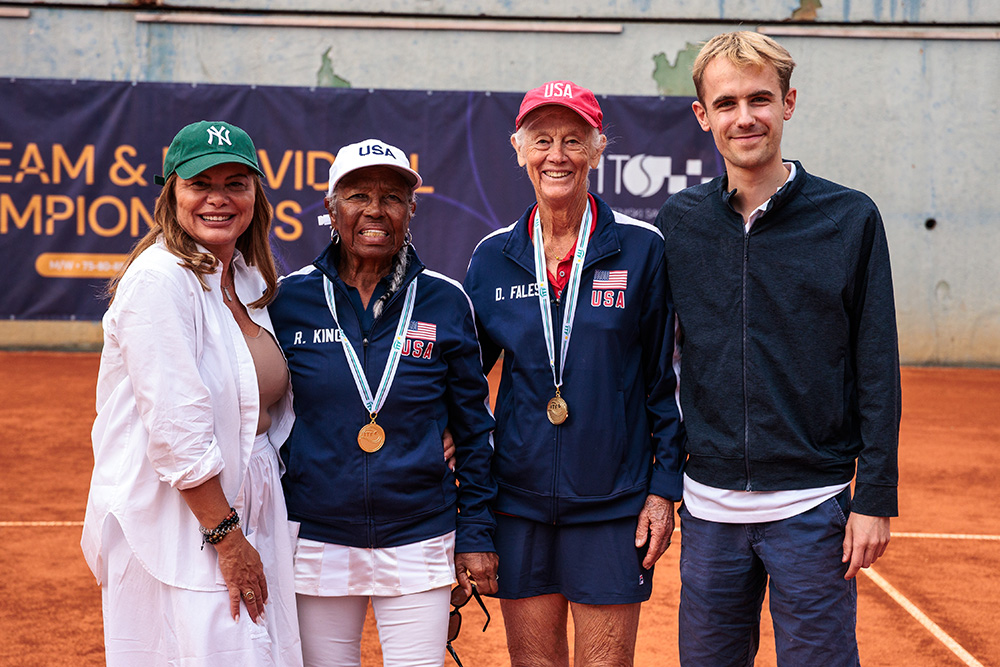
Middle #2: World Doubles champions Roz King and Donna Fales.
Bottom: Roz King and Donna Fales in action.
While most people fortunate enough to reach the age of 88 are content to enjoy quieter days, Rosalie ‘Roz’ King is doing quite the opposite. Roz is a constant presence on the San Diego tennis courts and shows no signs of slowing down anytime soon. Though she came to tennis later in life, Roz has become one of the sport’s most accomplished senior competitors. Now, she is a trailblazer, a former world No. 1, and multi organizational Hall of Famer who has represented Southern California on a national level with upwards of 45 USTA Gold Balls and multiple world championships across league, tournament, and national competition.
This National Tennis Month, Roz serves as the ultimate reminder that age is never a barrier to entry in tennis. Her career is proof that a new world of competition and community can emerge long after many believe their athletic chapters have closed.
Foundations of Service
A Northern California native, Roz was born in 1937 in the city of Quincy, while she spent the majority of her youth and early adulthood in Oroville. A student at Oroville High School, she was both a strong scholar and athlete, balancing academics with athletics as a member of the California Scholastic Federation, the Latin Club, the Girls Athletic Association, the field hockey team, and as a drum majorette.
Upon graduating in 1956, Roz received a full scholarship to Kaiser School of Nursing, where she graduated in 1959 and began her career as a registered nurse.
After spending the next ten years in NorCal, Roz made the decision to move to sunny San Diego. Looking to continue her education, she earned her Nurse Practitioner degree and license, becoming one of the early pioneers of the profession and the only African American woman in her training program. Separately, looking to expand her skill set, she attended National University, earning her bachelor’s and master’s degrees in 1974 from their business degree program, graduating as part of one of the university’s very first classes after its 1971 opening.
Working in the medical field until her retirement in 1998, Roz served in various administrative capacities with the Kaiser Medical Group, eventually rising to Director of Primary Care Services. In that role, she oversaw 18 medical offices across a 100 mile radius. Looking to further refine her leadership skills even as her professional life reached its peak, she graduated from the Leadership Program at the University of Southern California (USC) in 1995. This demanding professional environment required a physical and mental offset, leading Roz to seek an outlet, bringing her to the tennis court at an age when many athletes begin to step away from competition.
Transition to the Court
The pivot toward tennis happened almost by accident when Roz was 45 years old. While walking through a public park in Oakland, she stopped to watch a group of players in their fifties competing in mixed doubles.
“They were having great competition and fun, laughing and talking between change overs,” Roz recalled. “I visited this park several weekends just to watch, thinking I could do that!”
Unlike many elite players who developed their games at private country clubs, all of Roz’s preparation and training for tennis took place entirely on public park courts. Initially, Roz’s talent was far from apparent, and her transition to the court was humbling. She describes her early efforts as having “awful strokes,” and for the first few years, her only weapon was her speed and field hockey footwork. She focused on simply outlasting opponents by retrieving every ball, relying on her endurance while slowly building her technical game.
Her early progress was reinforced by the encouragement of friends like Virginia Glass, a Black Tennis Hall of Famer who broke ground as the first female president of the American Tennis Association (ATA) and the first woman of color to serve on the USTA Executive Committee. Recognizing Roz’s potential, Virginia pushed her to transition from recreational play toward formal competition.
With that support, Roz began entering tournaments, eventually playing her first USTA Adult National Championships in Tempe, Arizona, in her fifties. Even then, she continued to face the uphill battle of a late bloomer, often losing early while continuing to find motivation by setting small, intentional goals for improvement. As her passion grew, she began centering her vacations around tournaments, discovering that tennis provided a much needed escape to counterbalance her demanding career.
“Tennis became my mental health, stress relieving outlet,” Roz reflected.
Ascension to Excellence
Things began to click for Roz in her late fifties and early sixties, as steady progress through consolation draws turned into winning consolation draws. That success carried over into main draw seedings and growing recognition from her peers. This evolution was ignited by elite coaching and a work ethic that mirrored her academic and professional journey.
Roz credits coaches Tad Yamaguchi, former UC San Diego coach, and Ben Press for refining her game. Under their guidance, she developed a strong serve and an understanding of the game that allowed her to compete with the best in the country.
One of Roz’s most impactful memories from this period was her match against Southern California tennis legend Dorothy ‘Dodo’ Cheney. Born in Los Angeles and later passing away in Escondido, Cheney was a monumental figure in the sport. Back in 1938, playing under her maiden name Bundy, she became the first American to win the women’s singles title at the Australian National Championships by defeating Dorothy Stevenson. By the time she faced Roz, she was an International Tennis Association (ITA) Hall of Famer and a 394-time USTA Gold Ball winner.
Still relatively new to the scene, Roz was unaware of Dodo’s legendary status and assumed that because her opponent was fifteen years her senior, the win would come easily. That assumption was quickly dismantled. Dodo won the match, providing a necessary eye-opener for Roz. It was a moment that forced her to recognize not only the caliber of player Dodo was, but the level of excellence Roz herself could one day achieve.
That loss sparked a decade of dominance that saw Roz climb to the very top of the international rankings. In 2005, at the age of 68, Roz reached a major milestone by capturing her first USTA Gold Ball at the National Hard Court Championships in Folsom, California. Partnering with Dori deVries in the 65s doubles, the pair battled through a three-set final to secure the title. This win proved to be the gateway to the beginning of a prolific career. Recognition followed her rising win count, as she was named the San Diego District Tennis Association Player of the Year in 2008, a feat she would repeat in 2013.
In 2013, Roz reached the pinnacle of the sport, achieving the International Tennis Federation (ITF) world No. 1 ranking in both singles and doubles for the 75+ age division. Since then, she has become one of the rare players to win USTA Gold Balls on all four major surfaces. Her dominance reached another peak in 2017, a historic season where she achieved a national slam by winning USTA titles on hard court, clay, and indoor surfaces, while finishing the year ranked No. 1 in the world in the 80s division. This run earned her the SCTA Senior Player of the Year honors and solidified her reputation as one of the most versatile competitors in the nation.
Her success extends well beyond home soil. Roz has competed on eleven USTA World Cup teams, traveling to Spain, Turkey, Austria, Croatia, New Zealand, and Australia to represent the United States. Most recently, in October 2025, she traveled to Bol, Croatia, to help Team USA capture the Angela Mortimer Cup at the ITF Masters World Team Championships.
A Prescription of Longevity
This level of sustained elite performance is why tennis is frequently cited by researchers as the world’s healthiest sport. For Roz, the greatest evidence is in her own energy and continued desire to compete. At her home club, the Balboa Tennis Club (BTC), she is a living testament to the sport’s power.
“Roz is treated like royalty here at BTC, even though she shies away from the attention. Members who know her have complete respect and admiration for Roz,” shared Colleen Ferrell, Director of BTC.
Colleen frequently features Roz in the club’s weekly updates, highlighting her latest world ranking to motivate others.
“I usually note that Roz didn’t start playing tennis seriously until her 50’s and how amazing her run to the top of her age group has been, which inspires club members of all ages,” Colleen added.
Beyond her own training, Roz makes a point to give back, hit with others, and help them progress much like her friends did for her decades ago.
“Roz practices with players of all ages. I’ve seen her hit with a 95 year old male member all the way down to women in their 40’s,” said Colleen.
Her longevity is no accident. Roz has developed effective training methods to remain sharp without overtaxing her system. She is aware of her body’s limits and does not hesitate to scale back when necessary, a discipline that has kept her largely injury-free.
Roz’s current routine is disciplined, as she hits twice a week for ninety minutes with players in their sixties and seventies, supplemented by a weekly doubles match. Outside of tennis, she stretches religiously twice a day, tends to her own gardening, and keeps her mind sharp playing the strategic card game, duplicate bridge, both in person and online.
Advocacy and Community Work
Roz’s contribution to tennis extends far beyond her success on the court. She has dedicated years to the administrative side of the game, volunteering for more than a handful of years on the San Diego City Park and Recreation Board, over 20 years on the San Diego District Tennis Association Board, and serving on the Neighborhood Planning Committee.
Her most tangible impact can be found on the courts themselves. Because public parks were the concrete foundation of her own elite career, Roz has been a fierce lifelong advocate for preserving public spaces. As vice president and treasurer of the Greater San Diego City Tennis Council, she helped spearhead the funding and repair of 400 public courts.
“I became one of the initial members and Vice President of The Greater San Diego Tennis Council as I am a big advocate for public parks and preserving public tennis courts,” Roz exclaimed.
Her efforts have ensured that the barrier to entry remains low for others who might discover the game late in life, just as she did.
Continued Legacy and Impact
The recognition for her dual life of service and sport has been significant. In 2013, the City of San Diego proclaimed October 29 as Roz King Day to celebrate her reaching the world number one ranking. This appreciation from the tennis community continued with her induction into the SCTA Senior Hall of Fame in 2014, followed by her induction into the San Diego District Tennis Hall of Fame in 2020.
Her journey came full circle in 2017 when her hometown of Oroville added her name to the Wyandotte Academy Tennis Courts, placing her alongside legends like Arthur Ashe and Althea Gibson. Shortly after, she was inducted into the Oroville High School Hall of Fame in 2019.
Despite the world rankings and the 45 USTA Gold Balls, Roz considers her 1993 San Diego Sportsmanship Award to be her highest honor. Receiving this recognition early in her competitive career, well before her rise to international dominance, stands as a testament to her character.
An Ever-Expanding Horizon
Today, the Encanto resident remains a dedicated student of the game. Even with her extensive list of accolades, she maintains a growth mindset, often spending time with her 95-year-old husband and coach watching professional matches on television. This constant curiosity and drive for movement have become her ultimate guide for a fulfilling and happy life, one that she credits with nourishing her mind, body, and spirit.
As she prepares to enter the 90s age division, Roz offers simple, practical advice for those looking to follow in her footsteps. She suggests starting with a professional to build a solid foundation, utilizing a soft ball to master the basics, and finding a community to share the experience. She also notes that a love for dancing can be a secret weapon, as that natural rhythm translates seamlessly to the court.
Each day, Roz demonstrates that it is never too late to find success as long as there is still something to learn. She remains proof that the best set of the match might still be ahead of you.