


Tina Karwasky Breaks Near 15-Year Drought,
Clinches Gold at Women’s 65s Intersectionals
USTA SOUTHERN CALIFORNIA
USTA SOUTHERN CALIFORNIA
Top: Wendi Eusebio, Adaptive Tennis Champion of the Year; Middle: Nancy Abrams, USTA Coaching Member of the Year; Bottom: Adrian Bolton, Sales Rep of the Year.
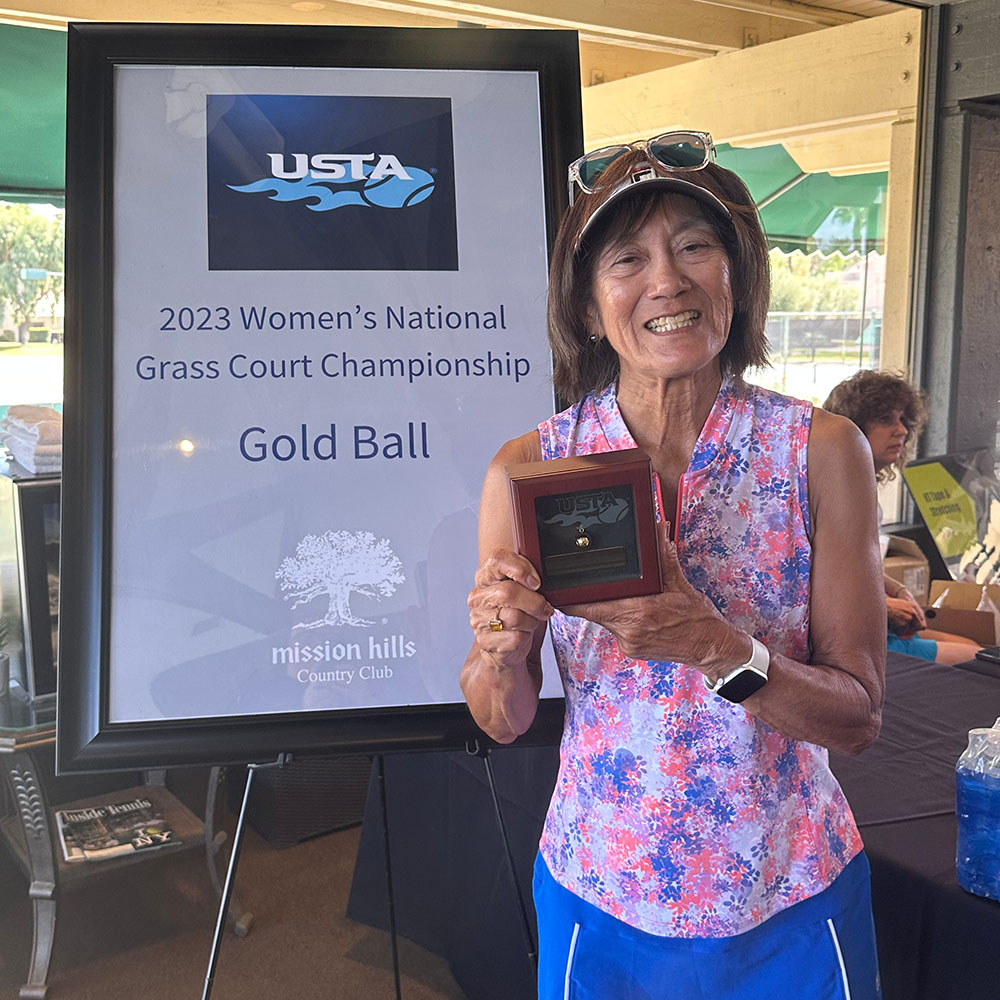
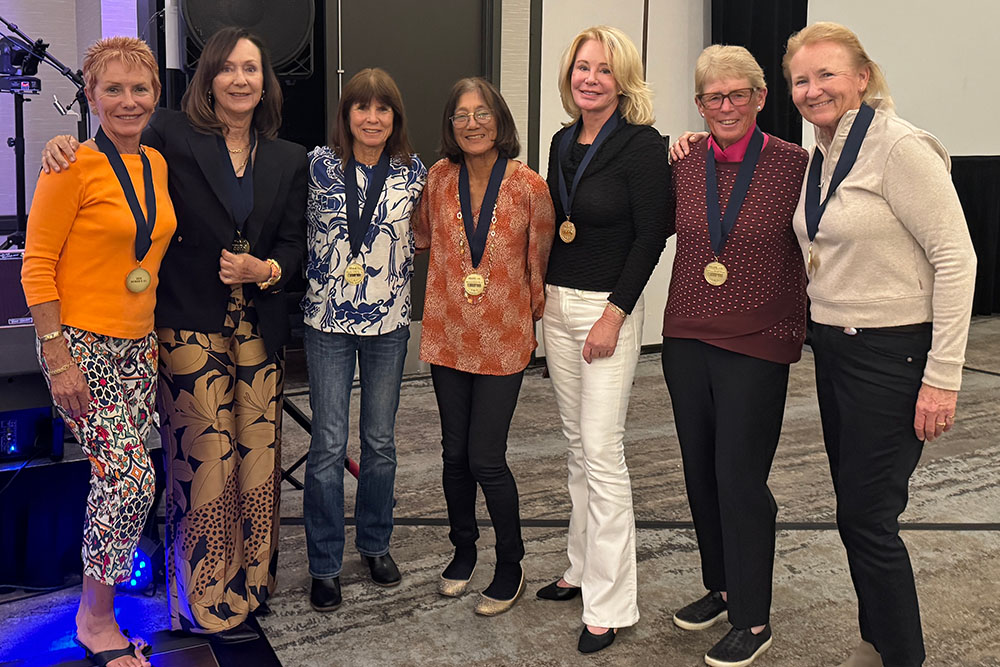
For nearly 15 years, Tina Karwasky has captained Southern California’s Women’s 55s and 65s teams to strong finishes at the USTA National Women’s Intersectional Team Championships, yet the gold medal always remained just out of reach. That changed last month, when Tina’s leadership and play helped deliver SoCal’s long-awaited championship at the 2025 edition of Intersectionals.
“Our teams have always gone to the finals but have never won gold,” Tina stated. “It was great to break the curse of being the bridesmaid for 15 years.”
A Southern California tennis legend, Tina took her next step into becoming a captain for Intersectionals following her retirement, and has led teams each year since.
A Lifetime Shaped By Tennis
For Tina, the gold medal in Phoenix was the culmination of a journey that began more than six decades earlier.
Raised in Los Angeles, Tina first picked up a tennis racquet at the age of eight, tagging along as her late mother and brother played. With no formal pathway or training system, she learned the game by repetition, spending hours hitting against the backboard and developing the consistency and heavy forehand that would later define her style of play.
“I guess I just got hooked,” Tina said. “I didn’t play other sports. Tennis was it.”
That singular focus carried her to Cal State Los Angeles, where she played No. 1 singles for the Golden Eagles from 1970 to 1974. Competing under the Association for Intercollegiate Athletics for Women (AIAW), before women’s tennis became an NCAA sport, Tina faced the top programs in the region on a regular basis, including UCLA and USC. As a junior, she advanced to the AIAW national singles final in 1973, finishing as the national runner-up and establishing herself as one of the top collegiate players in the country. Tina earned both her bachelor’s and master’s degrees in physical education, laying the groundwork for a career that would span competition, coaching, and service.
After college, Tina briefly worked as a high school teacher before turning her attention fully to professional tennis. Her first event, an Avon Futures Tour stop in Bakersfield, required her to win nine qualifying matches just to reach the main draw, an experience that, despite an early loss, convinced her she belonged at the professional level.
She went on to spend eight seasons on the WTA Tour, competing internationally and appearing in all four Grand Slam tournaments. Tina reached a career-high singles ranking of No. 79 in the world and recorded wins over several nationally ranked professionals such as Tracy Austin, Steffi Graf, Kathy Rinaldi, Alycia Moulton, and Bonnie Gadusek.
By her mid-30s, Tina was ready to step away from the tour in favor of a more stable life, but not from the sport itself. She returned to Cal State Los Angeles, where she spent the next 20 years as the head women’s tennis coach, leading the Golden Eagles to eight NCAA Tournament appearances while shaping generations of student-athletes. During her tenure, Tina coached players to eight All-American awards, guiding student-athletes from diverse ethnic backgrounds and creating an inclusive, competitive program built on accountability and opportunity.
A Cal State Los Angeles Athletics Hall of Fame inductee, Tina’s influence extended far beyond competition. In 2003, she received a USTA and ITA Sectional Community Service Award for Southern California, which included a $1,500 grant awarded to the Cal State Los Angeles tennis program. In 2007, she was honored for ten years of service as a board member of the Billie Jean King and Friends Fundraiser at Cal State Los Angeles, a role that helped raise more than $2 million in athletic scholarship support.
Now 73, Tina continues to compete at an elite level in age-group tennis, having amassed more than 100 USTA and ITF championships across singles and doubles, including multiple Gold Slams. At one point, she held the No. 1 singles ranking and the No. 2 doubles ranking in the ITF 65 and over division. Despite a résumé spanning collegiate excellence, the professional tour, and decades of coaching, an Intersectionals gold medal remained one of the few accolades still eluding her.
Intersectionals at a Glance
Held annually, the Women’s Intersectional Team Championships bring together the top players from USTA sections across the country in age divisions ranging from 35 & Over through 85 & Over.
For the Women’s 65s division, thirteen USTA sections sent teams to do battle from November 10-16 at the Phoenix Tennis Center in Phoenix, Arizona. Competing in a single elimination format, each dual match featured three singles lines and two doubles lines, with the first team to claim three points earning the victory.
Crafting a Championship Team
Representing SoCal, Tina constructed her roster with both versatility and experience in mind, selecting Colleen Clery-Ferrell, Julie David, Una Davis, Robin Harris, Jackie Head, and Elizabeth Kuhle.
Clery-Ferrell, Davis, and Kuhle returned from the 2024 silver-medal squad, while David was part of the 2023 bronze-winning team. Harris and Head made their Intersectionals debut in 2025.
Roster construction, Tina noted, is always a careful balance as a captain. “The roster construction is complicated. A captain has to put together three highly rated singles players and four very good doubles players. Any of the singles players could fill in for doubles.”
Preparation for the event was anything but simple. Though close as a group, the team was spread across Southern California, making in-person interactions a challenge.
“Our team comes from a wide area, with all of us living a minimum of two hours from each other. I live in Glendale in Los Angeles County, three players live in San Diego County, two players live in Orange County, and one player lives in Palm Desert. We have no home courts or any other commonality except for playing USTA National tournaments and league matches.”
Despite the distance, the squad made sure to get practice and match time in prior to the event. San Diego players practiced together under Clery-Ferrell’s coordination, Orange County players stayed match-ready through league play, and Tina and her Palm Desert teammate continued competing in national senior events.
“We entered this event with the mindset to compete,” Tina added. “Every player had the highest level of tenacity that a captain has to recognize. We all hate to lose.”
That shared mindset quickly translated into team cohesion.
“After the second day together I told everyone what a great team chemistry that we had,” shared Tina. “We all got along well and I was pleased that everyone was a team player.They all understood that the captain had a job of putting forth the strongest line-up considering that day’s circumstances.”
Path to Victory
Entering the tournament as the No. 2 seed, Team SoCal opened its run against unseeded Mid-Atlantic and delivered a dominant 5-0 sweep. Playing at line one singles, Tina set the tone with a convincing 6-0, 6-3 victory. Davis followed with a 6-1, 6-1 win in singles, while Kuhle added a 6-2, 6-1 decision. In doubles, the pairing of Clery-Ferrell and Harris earned a 6-2, 6-1 win, and Head and David completed the sweep with a 6-2, 6-0 victory.
SoCal controlled the match from start to finish, outscoring Mid-Atlantic 60-13 in games and not dropping a single set across all five lines.
After receiving a bye in the next round, SoCal advanced to face No. 3 seed NorCal in the semifinals. In a tightly contested dual, SoCal once again emerged victorious, this time by a 3-2 margin. Davis (6-4, 7-5) and Kuhle (6-3, 6-1) each collected their second straight singles wins of the tournament, while Clery-Ferrell and Harris clinched the decisive point in doubles with a straight-sets victory, 6-3, 7-5.
The Final That Changed Everything
Standing between SoCal and gold was a familiar foe: top-seeded Southern, the section that had ended SoCal’s championship hopes in each of the previous two years.
In a contest between the best two teams, the finale lived up to its billing.
Davis and Kuhle once again anchored singles play, each completing an undefeated run through the tournament. Davis battled through a three-set thriller, 6-2, 5-7, 6-1, while Kuhle followed with a steady 6-3, 6-4 victory. With SoCal up 2-0, attention turned to Tina, who was locked in a grueling three-set battle of her own as the doubles matches got underway.
After splitting the first two sets, the veteran captain steadied herself in the decisive moments.
“I was down myself for losing a singles match in the semifinals,” Tina admitted. “But I told myself that the finals was a brand new day. I had to beat someone almost 10 years younger than me. I had to focus and get rid of my pity party.”
Tina did exactly that, closing out a tense third set to secure the championship with a 7-5, 2-6, 6-4 victory.
“Upon winning match point, the entire SoCal team let out a loud scream of joy and swarmed Tina’s court,” Clery-Ferrell shared.
“When I won match point during the finals to win the entire championship, our team screamed in excitement and stormed my court,” Tina exclaimed. “We beat Southern. We had done the impossible!”
Southern went on to claim both doubles matches, but the outcome was already decided, as SoCal claimed the title with a 3-2 victory.
A Title Years in the Making
The gold medal carried enormous meaning for Tina and her team.
“Winning gold meant the world to this team,” she said. “They all played so well over the four-day competition. I’m very proud of them.”
The memory, she added, will last forever. “This will be embedded in my memory and my team’s memory forever. They earned it, and they’re already looking forward to a two-peat. We will embrace the challenge next year!”
Defending Their Crown
With the long-awaited championship secured, Tina now turns her attention to defending the title in 2026. Next year’s Intersectionals will bring new challenges, shifting to clay courts and relocating to the Frank Veltri Tennis Center in Florida, scheduled for November 9-15.