

at the 2026 US Open
USTA SOUTHERN CALIFORNIA
USTA SOUTHERN CALIFORNIA
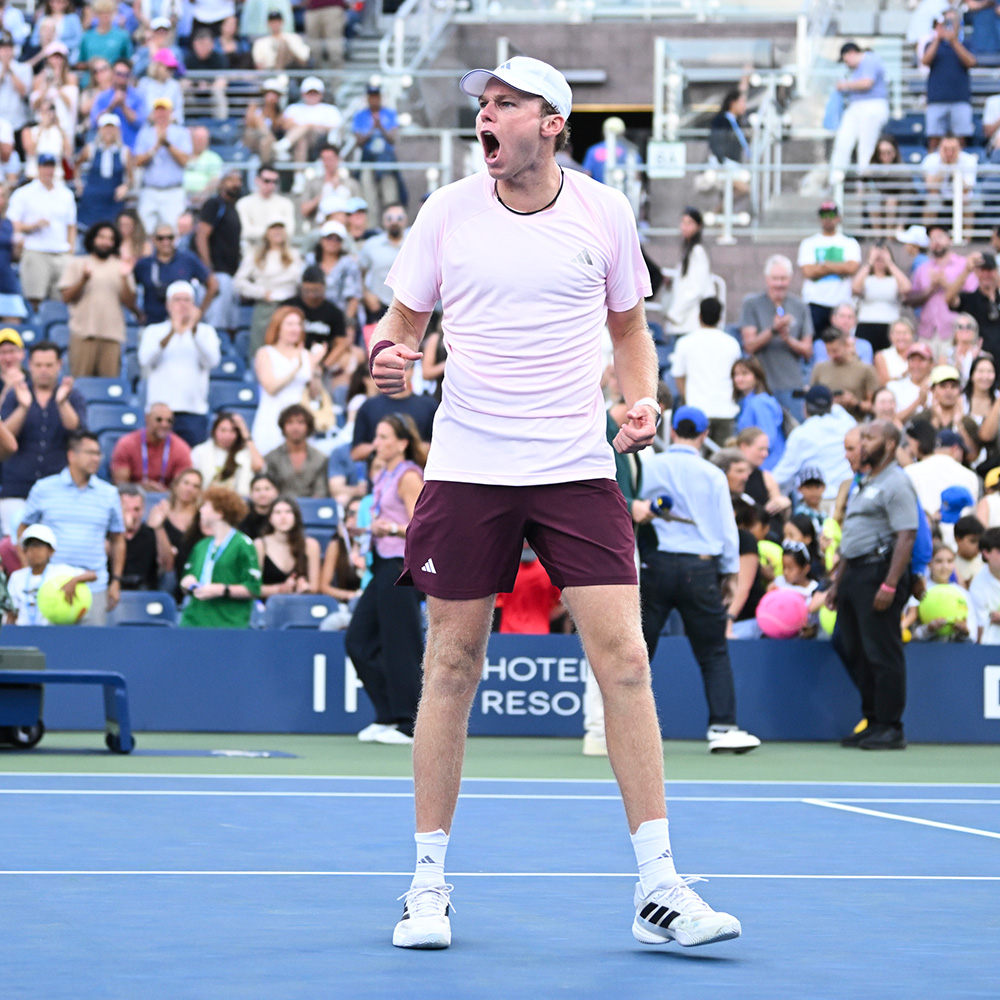
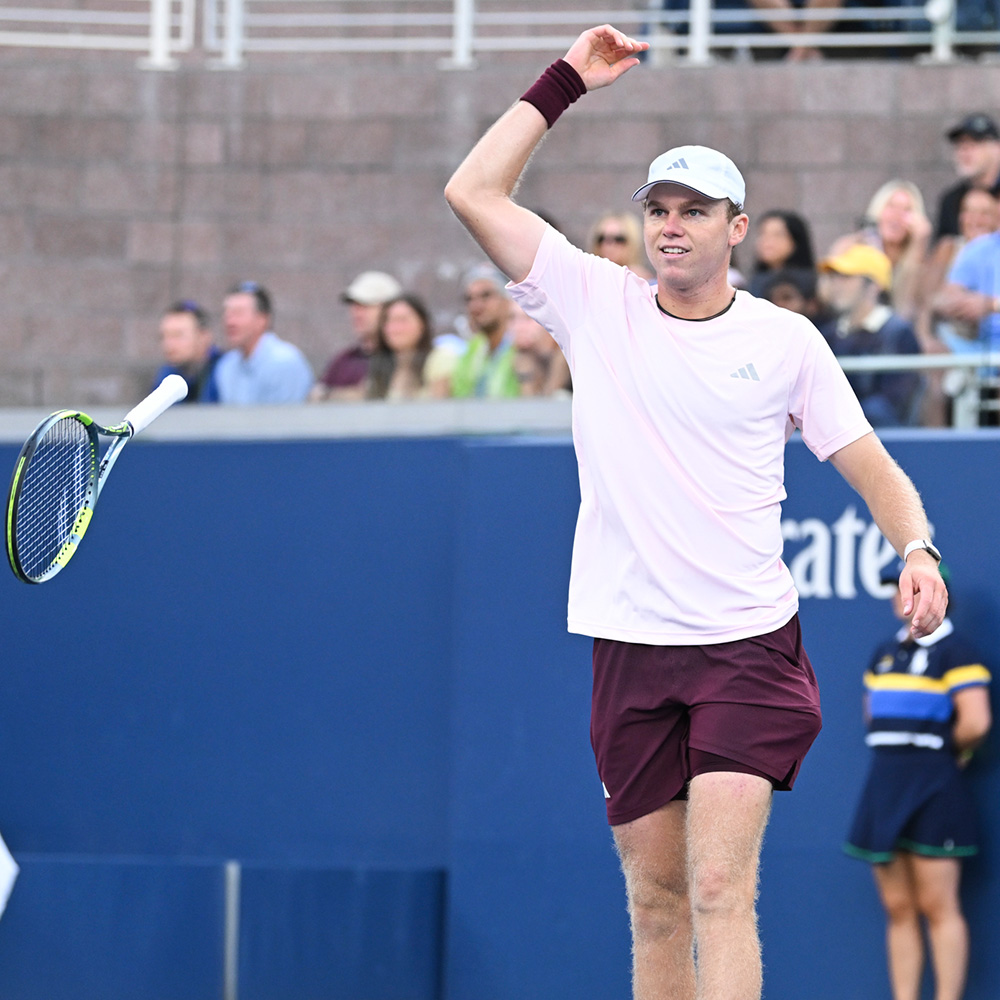
Top: Alex Michelsen lets out an intense roar in celebration after winning his fourth round match at the US Open.
Bottom: Alex Michelsen tossing his tennis racquet into the air after sealing the match with an ace.
(Photos – Mike Lawrence/USTA)
Alex Michelsen lets out an intense roar in celebration after winning his fourth round match at the US Open. (Photo – Mike Lawrence/USTA)
Hey Siri, play “California Dreamin’” by The Mamas & the Papas.
Released in 1966, nearly 40 years before Alex Michelsen was born, the California classic might as well have been written for this moment.
Because right now, Michelsen isn’t dreaming about California. He’s living the California dream with a New York state of mind.
The 22-year-old has stormed into his first Grand Slam quarterfinal at the 2026 US Open, winning four straight matches without dropping a set. On Sunday, the No. 46 ranked Michelsen took down No. 27 seed Tomas Martin Etcheverry 7-6(6), 6-4, 6-4 to become the first American man into this year’s final eight.
For Michelsen, the result is the biggest of his young career and the culmination of years of work.
“I have a lot of good thoughts right now. I can’t complain,” Michelsen said after the match. “I’ve been playing super well the whole week. I have a lot of emotions right now. I’m a little bit short for words, but I’m super happy.”
He admitted he was surprised to find himself in this position, especially after entering the tournament without his best form. But he was never surprised that a moment like this would eventually come.
“I’ve been working my ass off for, I don’t know how many years, playing this sport,” he said. “I’m a little bit surprised that it came like this, but at the same time, I always had a feeling it would come.”
That work has been on full display since he first stepped on court on August 30.
A Statement Week in New York
Michelsen arrived at the US Open without the same attention surrounding some of the other young American men. Earlier in the tournament, he said he preferred to stay “a little bit under the radar,” a mindset that allowed him to focus on the next match rather than the noise surrounding it.
Four matches later, there is no hiding.
He opened his tournament with a dominant performance against Federico Cina, 6-4, 6-1, 6-0, before dismantling San Diego’s Brandon Nakashima, the No. 16 seed, 6-3, 6-3, 6-4. It was a particularly compelling matchup between two Southern Californians who came through the same tennis ecosystem, but Michelsen treated it as another opportunity to prove what he could do.
Nakashima had arrived in New York riding the best stretch of tennis of his career. He had reached the Masters 1000 final in Montreal, the semifinals in Cincinnati, and climbed to a career high No. 17 ranking. Michelsen was ranked 29 spots lower.
It did not matter.
Michelsen played aggressively from the baseline, served at a high level, and maintained pressure throughout the three set victory. He also drew on the familiarity built through their frequent practice sessions, using his knowledge of Nakashima’s game to anticipate tendencies on the biggest points.
He became one of 15 Americans to reach the third round of singles at the US Open, the most since 2002, joining fellow Southern California standouts Taylor Fritz (No. 9 seed), Iva Jovic (No. 14 seed), and Learner Tien (No. 14 seed).
By the end of the first week, Southern California had made its presence impossible to ignore. Jovic and Tien, both No. 14 seeds in their respective draws, also advanced to the fourth round on Saturday, putting three players who came up through the SoCal tennis scene from the same generation into the second week of the US Open.
The Match That Changed Everything
Michelsen was the first of the three back in action for the round of 16. Sunday’s showdown with Etcheverry was the kind of match that can change the trajectory of a tournament.
The 6-foot-4 Michelsen looked completely at home on the US Open hard courts, taking control with his serve and heavy groundstrokes while repeatedly moving forward to finish points at the net. He finished with 44 winners and 12 aces, keeping the pressure on an opponent whose game is traditionally more comfortable on slower clay courts.
But the first set was anything but easy.
Michelsen found himself facing two set points at 4-6 in the tiebreak, just four points away from losing his first set of the tournament. Instead, he won the next four points to steal the opening set.
Looking back, Michelsen was candid about what was going through his mind.
“I played a horrendous breaker up until 6-4, to be completely honest,” he said. “I made a lot of errors, a lot of bad decisions. I was like, ‘Oh, I don’t deserve to win this set. Let’s just play a little free.’”
That looseness changed everything. He hit a couple of big volleys, played a great point at 7-6, and escaped with the set.
“Once I got away with the first set, I thought I had a good chance,” he said.
He was right.
Michelsen broke in the fifth game of the final set and never looked back. He closed out the 2 hour, 46 minute battle with an ace, then celebrated with a racquet flip and a roar as the magnitude of the moment sank in: his first Grand Slam quarterfinal and a place in history as the first man born in 2004 to reach a Grand Slam singles quarterfinal.
The nerves were there throughout the tournament. Michelsen simply learned not to let them dictate how he played.
“It’s a human experience,” he said. “It’s just about going out there and managing them to the best of my ability.”
For Michelsen, that has meant focusing on the only thing in front of him.
“One point at a time,” he said.
It sounds simple, but he acknowledged that it is something he has not always done well. In best of five matches, looking too far ahead can make the task feel overwhelming. There are too many games, too many sets, and too many points to win.
This week, he has stayed in the moment, and it has worked.
Learning to Believe
There is something fitting about Michelsen finding his biggest Grand Slam moment on a hard court. He grew up playing on them in Southern California, progressing through the same junior pathway that has helped produce so much of the region’s talent. But his journey to New York was anything but predetermined.
Michelsen was once an Aliso Niguel High School varsity player who did not expect tennis to take him this far. He became the first player in school history to reach a CIF singles final before finishing his education through Laurel Springs School, an online program that gave him the flexibility to pursue tennis at an increasingly serious level.
In 2020, he won the Southern California Boys’ 18s Junior Sectional Championship. Two years later, at 17, he swept the Boys’ 18s singles and doubles titles at the Easter Bowl in Indian Wells, becoming the first player since Donald Young in 2006 to accomplish the feat. He defeated Nishesh Basavareddy in the singles final and teamed with Sebastian Gorzny to win the doubles title.
By then, a professional career was beginning to feel possible. At 16, a coach told Michelsen he had Top 100 potential, planting a belief that continued to grow as his results followed. He eventually committed to play college tennis at Georgia, but 10 days before he was scheduled to leave for Athens, he changed course and turned professional instead.
His parents supported the decision. His mother, Sondra, was a standout Division I player at San Diego State, while his father, Erik, was a three-time All-American at the University of Redlands.
It was a risk, and the transition to the professional tour tested him. Suddenly, Michelsen was competing against players he described as “psychos” and “unreal,” a level of tennis that made the early stages of his career difficult.
“All these guys are psychos, they’re unreal. It gets tough,” Michelsen said.
But the belief that he could belong at that level remained.
Michelsen understood that believing he belonged was essential, particularly when the biggest moments arrived. He carried that mindset into his three set victory over Nakashima, a player he knew well from their frequent practice sessions.
“If you don’t [believe], I feel I’ll lose a match like today’s match or against Nakashima,” Michelsen said.
Now, that belief has carried him from a Southern California high school court to the US Open quarterfinals. His journey is a reminder that there is no single timeline for development and no one correct path to success. Michelsen found his, trusted it, and brought that belief with him to New York.
From SoCal Rivals to Grand Slam Rivals
Part of what makes Michelsen’s run compelling is the company he keeps. He and Learner Tien grew up pushing each other through the Southern California junior circuit and remain close friends.
“Learner’s been my guy for five, six years now,” Michelsen said. “We’ve put in so many hours together, trained at the same academy. Had the same coaches for a long time. He’s one of my best friends.”
While Tien has captured plenty of headlines during his own breakout season, Michelsen is making sure his name belongs right alongside him.
The Next Test
Michelsen’s reward for reaching his first Grand Slam quarterfinal is another all-American showdown, this time against Frances Tiafoe, who defeated former US Open champion Daniil Medvedev in straight sets to reach the final eight.
Tiafoe is no stranger to this stage. He reached the US Open semifinals in 2022 and 2024 and is 10-0 on Louis Armstrong Stadium, where he defeated Medvedev on Sunday.
Michelsen has lost both of his previous meetings with Tiafoe, but this matchup carries a different significance. As a 13-year-old, Michelsen sat in the stands at Arthur Ashe Stadium and watched Tiafoe battle Roger Federer at the 2017 US Open. Now, he could find himself sharing that same court with him in a Grand Slam quarterfinal.
“I’ve played him twice. I’m 0-2. Going to have to change something a little bit,” Michelsen said. “Frances has the ‘it’ factor, but he’s also an unbelievable guy and a very good friend of mine. I think it’s going to be an absolute blast.”
If the match is played on Ashe, it would be another first in a week already filled with them.
For Michelsen, the significance would extend far beyond simply playing on the biggest court in tennis. It would bring his journey from Southern California junior tennis into full view, from the Sectionals and Easter Bowl to high school matches, practices, friendships, losses, and the decision to turn professional. Along the way came wins over Top 10 players, injuries, and moments when other players received more attention.
Four matches into the US Open, the kid from Aliso Viejo who once doubted whether tennis could take him this far has yet to drop a set.
His California dream was not built overnight. It was built one point at a time.
And on tennis’s biggest stage, Alex Michelsen is just getting started.