

Heritage with Tennis Towns Distinction
USTA SOUTHERN CALIFORNIA
USTA SOUTHERN CALIFORNIA

L to R: Kelly Jones, Lornie Kuhle, Jai Nettimi, Trevor Kronemann, Peggy Michel, Mayor of Indian Wells Dr. Topper Taylor, Gordon ZawTun, Caerwyn Evans.
(Photo – Rachel Scalera/USTA SoCal)
In Memoriam: This feature was researched and written following an in-person interview with Gordon ZawTun in March 2026. After news of his passing in April, we publish this story as a tribute to his decades of leadership and immense impact on the Coachella Valley tennis community. As a Section, we are deeply grateful to Gordon for his years of serving the Southern California tennis community and for creating a lasting, positive impact on so many lives. We know that his professional legacy will live on through the players he mentored, while his kindness will endure through the many others who were moved by his character. Our deepest condolences and thoughts are with his loved ones and the players and families who were part of his journey on and off the court.
USTA Southern California continues its Tennis Town series, an initiative that spotlights thriving tennis communities across the region, from the Central Coast to San Diego and from the Inland Empire to the Pacific Ocean. Each community has a unique story, shaped by its history, achievements, and contributions to the growth of the game. These towns create opportunities for players of all ages, backgrounds, and abilities. From private clubs and college courts to public parks, they champion grassroots, community-driven programs while fostering an inclusive and welcoming environment.
Since launching in 2025, Tennis Towns has recognized communities with rich tennis traditions and strong player engagement. Each feature includes an in-depth written profile paired with a video spotlight showcasing the people, history, and unique character of the community.
The first four Tennis Town honorees—Bakersfield (March), Ojai (May), Claremont (August), and Long Beach (October)—were each recognized for preserving tennis history while promoting the game’s future. The series not only celebrates communities with outstanding facilities, programs, and tournaments, but also highlights the volunteers, coaches, and advocates who make tennis a vibrant part of local life.
The Coachella Valley now joins this distinguished list as the latest Tennis Town in Southern California, recognized for its world-class facilities and events, vibrant year-round tennis culture and community, influence on the sport, and dedication to growing the game at every level.
–
Sitting just two hours east of Los Angeles, the Coachella Valley is a desert oasis that holds as much history as it does heat. While many are drawn to the area for world-renowned music festivals like Coachella Valley Music and Arts Festival and Stagecoach, or to retreat in its luxurious, sun-soaked resorts, another story has steadily taken root. Tennis, woven quietly but deeply into the fabric of the valley, has transformed this desert escape into something more enduring. Far from just a nickname, “Tennis Paradise” represents a century-long legacy in American sport.
A Resort Town with a Connection to Hollywood
The Coachella Valley’s emergence as a tennis destination began in 1927 with the opening of the El Mirador Hotel. The area’s first true luxury resort, it featured a landmark 60-foot bell tower overlooking what would soon become a desert sanctuary for Hollywood’s elite.
Icons like Marilyn Monroe, Shirley Temple, Errol Flynn, and Lucille Ball frequented the hotel, drawn by its privacy, space, and world-class amenities. Championship tennis courts quickly became part of the resort experience, helping define the valley’s identity beyond hospitality and leisure.
During World War II, the El Mirador property was converted into Torney General Hospital to serve wounded soldiers. After a brief return to hotel use, it was redeveloped as Desert Regional Medical Center, which still stands today. While the original structures are gone, the bell tower remains a lasting symbol of the era that first put Palm Springs on the map.
A major shift followed in 1934 when actors and tennis enthusiasts Charlie Farrell and Ralph Bellamy opened the Racquet Club of Palm Springs, starting with just two courts and a snack bar. It soon became one of the first private Hollywood social clubs in the desert, built around sport and informal gathering rather than the traditional hotel setting. Its rise aligned with the common 1930s-1950s Hollywood studio “Two-Hour Rule” which required actors to remain within a two-hour radius of Los Angeles during production schedules for quick access to reshoots or callbacks. Recognizing its profound impact on the city’s heritage, the Palm Springs City Council designated the Racquet Club a Class 2 historic site on January 28, 2021.
That positioning made the desert a natural hub for leading actors like Humphrey Bogart, Clark Gable, and Lana Turner, where tennis and social life became tightly linked. Over time, the region shifted from seasonal visits to permanent residence. Elvis Presley famously established homes here, while others such as John Wayne and Bob Hope became such a part of the community that major streets are now named after them.
By mid-century, the valley had evolved beyond a retreat into a cultural meeting point for entertainment and sport. Frank and Barbara Sinatra became central figures in that ecosystem, helping connect the two worlds.. Frank’s connection to the game extended through friendships with legends like Don Budge, the first player to achieve a calendar-year Grand Slam, and Charlie Pasarell.
As the desert’s tennis culture evolved from social clubs into a major professional destination, figures like Pasarell helped bridge that transformation, carrying its early momentum into the modern tournament era.
“The 1995 [men’s singles] finals match between Andre Agassi and Pete Sampras took the air of a heavyweight championship fight,” shared Pasarell, a top-ranked professional in his own right, who would eventually become the visionary pioneer who transformed the Coachella Valley into a global tennis epicenter. “We started getting phone calls from people that were ready to fly their private planes and needed tickets. Barbara Sinatra always came to the tournament, but Frank never did—until this time, when he wanted to come. I had to get a special seat for the Sinatras and they asked me to sit next to them. Pete beat Andre quite handedly so it wasn’t that great of a match, but the buildup was incredible. We could have sold 20,000 more tickets than we did.”
This era created a lasting connection between Hollywood and tennis that continues today at the Indian Wells Tennis Garden. Each year, the Garden, home of the iconic BNP Paribas Open, draws a new generation of Hollywood entertainers like Zendaya, Tom Holland, Kylie Jenner, and Timothée Chalamet, alongside thousands of fans watching the best players in the world compete on the professional tour.
Beyond the tournament, Desert Smash serves as the premier modern intersection between the Coachella Valley, professional tennis, and the entertainment industry. Founded in 2004, this annual philanthropic event takes place during the first week of March, serving as the unofficial kickoff to the Masters 1000 event. Held at the La Quinta Resort & Club, it raises significant funds for charitable causes while featuring professional athletes, celebrities, and influencers.
In 2026, the primary beneficiary was the USTA Foundation, an organization dedicated to transforming the lives of young people through the powerful combination of tennis, education, and mentorship. Since its inception, the Desert Smash has grown into a global spectacle, drawing massive media attention while raising millions. The 2026 edition featured a mix of current and former top ATP and WTA pros, including Southern California’s own Tracy Austin, Bob and Mike Bryan, and Iva Jovic alongside Alex de Minaur, Victoria Mboko, Lorenzo Musetti, Naomi Osaka, Elena Rybakina, and Alexander Zverev, among others. Notable entertainment and sports figures in attendance included Lance Bass, Reggie Bush, Colton Haynes, Jarvis Landry, Jon Lovitz, Yvonne Orji, Cheri Oteri, Gavin Rossdale, and Regina Hall.
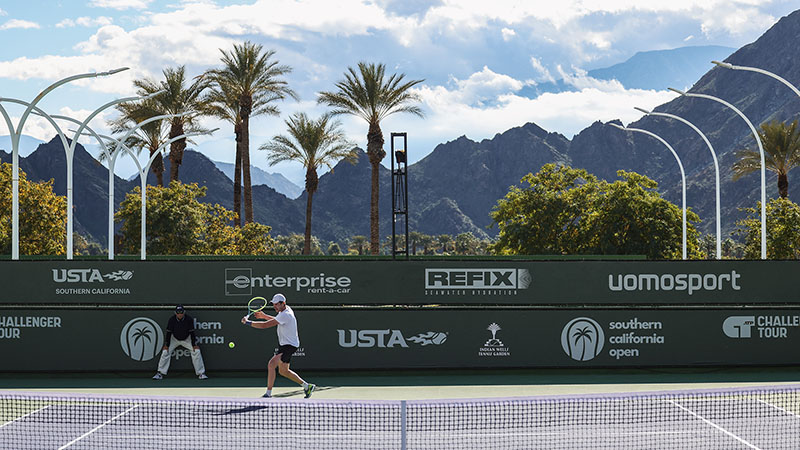
The Southern California Open, two straight weeks of ATP Challenger-level events, was held at the Indian Wells Tennis Garden in January 2024.
(Photo – Jon Mulvey/USTA SoCal)
Weathering the Elements
As much as people were initially drawn to the Coachella Valley to escape the pace of Los Angeles, the desert’s climate was an equal appeal. The area earns its reputation as a premier destination from October through May, offering what many consider the best athletic climate in the country, with winter temperatures averaging between 70 and 75 degrees.
For tennis, this means reliable, year-round play. This pocket of Southern California offers minimal rainfall and predictable conditions, allowing players to train and compete without the interruptions of snow and severe storms common in other regions.
From June through September, however, temperatures regularly exceed 100 degrees, forcing the local community to adapt. During these months, courts come alive in the early morning before the sun rises or after sunset, when the desert finally begins to cool and the sun dips behind the mountains.
“The weather is amazing and allows you to play tennis year round,” shared Jai Nettimi, Director of Tennis at the Indian Wells Tennis Garden. “You don’t need to look outside to see what the weather is going to be like for you to participate—it’s impeccable and reliable.”
Growth of Club Culture
Building on the foundation of early Hollywood-era clubs, the Coachella Valley region experienced an explosion of dedicated tennis facilities. The Palm Springs Tennis Club was an early hub, established in the late 1930s to attract legends like Bill Tilden and Jack Kramer.
As the population grew, tennis expanded from hotel courtyards into the heart of residential life. This shift was accelerated during the 1970s tennis boom, fueled by the rise of color television and global, charismatic stars like Long Beach’s Billie Jean King and Björn Borg. The Coachella Valley responded by building entire neighborhoods around courts, embedding the sport into daily life.
While Palm Springs served as the original sanctuary and playground, the sport soon expanded east. Shadow Mountain Resort became the catalyst for tennis in Palm Desert, offering a high-performance environment for players nationwide. In Rancho Mirage, Mission Hills Country Club set a new standard by offering grass, clay, and hard courts, a rarity at the time.
The 1980s brought large-scale developments like the JW Marriott Desert Springs and the Renaissance Esmeralda Resort & Spa, expanding access to professional coaching to both locals and tourists. Other iconic spots like the Omni Rancho Las Palmas and Palm Valley Country Club helped create the tennis-first lifestyle that defines the valley today. These venues eventually became hosts for USTA League play and junior tournaments, ensuring the valley remained the top destination for competitive tennis in Southern California.
A unique element of this culture is a feature called the Game Arranger. Because many residents live in the area seasonally, clubs developed a system to keep players consistently matched. Club professionals act as coordinators, tracking skill levels of hundreds of players and organizing daily matches that keep the community active and connected.
With the high concentration of elite clubs, the desert became a magnet for retired former professional players. Many of them remained in the area to lead programs and mentor the next generation of talent, further solidifying the valley’s reputation as a premier tennis destination.
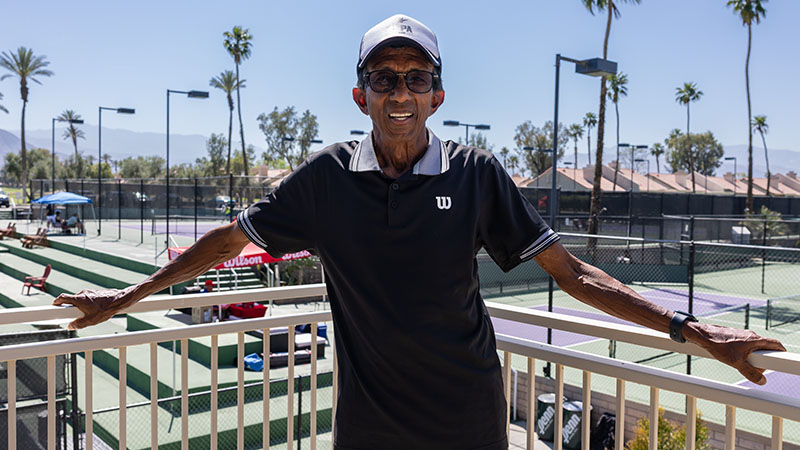
Gordon ZawTun (above), former Director of Tennis at Palm Desert Resort Country Club and Palm Valley Country Club, left a lasting legacy on the Coachella Valley tennis community. (Photo – Rachel Scalera/USTA SoCal)
Coaching & Development of Public Play
Over the decades, the Coachella Valley has developed into a unique tennis ecosystem shaped by an influx of former ATP and WTA professionals who settled in the region to lead resort programs. That presence elevated the overall standard of instruction and gradually influenced the public court scene, creating a landscape where private clubs, resort programs, and public parks operate within the same interconnected tennis culture.
That structure has also helped position the valley as a premier recruiting ground for college tennis. Many local high school programs are often led by the same pro-level coaches who work at the resort system, creating a direct pathway for junior players moving from public courts into competitive high school tennis and, eventually, college opportunities.
The desert’s coaching network was long anchored by veteran leaders like Gordon ZawTun, whose recent passing left the community mourning a mentor who spent decades training talent and shaping lives in the Coachella Valley. ZawTun helped shape a culture where character development carried as much weight as high-performance training.
This concentration of expertise is matched by an unusually strong infrastructure of world-class facilities that are available to everyone, with a culture that prioritizes youth mentorship just as highly as elite competition. While many communities of similar size rely on limited public courts or a few high school courts, the Coachella Valley offers access to professional-grade surfaces at Palm Desert Civic Center Park and Fritz Burns Park in La Quinta. Even prestigious venues like the Indian Wells Tennis Garden and the La Quinta Resort & Club offer public court rentals and clinics. This ensures that the “Tennis Paradise” experience is available to everyone who calls the Valley home.
“I’ve seen kids grow up with tennis in their life who then go on to college and start their careers, but we still remain close because of the sport,” shared International Tennis Hall of Famer Rosie Casals, a trailblazer of the “Original 9” who, alongside partner Tory Fretz and the Love & Love Tennis Foundation, works to dismantle barriers for underserved youth. “Tennis gives them purpose and stability; it teaches them how to win and lose and how to deal with life. All of them have made themselves better people because of it.”
While Casals emphasizes the internal growth of the players, ZawTun’s philosophy centered on the accessibility of the game. Even after his passing, his vision of an inclusive desert tennis community remains a guiding principle for local pros.
“We have an open system here, not just for members,” stated ZawTun. “Any club will welcome a guest or tourist to come and play. Because there are so many facilities, we can find a match for any level of player, and that is what makes this town so special.”
Joining them in this mission is Kay Butler, who has spent over two decades expanding opportunities for youth across the valley, ensuring everyone has a place on the court regardless of their finances. Through Grassroots Junior Tennis, her nonprofit provides free, year round instruction for underserved players, helping foster cohesion between private facilities and local neighborhoods.
“I found that many underprivileged kids couldn’t take lessons because they couldn’t afford it,” stated Butler. “I started Grassroots Junior Tennis so they can learn all year long without having to worry about money. It’s a wonderful sport for kids around here, and it’s important to provide those opportunities.”
Another figure defining the modern era of desert coaching is Caerwyn Evans, the founder of WynTennis. Originally from Western Australia, Evans has been a fixture in the desert since 2005 and has impacted the game across multiple levels, from high school competition to international events. He guided the Palm Desert High School girls team to a CIF Championship in 2009 and helped popularize the high-energy live ball sessions that are now a staple of local play. Today, he also serves as the director for the ITF World Masters Tour at the Indian Wells Tennis Garden. This event brings thousands of international players to the desert and reinforces the Valley’s role as a global destination for competitive tennis across all ages. Despite managing world-class events, Evans finds his greatest fulfillment is the individual breakthroughs of local players.
“You have to get out of your own head and remember what influence you have on the planet, because it’s bigger than us,” mentioned Evans. “One of my favorite things working with kids is when you get the light bulb that comes on and everything clicks for them. I remember a parent asking me, ‘Is there any hope for my kid? Do they get it?’ and I told her to just wait. Three months later, everything was coming to play—rallies, shots, crosscourt, hitting down the line. It was amazing. I looked at her and she was just streaming crying. That gives me shivers down my spine even thinking about it.”
A key driver of the junior pipeline has been the growth of Junior Team Tennis (JTT). This movement was led by Eli Celis, head coach at Xavier College Preparatory High School in Palm Desert, who helped launch the area’s first JTT teams. Celis recognized that the sport needed to move beyond individual lessons and into a team-based format to truly thrive. Through his work with the Coachella Valley NJTL (National Junior Tennis and Learning), Celis continues to prioritize accessibility. By providing equipment and high-level coaching to players from all backgrounds, he ensures the sport remains a community-wide asset rather than just a resort luxury.
“I think the one thing that makes junior tennis unique is that you see every financial situation,” said Celis. “You see kids that come from a really well-off background and the kids that don’t get the exposure, like I did. Creating an equal opportunity for all kids, regardless of their financial means, is about creating a sport where everybody can enjoy it.”
The Pro Revolution
Beyond hosting the world’s top talent, the Valley has also established itself as a pipeline for homegrown stars.
Born in Rancho Mirage and raised in Palm Desert, Desirae Krawczyk is the ultimate local success story. Now 32 years old, Krawczyk grew up on the Valley’s public and club courts before leading Palm Desert High School to a CIF Championship in 2009. After a standout collegiate career at Arizona State, she transitioned to the professional tour and has become one of the most dominant forces in doubles.
Her resume includes four Grand Slam mixed doubles titles, with wins at the French Open, US Open, and back-to-back championships at Wimbledon. By 2024, she reached a career-high world ranking of No. 7. For Krawczyk, competing at the Indian Wells Tennis Garden is more than a tour stop, but a homecoming. She represents the realization of a local dream as a kid who once watched the world’s best from the stands and then returned to conquer those same stages herself.
The next wave is already taking shape in players like 18-year-old Charlie Cooper, a rising force in wheelchair tennis. Growing up just minutes from the Indian Wells Tennis Garden, Cooper developed his game in an environment where elite competition was part of the everyday landscape. His ascent has been swift, reaching a career-high junior world ranking of No. 2 and earning ITF Junior Wheelchair Player of the Year honors in 2024. Now competing professionally, he has already broken into the top 50 in the world.
“It means so much to represent the Coachella Valley at the international level,” commented Cooper. “Starting as a nine-year-old kid to now playing in Grand Slams is so huge and I just want to give back to the community. I hope that coming out and playing in these tournaments is an inspiration for younger kids with disabilities; hopefully they see that they can do this too.”
Beyond the professional ranks, the Valley’s impact is felt just as strongly at the community level, where players like Melissa Hoffman reflect the accessibility and connection that define the local tennis culture. What began as a way to stay active quickly became something more lasting.
“I had just gone to the US Open as a spectator and thought, ‘Maybe this could be a way for me to get exercise.’ So I found a camp that happened to be going on that weekend, and the rest was history,” shared Hoffman. “What’s kept me interested has been the community and the relationship building. Out here, there is a constant flow of new people reminding you how lucky you are to play in a place where people love being outside and active. Tennis has become the thing that grounds me.”
Together, these stories reflect a system that continues to develop players at every level, reinforcing a vision that took shape decades ago. In the 1970s and 80s, visionaries Charlie Pasarell and Raymond Moore recognized that the Coachella Valley offered the ideal setting for world-class tennis, laying the foundation for what would become one of the sport’s most iconic destinations.
The BNP Paribas Open
The hallmark of desert tennis is the BNP Paribas Open, held each March at the Indian Wells Tennis Garden. Often referred to as “Tennis Paradise” or the “fifth Grad Slam,” it is widely regarded as the premier tennis event on the West Coast and is one of the most significant tournaments in the United States behind the US Open in New York.
The tournament offers a level of intimacy unlike any other major event. Fans can watch their favorite players from just a few feet away on a vast network of practice courts. Because of the facility’s design, even those with a grounds pass can often catch the world’s best talent competing on outer courts.
The era began in 1976 when this tournament, then called the American Airlines Tennis Games, moved to the Mission Hills Country Club in Rancho Mirage. Jimmy Connors won that inaugural desert title.
In 1981, Charlie Pasarell became the tournament director and moved the event to the La Quinta Resort, where he built a 7,500-seat stadium. By 1987, the tournament moved to the Grand Champions Hotel in Indian Wells and added a WTA event. Then in 1990, the event was designated as part of the elite ATP Masters 1000 series. To accommodate its massive growth, the state-of-the-art Indian Wells Tennis Garden facility was completed in 2000.
2009 served as a major turning point for the tournament’s future. It was the year BNP Paribas became the title sponsor, a deal spearheaded by Assistant Tournament Director and former Grand Slam champion Peggy Michel. Michel was instrumental in navigating the partnership that has since become the longest-running title sponsorship in the event’s history. Oracle co-founder Larry Ellison purchased the tournament and the facility. Ellison shared Pasarell’s vision of creating a premier global destination. He oversaw massive renovations, including a total transformation of Stadium 1 with new seating, sunken television cameras, and 21 new restaurants.
“The vision of Charlie Pasarell, Raymond Moore, and myself when we started this was that it was going to be one of the best tournaments in the world,” said Michel. “Relationships in business are very important, and my word is more important than anything. Dealing with a partner like BNP Paribas—one of the best companies to sponsor tennis—required that honesty. My loyalty to them is one of the main reasons I continued to work here; I see them staying here.”
Under Ellison’s leadership, the event has transitioned from a sporting competition into a world-class vacation destination. It now draws fans from across the country and the globe who come for more than just the tennis. With luxury shopping, fine dining, and even live entertainment like candlelight concerts and fireworks, the tournament has become a getaway for tennis fans and non-fans alike. This expansion has significantly boosted local interest in the sport, as the festival atmosphere introduces thousands of new people to the game each year.
The investment continues to pay off as the event grows every year. In 2026, the tournament set an all-time attendance record with 527,626 fans passing through the gates. The financial stakes have also reached new heights as the 2026 edition featured a total prize pool exceeding $20 million, the largest payout in the history of the event and the highest for any 1000-level tournament on the tour.
Throughout its history, the tournament has been defined by the sport’s greatest names. On the men’s side, Novak Djokovic and Roger Federer share a record five titles each, though the Coachella Valley celebrated a historic breakthrough in 2022. By defeating Rafael Nadal, Southern California’s own Taylor Fritz became the first American man to win the tournament in 21 years. This victory ended a drought dating back to Andre Agassi in 2001. The women’s side has seen incredible parity, with several legendary players holding the record of two titles, including Steffi Graf, Serena Williams, Maria Sharapova, and most recently, Iga Swiatek.
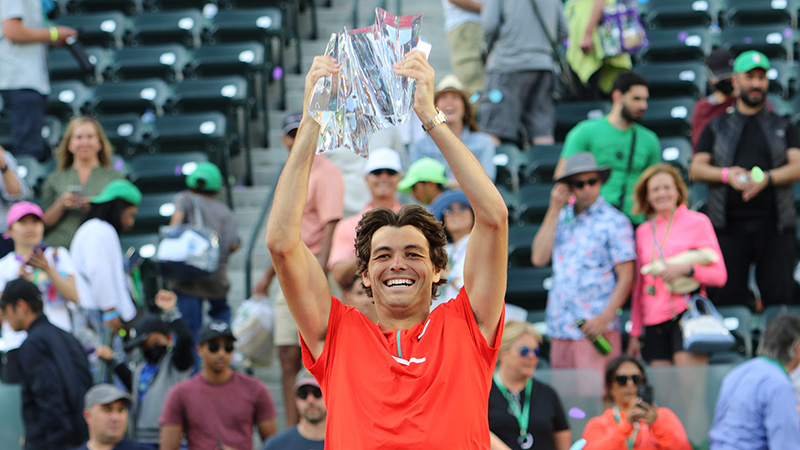
Taylor Fritz celebrates with the championship trophy after defeating Rafael Nadal to win the 2022 BNP Paribas Open at Indian Wells Tennis Garden.
(Photo – Lexie Wanninger/USTA SoCal)
The Indian Wells Tennis Garden
Opened in March 2000, the Indian Wells Tennis Garden was intentionally designed as a sanctuary for the sport. This 54-acre mecca was the brainchild of Pasarell, who partnered with Raymond Moore and the late Mark McCormack to privately fund the project at the turn of the millennium. Their goal was to create a venue that served everyone, from the world’s elite to the local amateur.
The facility is anchored by Stadium 1, which holds 16,100 people and remains the second-largest outdoor tennis stadium in the world. To meet the growing demand, Stadium 2 was added in 2014, providing an additional 8,000 seats and three permanent restaurants. Beyond these main stages, the grounds feature 29 regulation hard courts, a member lounge, and a fitness center.
The Garden is defined by its signature “Pro Purple” courts. This specific shade was created for the desert because purple sits exactly 180 degrees opposite yellow on the color wheel. This provides the highest possible contrast, making the ball easier to track for both players and fans.
“We were the first with this color scheme. We did a study as to what color best made it so you could see the ball on television, and they said purple,” stated Pasarell. “We didn’t want an all-purple court because it would be too dark, so we did purple on the inside and green on the outside. The court really jumps out at you and you can see the ball very well.”
The true magic of the venue lies in its atmosphere. Unlike other major tournaments where stars are kept behind closed doors, the Garden encourages intimacy. The practice courts are a central attraction, allowing fans to stand just feet away from legends as they warm up. Above the practice area, viewing balconies offer a bird’s-eye view of the action, framed by hundreds of swaying palm trees and a stunning backdrop of the Santa Rosa and San Jacinto mountains.
While the Garden is the center of the professional world each March, it functions as a year-round hub for the Coachella Valley.
“Tennis life here is very consistent. We have the tournament in March, but year-round we have clubs creating social programming, leagues, and junior programs,” stated Nettimi. “I know this is a resort town, but people have to realize that tennis is a quality of life here for us. It’s not just a place to play tennis; it’s a place to build friendships and relationships on court. It’s a livelihood.”
The evolution of the venue continues under the guidance of Chief Marketing Officer Philippe Dore, who has prioritized the fan experience through modern technology and improved on-site amenities. By combining massive professional stadiums with an active community membership, the Indian Wells Tennis Garden has become the physical heart of desert tennis.

World #1 Jannik Sinner was the 2026 BNP Paribas Open champion.
(Photo – Jon Mulvey/USTA SoCal)
The Easter Bowl
The versatility of the Indian Wells Tennis Garden is best displayed when the professional tours depart and the next generation takes over. Each spring, the facility hosts the Easter Bowl, one of the most prestigious junior tournaments in the world. Often called the Super Bowl of Junior Tennis, the event moved to the desert to provide young players the opportunity to compete in a true Grand Slam atmosphere.
The Easter Bowl was founded in 1968 by Seena Hamilton, a marketing pioneer who wanted to treat junior players like professionals. Originally launched in New York City, the tournament was nomadic for decades, moving through Florida and Arizona. Hamilton’s goal was revolutionary at the time. She did not just focus on the matches, but on the whole athlete’s experience by addressing fitness, nutrition, and the unique pressures of high-level competition.
The tournament’s modern era began when Lornie Kuhle, a staple of Southern California tennis and Chairman Emeritus of the event, moved the tournament permanently to the Coachella Valley. Kuhle recognized that the tournament needed a venue that matched its stature. By moving the event to the Garden, he gave juniors the chance to compete on the same stadium courts where their idols play.
Beyond his leadership of the Easter Bowl, Kuhle’s career is defined by his role at the center of some of the sport’s most iconic moments, notably serving as the manager and coach for Bobby Riggs during the historic 1973 Battle of the Sexes. His expertise as a world-class mentor also saw him spend five years as a traveling coach and practice partner for Jimmy Connors, and he further solidified his impact on the junior game by serving as Tournament Director for the USTA Billie Jean King Girls’ 16s and 18s National Championships.
Under his guidance, the Easter Bowl began to mirror the professional tour, featuring live streaming, digital scoreboards, and the high-stakes environment of a major championship.
The Easter Bowl’s history is written in the names of its champions. With the exception of the Williams sisters, virtually every American tennis legend of the last 50 years has competed in this event. The pioneer era included names like Jimmy Connors, John McEnroe, Tracy Austin, and Andre Agassi. This was followed by a modern era featuring Pete Sampras, Lindsay Davenport, Andy Roddick, and Jennifer Capriati. Today, current stars like Taylor Fritz, Frances Tiafoe, and Coco Gauff all count themselves as part of the tournament’s storied alumni.
The 58th Annual Easter Bowl in 2026 saw over 500 of the nation’s top juniors competing for the coveted USTA Gold Ball. Southern California talent made a major impact on their home turf this year, with several local competitors taking home gold and silver balls as well as sportsmanship awards across multiple age divisions. By hosting the Easter Bowl, the Garden closes the gap between junior dreams and professional reality, proving the Valley’s commitment to the sport starts at the very beginning of a player’s journey.
“The BNP Paribas Open had a record-breaking year, but that was only the beginning,” said the Mayor of Indian Wells, Dr. Topper Taylor. “The Easter Bowl brought young amateurs who are aspiring to be professional tennis players to compete at the beautiful Indian Wells Tennis Garden. We are celebrating the future of tennis while at the same time celebrating the success of the professional game. To the Coachella Valley, tennis is not just something we celebrate—it’s part of who we are.”
A Tennis Town Forever
The Coachella Valley’s rise as a global tennis destination is the result of long term vision and sustained investment across every level of the sport. While the BNP Paribas Open provides the annual spectacle, the Valley’s strength lies in its year-round accessibility, stretching from high-performance training hubs to free youth clinics, vibrant social leagues, and public access points that foster a sense of community throughout the area.
By maintaining a professional standard across both private and public sectors, the community has created an environment where the sport is a primary driver of local culture and economy. This destination has successfully transitioned from a seasonal stop on the tour to a self-sustaining tennis ecosystem, positioning itself not just as a keeper of the sport’s history, but as the primary engine for its future growth in Southern California.