

Earns Deserving Tennis Towns Recognition
USTA SOUTHERN CALIFORNIA
USTA SOUTHERN CALIFORNIA
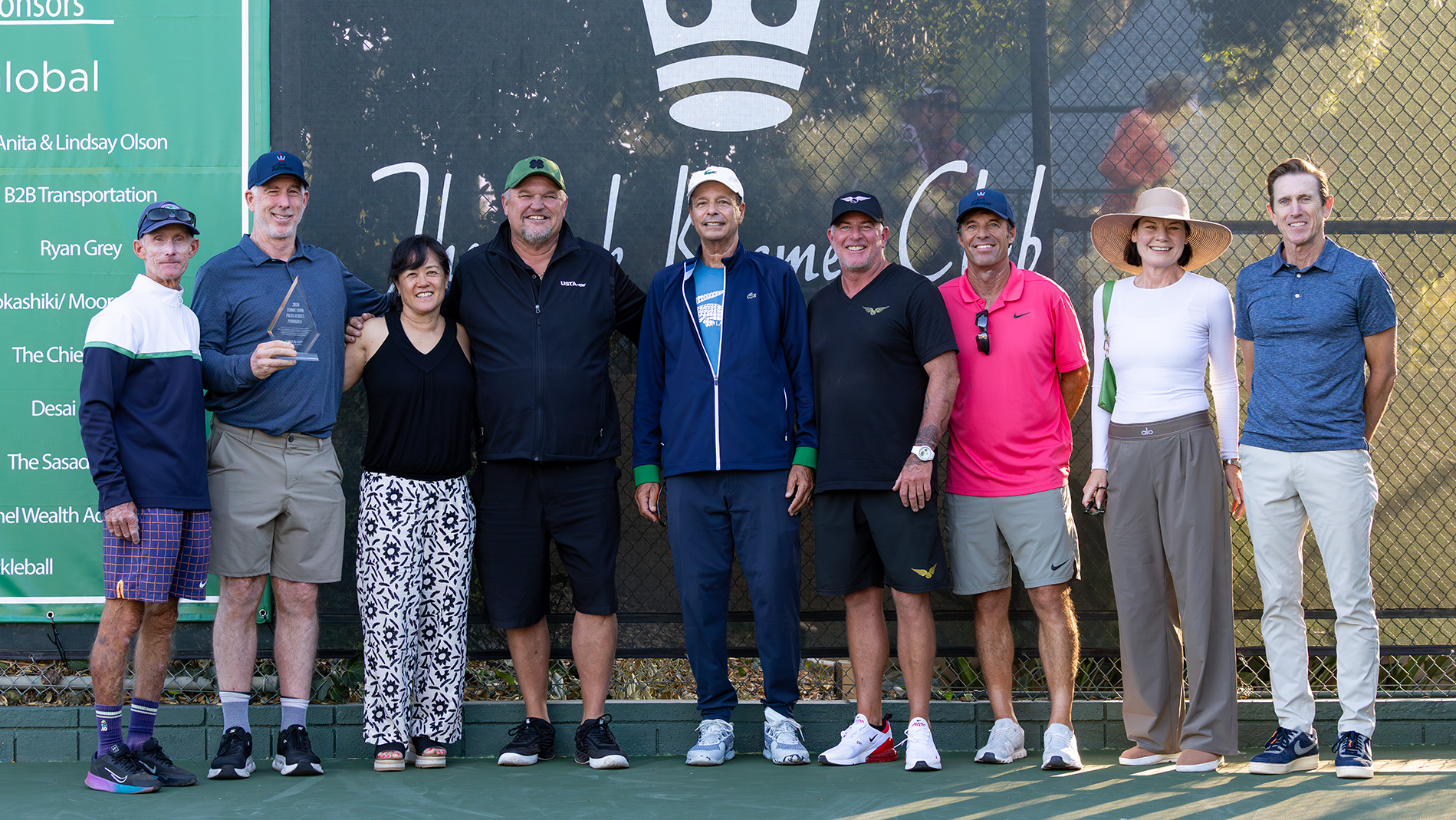
Left to Right: Bob Krueger, Peter Smith, Kimberly Po, Trevor Kronemann, John Carrizosa, Oliver Messerli, Kip Brady,
Aisling Bowyer, and Wade Murphy at the Jack Kramer Club. (Photo – Jon Mulvey/USTA SoCal)
Left to Right: Bob Krueger, Peter Smith, Kimberly Po, Trevor Kronemann, John Carrizosa, Oliver Messerli, Kip Brady, Aisling Bowyer, and Wade Murphy at the Jack Kramer Club. (Photo – Jon Mulvey/USTA SoCal)
USTA Southern California continues its Tennis Towns series, an initiative that spotlights thriving tennis communities across the region, from the Central Coast to San Diego and from the Inland Empire to the Pacific Ocean. Each community has a unique story, shaped by its history, achievements, and contributions to the growth of the game. These towns create opportunities for players of all ages, backgrounds, and abilities. From private clubs and college courts to public parks, they champion grassroots, community-driven programs while fostering an inclusive and welcoming environment.
Since launching in 2025, Tennis Towns has recognized communities with rich tennis traditions and strong player engagement. Each feature includes an in-depth written profile paired with a video spotlight showcasing the people, history, and unique character of the community.
The first five Tennis Town honorees—Bakersfield (March ‘25), Ojai (May ‘25), Claremont (August ‘25), Long Beach (October ‘25), and Coachella Valley (May ‘26)—were each recognized for preserving tennis history while promoting the game’s future. The series not only celebrates communities with outstanding facilities, programs, and tournaments, but also highlights the volunteers, coaches, and advocates who make tennis a vibrant part of local life.
The Palos Verdes Peninsula joins this prestigious list as the latest Tennis Town in Southern California, celebrated for its rich heritage of legendary champions, world-class facilities, and deeply interconnected tennis community.
—
Nestled along the coast of Southern California in the South Bay region of Los Angeles County lies the quiet luxury of the Palos Verdes Peninsula comprised of four cities: Palos Verdes Estates, Rolling Hills Estates, Rolling Hills, and Rancho Palos Verdes. With its dramatic bluffs, breathtaking ocean views, and tranquil neighborhoods, the area is known for its striking beauty perched above the Pacific Ocean. Its secluded nature and coastal elegance contribute to its distinct character, while the ocean and natural terrain give the area a feeling that is simultaneously upscale and grounded in nature. In many ways, the Peninsula feels separate from Los Angeles as it’s defined less by the fast-paced urban energy and more by an unhurried, relaxed lifestyle.
Beyond its aesthetic, the Peninsula has long been associated with highly rated schools, an abundance of outdoor recreation, and a deep sense of local identity. Families often stay in the area for decades, creating a strong multigenerational culture and tight-knit sense of community. Residents also grow up surrounded by hiking trails, beaches, golf courses, parks, and tennis courts, with wellness woven into everyday life.
Among the many recreational activities in the area, few sports have shaped the identity on the Peninsula quite like tennis. For decades, it has been a defining part of life, from its rich history and homegrown talent to its world-class facilities and continued preservation of the sport. Today, the Palos Verdes Peninsula remains an undeniable mecca of tennis that is deeply embedded into its culture, making it a deserving recipient as USTA Southern California’s newest Tennis Town.
Kramer, Braden, and the Club That Started It All
Historically, the Palos Verdes Peninsula sits within one of the richest tennis regions in the country. The area has helped shape American tennis throughout the 20th century, producing a roster of champions and premier facilities that influenced the sport nationwide. South Bay communities became tennis hotbeds during the sport’s growth in the 1960s, ’70s, and ’80s, and the Peninsula quickly emerged as one of the region’s enduring centers for player development and competition.
In the 1960s, two private clubs were established on the Peninsula in what would mark the start of a historic boom in the region. The first was Jack Kramer Club in Rolling Hills Estates, which opened in 1962 by two American tennis pioneers and International Hall of Fame Inductees, Jack Kramer and Vic Braden.
Kramer revolutionized the sport in many ways as a tireless promoter and influential figure in the sport. Notably, he achieved a World No. 1 singles ranking in 1946, won 10 major amateur titles, and co-founded the Association of Tennis Professionals (ATP). Similarly, Braden shared an innovative mindset as an instructor and educational psychologist who leveraged scientific research and video analysis for tennis mechanics. The duo’s partnership began in 1953 when Braden joined the professional tour alongside Kramer. Recognizing Braden’s promotional skills, Kramer hired him to talk to local media about players on tour. Over time, Braden closely studied the world’s best, honing in on a teaching philosophy that later prompted Kramer to remark, “Vic knew our guys and their games better than they did.” After years of travel and seeking a permanent home to build a tennis community, Braden found a prime piece of land tucked away in Rolling Hills Estates. Kramer made the purchase, Braden oversaw construction, and together, the two created a hub to transform local Southern California talent into world-class athletes, while also investing in elite coaching and a family-oriented environment through amenities such as a swimming pool, clubhouse, and playground.
Peter Smith, current General Manager and Director of Tennis at the Kramer Club since 2020, says much of the club’s success comes down to Kramer’s visionary investment and Braden’s masterful coaching.
“Vic was arguably the greatest coach and the godfather of coaches. He set the table. Jack Kramer Club was one of the very first clubs ever to set aside courts just for juniors. And Vic actually started this club to create the next Federation Cup [now Billie Jean King Cup] or Davis Cup champion. So that’s what his whole goal was, to train the next level of great players,” Smith shared.
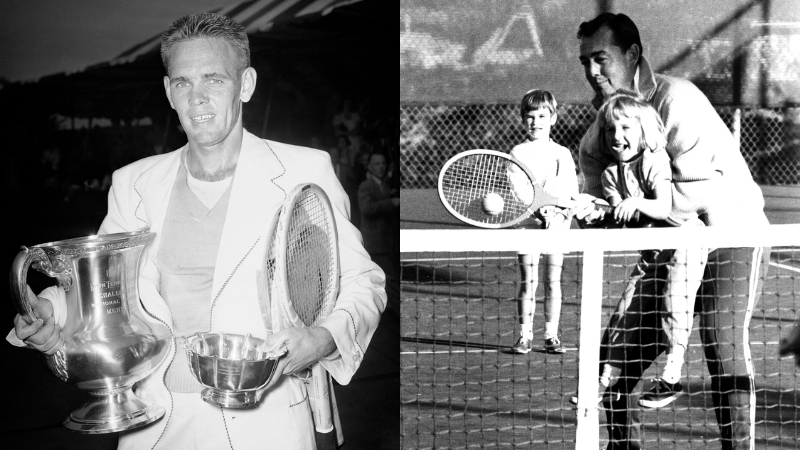
championship on September 8, 1946. Kramer captured his lone Wimbledon title 80 years ago, helping pioneer
the path from amateur success to a professional tennis career. (Photo – John Lindsay/AP); Right: Tennis coach, educator,
and innovator Vic Braden, whose influence helped shape generations of players and coaches.
A Sanctuary in Rolling Hills Estates for World No. 1 Talent
Kramer and Braden’s vision proved highly successful. Since its opening, the club has developed a legendary training ground that helped launch the careers of homegrown World No. 1 players and International Tennis Hall of Famers like Tracy Austin, Eliot Teltscher, Pete Sampras, Lindsay Davenport Leach, and Kimberly Po.
Austin practically grew up on the Kramer Club courts. Her mother, Jeanne—who was pregnant at the time with Tracy—was hired by Braden to manage the club’s pro shop when it opened. Under the guidance of Braden, the club became a second home for the Austin family, with all five children going on to play professionally. Not only did Austin capture two US Open titles in (1979, 1981) and the World No. 1 ranking (1980) at just seventeen years old, she also won Wimbledon Mixed Doubles in 1980 with her brother, John.
“I grew up playing at the Jack Kramer Club,” Austin recalled. “My mom, Jeanne, was the pro shop manager six days a week. Of course, Vic Braden started [the club] with Jack Kramer. We had fantastic coaches with Braden, Robert Lansdorp, and currently, Peter Smith. I feel so lucky to be raised in the Palos Verdes Peninsula, especially because of the Jack Kramer Club.”
Austin also grew up on the Kramer Club courts in the late ’60s and ’70s alongside Teltscher. Teltscher was part of the first wave of elite junior athletes to train at the club, eventually becoming the No. 1 ranked junior player in the United States. His development further translated to collegiate and professional success with a standout stint at UCLA, a career-high singles ranking of World No. 6 in 1982, and a Grand Slam Mixed Doubles title at the 1983 French Open.
“I would not have been a professional tennis player if not for the Kramer Club,” Teltscher emphasized. “The experience of playing with so many great players and being around great people and coaches is something I will always be grateful for.”
Technical Icons and Grand Slam Champions Shaped on the Same Courts
In 1978, Sampras joined the club at age seven after his family moved from Maryland to Palos Verdes. There, he was taught by Dr. Jack Fischer, a local pediatrician and tennis mechanics analyst, from 1980 to 1989. Fischer volunteered to coach Sampras after noticing his natural athleticism and hand-eye coordination on the Kramer Club courts, and was famously responsible for a career-defining technical change in his game: switching from a two-handed to a one-handed backhand that would ultimately shape his dominant, serve-and-volley playing style. As Sampras’ career skyrocketed and he required a full-time touring coach, their relationship ended just before Sampras won his first US Open title in 1990. Sampras later went on to capture an impressive 14 Grand Slam titles and the World No. 1 ranking for a total of 286 weeks over the course of his career.
Davenport, born and raised in Palos Verdes, also honed her trademark power and clean ball-striking within the club’s highly competitive environment. In 1982, her family joined the Kramer Club shortly after she picked up a tennis racquet at age six. The facility served as her primary training base for the next decade, where daily access to elite coaching and top level junior talent helped shape both the technical precision and mental toughness that would define her career.
Davenport went on to become one of the most accomplished players of her generation. A former World No. 1 in both singles and doubles, she spent 98 weeks atop the singles rankings and finished as the year-end No. 1 four times. She captured three Grand Slam singles titles, three Grand Slam doubles titles, a gold medal in singles at the 1996 Olympic Games, and 55 WTA singles titles overall. Inducted into the International Tennis Hall of Fame in 2014, Davenport remains one of Southern California’s most successful tennis products and a testament to the region’s longstanding tradition of developing world class talent.
Like Sampras and Davenport, Po started playing tennis at age nine in the early ’80s. She spent her formative junior development years training at the Kramer Club, sharpening her skills against fellow standouts and working under the club’s excellent coaching before transitioning to collegiate and professional excellence. Though highly formidable in singles, Po made the biggest impact as one of the world’s elite doubles players, notably winning her maiden Grand Slam in mixed doubles at Wimbledon in 2000 alongside partner Donald Johnson. She also reached two other Grand Slam doubles finals and achieved a career-high ranking of World No. 6 in doubles in 2001 and No. 14 in singles in 1997.
The Lansdorp Standard
One commonality between Austin, Teltscher, Sampras, Davenport, and Po was the elite coaching that helped shape them into champions. One of the most influential and widely celebrated coaches among the Palos Verdes Peninsula who largely contributed to each of their success was the legendary Robert Lansdorp, who passed away in 2024 at the age of 85 after decades coaching many of the world’s best. He was not your typical coach, but rather known to be filter-free, relentlessly demanding, and rigorously intentional in his craft.
“Robert Lansdorp was my coach for so many years,” Po shared. “I do believe he is and was the greatest coach of all time because of what he was able to do. Besides just technically, the mental side with him was amazing…he was just trying to get the most out of us and make us the best that we could be. I know there’s no way I would have never achieved what I did without him.”
Lansdorp achieved a feat no other tennis coach in history has ever duplicated: he personally coached and developed four different players who reached the World No. 1 ranking (Austin, Sampras, Davenport, and later Maria Sharapova), cementing the Kramer Club as one of the most successful clubs the sport has ever seen.
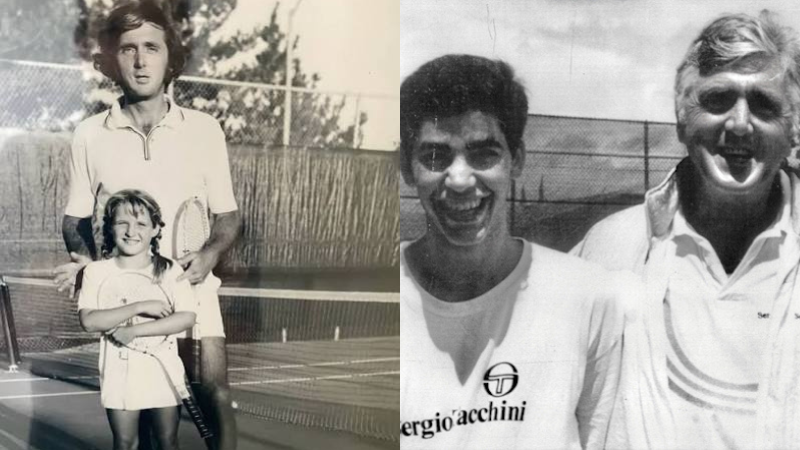
Robert Lansdorp with Tracy Austin and Pete Sampras.
Rizza, Smith, and the Coaches Who Kept the Pipeline Going
The Kramer Club’s coaching roster runs deep. Shortly after Lansdorp began coaching in the early ’70s, Dennis Rizza arrived and assumed the title of General Manager and Director of Tennis at the club in 1986—a role he held for nearly 31 years until his retirement in 2017. Rizza and Lansdorp worked side-by-side through the late ’80s, ’90s, and 2000s, with Rizza managing the facility, spearheading the junior program, and directing local tournaments, and Lansdorp functioning behind the scenes as a master technician with his students.
Rizza was a well-respected and beloved fixture on the courts for decades, coaching hundreds of players that have played college and professional tennis. He cared deeply about the facility and its members, largely contributing to its longstanding reputation and legacy. But for Rizza, what makes this club particularly attractive to members comes down to its consistently strong coaching and programming.
“I think we have great coaches like Peter Smith, my son Rylan, Robert Landorp who was here years ago, and a couple other pros,” Rizza stated. “You have to have high-level coaches in order to develop [elite] programs. And then you need players that are attracted to the coaches, facility, and [current] players. If you have talented players, then it’s just a magnet. Other players want to come and be a part of that program. I think that’s one of the reasons why our programs have always been really, really good.”
Passing the Torch to the Next Generation at Jack Kramer Club
Today, the baton has been passed to Smith. Before taking over, Smith established himself as one of the greatest men’s collegiate tennis coaches in history. Most notably, he spent 17 seasons (2002-2019) as the University of Southern California (USC) Head Coach, where he led the Trojans to five NCAA National Championships—including a legendary run of four consecutive titles from 2009 to 2012. Now, he’s focused on building the next generation of elite players that the club is so famously known for. Under his direction, the club has already produced top-tier talent, including current Women’s Tennis Association (WTA) World No. 17 star Iva Jovic (age 18) and national junior standout and one of the youngest players to ever win an International Tennis Federation (ITF) World Tennis Tour title, Andy Johnson (age 16).
For both Jovic and Johnson, the Kramer Club’s unique atmosphere and connection to tennis royalty have been instrumental to their rapid rise.
“I think there’s a history and culture to the club as a place that’s developed many high-performance elite tennis players,” Jovic said. “All the club members are very involved in what the juniors are doing and it’s pride for the club when [their] players are doing well. Tracy and Lindsay—these are people that I have communication with and a relationship now. So it’s nice to have people that you can rely on and mentors who have done it extremely successfully.”
For Johnson, who has trained there since he was six, the Kramer Club has been a second home for as long as he can remember. From early training days to recently placing second in singles at the SoCal Pro Series ITF/USTA Pro Circuit $15,000 tournament in front of his home crowd, the club has provided a steady foundation of unwavering guidance and support.
“What I love most about the club is that it’s family,” he said. “Playing the M15 at Jack Kramer was really special because it felt like I had my family behind me. Every time I looked up, I saw so many familiar faces supporting me, and that’s what made the experience mean so much to me.”
That family environment is anchored by world-class guidance, particularly from Smith himself.
“Peter Smith has been a huge help in guiding me through the [professional] circuit,” Johnson added. “Not just as a coach, but as an amazing person overall. His support and advice have meant a lot to me throughout my journey.”

Tennis rising star Iva Jovic pumps her fist in celebration during a hard-court match at the 2026 BNP Paribas Open
in Indian Wells. (Photo – Lexie Wanninger/USTA SoCal)
Tennis rising star Iva Jovic pumps her fist in celebration during a hard-court match at the 2026 BNP Paribas Open in Indian Wells. (Photo – Lexie Wanninger/USTA SoCal)
A Quiet Oasis: Palos Verdes Tennis Club
Cultivating exceptional talent at the Kramer Club is just one chapter in the Peninsula’s decades-long love affair with tennis. Another prestigious club steeped in a quiet legacy of excellence is the Palos Verdes Tennis Club (PVTC), located just four miles down the road from the Kramer Club. Tucked away and nestled alongside the Palos Verdes Golf Club, PVTC opened its doors to the community with five courts and a small wooden pro shop in 1963. Local residents and tennis enthusiasts championed its opening, eager to build a dedicated tennis facility in Palos Verdes Estates for youth and adults. After extensive campaigning and fundraising from the public, interest rapidly began to take shape. Soon enough, an agreement was reached between the City of Palos Verdes Estates and the Palos Verdes Tennis Club in 1961 to begin construction, with charter members personally funding the surfacing of the courts.
Once open, PVTC hired Jack Weber as its first head tennis professional. Weber was an accomplished tennis player, educator, and coach who captured over 250 titles in his time. A longtime South Bay resident, he spent his time teaching junior high school while running city park tennis programs and tournaments on the side. In 1963, he left his school teaching position and turned to the newly built PVTC. There, he led free clinics for over 300 children on the Peninsula and taught about 5,000 students during his career.
Today, PVTC is recognized as one of the community’s premier facilities, featuring twelve tennis courts and eight pickleball courts for its members. The club is led by a robust team of talent, including Head Tennis Professional John Carrizosa, who joined PVTC in 2012 with more than 30 years of experience, including coaching Iva Jovic and her sister Mia, who just completed her junior year season at UCLA.
“When I started working with the girls, Mia was a very good athlete and was winning a lot of tournaments. That made Iva want to play, and she was different. She was dead serious and didn’t want to lose a game in practice,” he laughed. “It was fun working with her and Mia. Iva was competitive with a lot of talent, but a lot of it is upstairs—the mental fortitude.”
Carrizosa, who came to PVTC after working nearby in Torrance for over twenty years, was initially attracted to the club because of the environment and bustling yet simultaneously laid-back atmosphere.
“It’s kind of a laid back club. I mean, you drive down through the golf course and it’s settled in,” he explained. “There’s not a lot of noise, and it’s just a sleepy little club. The people are also so kind. They’ve always been supportive and generous and really nice people. It’s an oasis.”
Beauty and Community: Peninsula Racquet Club
Over the hill and tucked away lies another quiet sanctuary in the Peninsula Racquet Club (PRC). Located in Rancho Palos Verdes since 1975, the club features twelve courts, panoramic ocean views, and an accessible, community-oriented atmosphere. Led by Director of Tennis Oliver Messerli and General Manager Aisling Bowyer, PRC offers a variety of play opportunities, including tournaments, leagues, social events, and clinics.
Besides the undeniable beauty, the true soul of the club lies in its unique size and interpersonal connection, as Messerli explained.
“I think it starts with the ocean. I mean, it’s a pretty amazing place when you look at the location,” he noted. “[Also] the very close knit community, the members, and the small club [environment] where you can really make an impact. I think that a lot of these larger clubs can offer tennis, but you can’t really dig into the community the same way. We’re able to, as an academy, really impact the younger kids. But we’re also still very close with the adults. So I think that that’s something that stands out.”
Bowyer agrees, adding that the standout elements of PRC are its supportive culture, elite coaching, and dedicated player resources. “As the General Manager, my number one focus is community. Oliver really helps support that. Anything we can do with grassroots tennis is really important to us,” she emphasized.
She also points to the club’s premier training program, TennisPower Academy, as the deciding factor that drew her to the team. “Our coaching program sold me. It’s an elevated program that produces amazing players. Everybody is so happy on court—and that’s huge to me. Oliver focuses on not just the player, but the whole person.”
Under the direction of Messerli, TennisPower Academy focuses on junior development training for all ages and skill levels, from orange and green dot programs to elite play designed to test physical and mental toughness. The Discovery Camp, a pillar of the Academy created for ages 10 and under, offers a unique blend of tennis instruction and art exploration with engaging weekly themes and personalized awards. PRC is also one of three USTA Coaching Education Centers in Southern California, a testament to their dedication to advancing the sport through continued learning opportunities across every aspect of tennis.
Home Away From Home
PRC is no stranger to producing champions of their own. Rancho Palos Verdes resident, WTA pro, 2022 Roland Garros Mixed Doubles Champion, and two-time Olympian, Ena Shibahara, calls the club her extended family, training there during the tour’s offseason alongside her brother and coach, Shuhei Shibahara. Growing up on the Peninsula and playing varsity tennis at Peninsula High School, Shibahara attributes a large portion of her success on tour to PRC’s staff, coaching, and members she surrounded herself with at a young age.
“I love the Peninsula Racquet Club. It’s my second home. If I’m not at home—like my actual home—I’m here,” she shared. “Everyone here is just so welcoming. They’ve been so supportive. I’ve known most of the members for as long as I’ve been here, and they know what I’ve been through. Even with every chapter of my life, they’ve been so supportive and encouraged me to keep going for my dreams. I think that’s just so special for me to have a tennis club be my second home. I can’t imagine anything better than that.”
Shibahara’s deep connection to PRC is exactly the kind of lasting bond the club strives to cultivate in every young athlete who walks through its doors.
“I think part of why a lot of athletes come back here is because of the kind of the grassroots program that we have,” Messerli reflected. “When you develop at the age of four or five or six years old in a certain community, a certain place, it feels like home, right? Whether it’s Ena [Shibahara] or Andy [Johnson] who started here at seven, it’s part of their upbringing. One of the biggest things here at the club for me is it has to be a safe place. And when I mean safe, it’s a safe place in the sense that we have to be nurturing. We have to be impacting. And at the same time, we do challenge the kids and because part of growth is challenging boundaries and becoming uncomfortable. They come back because they know it, they feel it.”
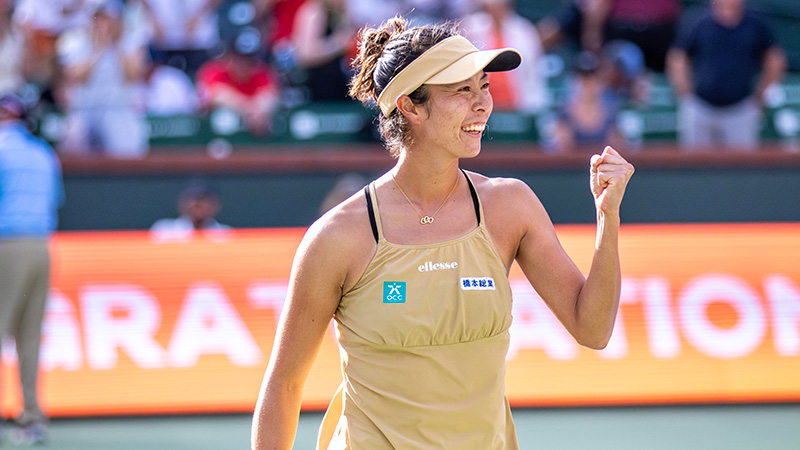
Ena Shibahara celebrates at the BNP Paribas Open. (Photo – Lexie Wanninger/USTA SoCal)
Inclusivity and Adapted Excellence
Atif Moon—a South Bay native, professional wheelchair tennis player, motivational speaker, and entrepreneur—also frequents PRC often. Moon has competed in numerous adapted tournaments and events there, including USTA Southern California’s 3rd Annual Adaptive Unified Doubles Tournament in 2025, which pairs adaptive athletes with able-bodied partners to promote inclusive, competitive match play.
“That was a really cool event,” Moon said. “I think more of those events are great to do because it brings more awareness. And you’re having fun playing tennis, meeting people and learning that, hey, this person can play too.”
For Moon, the supportive culture at PRC reflects a lifelong experience in the South Bay. “Growing up, there were a lot of different wheelchair tennis events and clinics [in the area], with tournaments all over,” he recalled. “I got to meet a lot of amazing people teaching wheelchair tennis, and it made me realize that I can play a sport, just like anyone else. When I go to facilities like PRC, they are always very welcoming and make sure everything is accommodating.”
High School Legacies and Dominance
Beyond the clubs that have cemented Palos Verdes Peninsula tennis lies three high schools that continue to cultivate standout junior talent. Programs at Palos Verdes High School (PVHS), Palos Verdes Peninsula High School (PVPHS), and Chadwick School have built generations of greatness, earning California Interscholastic Federation (CIF) championships, state titles, and national recognition for decades. The Peninsula’s uniquely deep talent pool has always fostered a highly competitive environment, with many players growing up together through USTA junior tournaments, local clubs, and clinics before eventually becoming teammates—or rivals—at the high school level.
Wade Murphy, former coach of the PVHS girls tennis team for nine years, played a large part in fostering the area’s long standing reputation. As Head Coach in 2024, the girls tennis team had its best season in CIF-SS history, becoming the first team to win the CIF-SS Open Division, CIF SoCal Regional Open Division, and CIF State Championship in one season, finishing with an emphatic 27-0 record.
Murphy told the Daily Breeze: “It was a truly remarkable season and this was historic. The girls really did something amazing, and in undefeated fashion.”
This standard of excellence extends across the entire Sea King program, as the PVHS boys tennis team has mirrored that championship pedigree for decades, consistently producing deep CIF runs and serving as an elite launching pad for collegiate and professional talent.
The culture of success did not emerge overnight. Decades of investment in high school athletics, strong youth development programs, and a community-wide enthusiasm for the sport have helped transform tennis into a defining part of life on the Peninsula. Murphy believes that the commitment to maintaining courts, encouraging youth participation, and celebrating high school competition has created an environment unlike anywhere else in Southern California.
“I think Palos Verdes is a unique tennis town because we are still back in time as far as tennis is concerned,” Murphy reflected. “There’s so many public courts; they haven’t taken that space and turned them into something else. So there’s a lot of opportunity. High school matches get crowds. And the tennis team gets press as well. Some of our better athletes that maybe would have gone to other sports gravitate toward tennis.”
Formidable Cross-Hill Rivals
Over the hill about five miles from PVHS is its equally impressive rival, PVPHS. With a decorated résumé spanning generations, the Panthers have built a tradition of excellence that rivals many programs in the region, with numerous league, CIF, and state championships to their name. Champions like Shibahara have helped cement that legacy, who largely credits the high caliber of talent as a key contributor to her success today.
“Growing up, I’ve always loved playing on a team and being in that environment competing with each other. I’ve met my greatest friends at Peninsula High School,” she shared. “I feel like we’ve accomplished everything that we could together. And for me, I kind of took it as an opportunity to give myself the most practice in those match settings…it helped me develop my game and work on a lot of things.”
Further contributing to the Peninsula’s rich tennis culture is Chadwick, a private college preparatory school that sits atop of a neighborhood referred to as Academy Hill just a few miles from the Kramer Club. The tennis program similarly fosters a deep team connection alongside high-level athletic development, with legends like Davenport previously gracing its halls. The school has also had its fair share of impressive accolades, including six CIF Championships and 23 League Championships between the boys and girls teams combined.
For Chadwick rising sophomore and Rancho Palos Verdes native Avery Chan-Mott who finished the 2025 fall season undefeated and earned Prep League Singles champion in her first year, competing on the girls tennis team provides a unique sense of purpose that contrasts with the individual nature of USTA tournaments.
“In USTA junior tournaments, I’ve learned to play for myself and for my love of tennis,” Chan-Mott explained. “But on high school tennis teams, it’s a little deeper. Not only am I playing for myself, but also for my teammates. And more than that, I’m representing my school. So that’s something very unique about high school tennis. It’s a really enjoyable experience.”
The Social Glue: Ernie Howlett Park
While private clubs and elite high school programs provide a competitive backbone for the Peninsula, another important force of tennis in the area is its public spaces. In an area dominated by exclusive facilities, public parks ensure that the sport remains accessible to everyone and act as a vital conduit for community engagement. Among these is the Rolling Hills Estates Tennis Club at Ernie Howlett Park, a public facility deeply cherished by locals. It features eight courts and an atmosphere designed to match the high standards of neighboring private clubs while retaining the welcoming spirit of a park.
For over four decades, the park’s tennis programming has been shaped by Head Teaching Pro Bob Krueger, who arrived in 1985 and has since guided multiple generations of players. Krueger views the facility as an essential bridge within the Peninsula’s broader tennis ecosystem.
“Ernie Howlett is definitely the social glue for the public parks environment,” Krueger noted. “It brings a lot of people in…[and] it allows the people who don’t necessarily want to be in a private environment all the time to be able to come out and play tennis and have something for them.”
By offering comprehensive developmental pathways—ranging from specialized youth programs to advanced junior clinics and adult social play—Ernie Howlett Park acts as a primary catalyst for grassroots tennis in an inviting, supportive environment.
Community Traditions
The impact of Ernie Howlett Park is further amplified by the prestigious local tournaments it hosts, which regularly draw talent from all corners of the region. Among these is the 45th Annual Woody Hunt Junior Tournament. For longtime Tournament Director Rizza, the event is a vital competitive fixture on the Peninsula, honoring the area’s rich history of player development by giving rising juniors a platform to compete against a high caliber of talent in Southern California.
“It’s part of Southern California tennis and culture,” Rizza shared. “And it started 45 years ago when we had all these great tennis players on the Peninsula, and there were no tournaments for them to play. At one time we had 1,100 kids playing in the tournament and it was probably the second biggest junior tournament in the world…since then we’ve narrowed it to a 64-person draw, but it was so nice to have a big event in the South Bay and Palos Verdes where the kids could spend two weekends and shine in their backyard. So that’s really why I started it.”
Equally foundational to the community is the Tracy Austin Doubles Tournament, a beloved annual event played on the Kramer Club and Ernie Howlett’s courts. Named after the hometown World No. 1 and International Tennis Hall of Famer, the tournament celebrates the Peninsula’s close-knit, multigenerational tennis culture through a fun, family-oriented format, with champions and finalists earning the unique opportunity to be interviewed by Austin herself.
As Krueger has observed over the years, the event brings immense joy to participants and the local community. He relishes “watching little kids play with their moms, or older kids play with their dads…those kinds of things, just the ability to family-orient that and still make it competitive is amazing.”
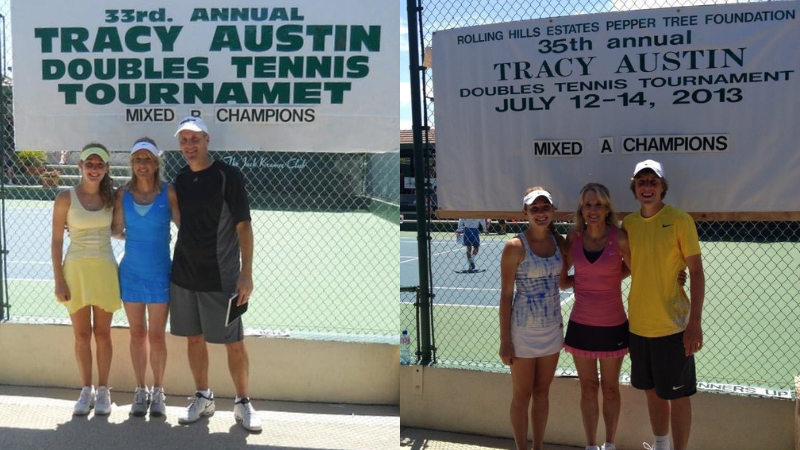
Left: Riley Shear, Tracy Austin, and Riley’s father, Peter Morgan at the 2011 Tracy Austin Doubles Tournament.
Right: Riley Shear with Tracy Austin and Tracy’s son, Dylan Holt at the 2013 Tracy Austin Doubles Tournament.
A Supportive Culture
The connection between public parks, private clubs, and local schools highlights a uniquely collaborative athletic culture across the South Bay. Rather than operating in isolation or fiercely guarding their clients, local coaches and organizations actively support one another to ensure players find the right competitive fit. Jeanette Lee, a veteran Junior Team Tennis (JTT) Area League Coordinator, has witnessed this interconnectedness firsthand while expanding youth leagues throughout the area.
“We’re all connected and we all know and help each other,” Lee explained. “I know other areas…they don’t want to recommend the other competition. But I feel in the South Bay after working here for years that we’re all connected…that’s what makes it special.”
This supportive framework explains why families across Southern California—and coaches from as far as San Diego—willingly commute hours to participate in the Peninsula’s tennis scene. Programs like JTT act as crucial transitional steps by instilling a team-first mentality where camaraderie and sportsmanship matters just as much as competition. It’s why this shared, collaborative spirit elevates the region from a mere collection of individualized facilities into a unified tennis community.
A Legacy Sustained
What makes the Palos Verdes Peninsula uniquely deserving of its title as a Tennis Town is that its history is entirely active. It’s not a museum preserved in time dedicated to the golden eras of the past. Rather, it’s a living, breathing ecosystem where the next generation of champions is actively being written, while also following in the footsteps of homegrown champions before them.
Ultimately, it’s this relationship between the prestigious private training grounds and accessible public courts that preserves the area’s identity. By offering beautiful coastal scenery, historic tournament traditions, and a deeply welcoming spirit, the Peninsula continues to maintain its reputation as a true, enduring tennis paradise for years to come.